![]() |
|
|
|
|
#1 | |
|
Member
Join Date: Dec 2004
Location: Ann Arbor, MI
Posts: 5,503
|
Quote:
100% correct observation. But old blades were mounted and remounted over and over again on Caucasian shashkas. They were indeed highly valuable, and the term "gurda" was related to the Genoese "jaws" mark. Just like "ters maimal" ( screaming, or crazy, ape) defined a blade with the originally German ( (Passau) running wolf. Most were locally made and the variations of either mark fill large illustrations in the book by Astvatsaturyan. ~18th century German blades with elaborate depictions of "man in the moon" and arm with a sword coming from a cloud for some reason were locally called Abbas Mirza. Go figure:-)) Regretfully, there is not a single example of a 16-18 century blade mounted on contemporaneous handle, and the latter is what largely defines a shashka. |
|
|
|
|
|
#2 | |
|
Member
Join Date: Oct 2012
Location: Ionian Islands, Greece
Posts: 96
|
Quote:
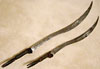
Andreas Buttin's description: 646. — SABRE DU CAUCASE (Chacheka), XVIle-XVIII, siècle. (Pl. XX).Belle lame du xvie siècle, légèrement cintrée et finissant en langue de carpe. Large de 0,03 au talon sur 17 cm. elle est à ce point, par un brusque rétrécissement au dos, ramenée à 0,027. Trois gouttières jusqu'à ce rétrécissement, puis ensuite deux jusqu'à 0,20 de la pointe. A partir de cette longueur, la lame devient à deux tranchants et n'a plus qu'une gouttière qui s'arrête à 0,10 de la pointe pour lui laisser toute sa force.Sur le côté droit le poinçon de Gênes, qui est la marque la plus estimée au Caucase.Aussi a-t-il été très copié par la contrefaçon syrienne, mais les lames génoises, surtout celles du xvie siècle, sont bien plus belles de qualité, ont les gouttières plus régulières et les intervalles qui les séparent sont plus étroits et finissent en arête vive. La pointe parfaitement calculée est assez en arrière pour permettre le coup d'estramaçon et en même temps assez aiguë pour permettre le coup de pointe, chose rare dans les chachekas. Poignée d'une seule pièce, en corne noire, sans garde, formant crosse en bec au pommeau pour retenir la main, et fendue en 2 lobes ou oreilles comme celle des yatagans, mais bien plus rapprochées. C'est la forme typique de la poignée de chacheka.Fourreau en chagrin vert, sans garniture et destiné à être passé dans la ceinture. La poignée y entre à demi.Arme ancienne, de conservation parfaite, et à laquelle la qualité incomparable de l'acier de sa lame donnerait aujourd'hui encore une grande valeur au Caucase.C'est une des meilleures lames de notre collection. Long. : 0,940. Lame : 0,810. |
|
|
|
|
|
#3 | |
|
Member
Join Date: Oct 2007
Posts: 2,818
|
Quote:
|
|
|
|
|
|
#4 |
|
Member
Join Date: Dec 2004
Location: Ann Arbor, MI
Posts: 5,503
|
Andreas,
Obviously, there were no shashkas in Europe; such blades were used for mass manufacture of garden variety sabers, with handguards and all. But there was a whole industry in Italy, Germany and Styria producing blades for export to the Orient. And the final product was determined by the end user: the same blade could have become shashka in Caucasus, tulwar in India, nimcha in Morocco etc. They were hugely popular everywhere and the natives quickly caught the drift and started making imitations locally and even putting European marks on them. |
|
|
|
|
#5 | |
|
Member
Join Date: Oct 2012
Location: Ionian Islands, Greece
Posts: 96
|
Quote:
My point was, if such 15th - 18th century blades were exported to the Caucasus, what were they exported for if not for shashkas? It seems reasonable to assume that the type existed back then, and I'm saying this because I get the impression from this thread ( I might be wrong) that the shashka is a later development, end 18th-early 19th. Andreas |
|
|
|
|
|
#6 | |
|
Member
Join Date: Jun 2012
Location: USA
Posts: 1,492
|
Quote:
|
|
|
|
|
|
#7 |
|
Member
Join Date: Dec 2004
Location: Ann Arbor, MI
Posts: 5,503
|
I hate to disagree with Buttin, but my gut is telling me that his dating was overly optimistic: I think that 17 or more likely 18 century at the latest would be more realistic. And again, finding even 16 century blade on a shashka does not mean that the entire "saber" was made as such in the 16 century.
Genoese colonies in Crimea and Abkhazia existed since 12-13 centuries. Documented import of blades was recorded in the 17-18 centuries. What were the 17 century blades exported to Circassia used for? I do not know. And nobody does. Everybody would love to say " for shashkas", but there is not a single example of a shashka reliably or even tentatively attributed by the handle to anything earlier than the very end of 18 century. Caucasus was in the throes of uninterrupted wars for centuries; weapons were broken, lost, parts used and reused, combined and recombined.... One cannot find neither heads nor tails. |
|
|
|
|
#8 |
|
Vikingsword Staff
Join Date: Dec 2004
Location: The Aussie Bush
Posts: 4,613
|
Andreas, Please take time to translate the Bouttin entry. The translation here is terrible. I have not spoken or written French for 50+ years but I do know that the last sentence should read, "It is one of our collection's best blades." No doubt your French is better than mine, so please favor us with a more meaningful translation.
On the issue of using former European blades in Caucasian shashkas, there are some gaps in logic when assuming that these were converted to shashkas in the 17th-18th C. Basically, we don't know when these shashkas were made. The blades could have been repurposed, such that a guarded hilt was replaced by the guardless shashka hilt at a later time. High quality blades such as these would have been passed down within families and could have been updated/modified at any time. Ian |
|
|
|
|
#9 | |
|
Member
Join Date: Oct 2012
Location: Ionian Islands, Greece
Posts: 96
|
Quote:
|
|
|
|
![]() |
|
|