
|
 26th May 2026, 07:38 PM
|
#1 |
|
Member
Join Date: Feb 2023
Location: Amsterdam
Posts: 174
|
 Keris Surakarta today's buy.
Today's buy,
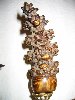
I bought this Keris from a colleague he inherited together with some other Tjikeroe knives and Golok from his deceased father in law who was stationed in Indonesia just before the war. I found this Keris appealing to me despite the relatively thin blade. (Not super thin) I don't know the Dapur and the ganja is in a form I have not seen often. The dress is relatively simple and plain and does not fit very good inside the Warangka but the ganja is of nice proportion with the curled up grening. I guess the mendak is a cage mendak from West Java if I am correct. Who can share some more info about it. I thi k it has 7 Luk |

|

|
|
27th May 2026, 02:40 PM
|
#2 |
|
Member
Join Date: Aug 2007
Location: Germany, Dortmund
Posts: 9,784
|
Hi Martin,
The ganja is called ganja wilut!  The sarung/scabbard looks very West Javanese to my eyes. The blade is sadly very worn! The sarung/scabbard looks very West Javanese to my eyes. The blade is sadly very worn!Regards, Detlef |
|
|
|
|
27th May 2026, 04:42 PM
|
#3 |
|
Member
Join Date: Feb 2023
Location: Amsterdam
Posts: 174
|
Hi Detlef,
Yes it's worn but it also shows history, and it has been cleaned often so for me it's also a relic of being cherished. So I cleaned the blade allready just need to stain it with warangan and I will get some lessons from someone I met lately. I learn him French polishing and he learns me to stain traditionally Keris. So in june I will start with a few cleaned Keris. And it is not the only Keris in my collection that is worn so I am fine with it as I still can see the craftsmenship in them. And thank you for the reply on my message. Regards, Martin |
|
|
|
|
28th May 2026, 04:41 PM
|
#4 |
|
Keris forum moderator
Join Date: Aug 2006
Location: Nova Scotia
Posts: 7,295
|
Yes Martin, i also believe that it os worth preserving some keris even when they are very worn. I look forward to seeing this blade once it is fully cleaned and stained. I believe the wrongko can be restored to some a much nicer level as well, especially if you are skilled with French Polishing.
I find the mendhak rather interesting. Is any familiar with this form? I don't know that i have seen it before. |
|
|
|
|
28th May 2026, 06:12 PM
|
#5 | |
|
Member
Join Date: Aug 2007
Location: Germany, Dortmund
Posts: 9,784
|
Quote:
I can't tell you more about this type of mendak, I know that this type is rather rarely seen, Alan has shown once this type in two threads, pics are attached. I also have a keris with this type, last pic. Alan will be able to tell us more, hopefully. Regards, Detlef |
|
|
|
|
|
29th May 2026, 08:48 AM
|
#6 |
|
Member
Join Date: Feb 2023
Location: Amsterdam
Posts: 174
|
Hi David and Detlef,
What i was told by some Dutch collectors that it is a cage mendak from West Java and pretty rare. And I truly hope to bring back some pamor with staining. Especially I have a lot Keris cleaned allready but not yet stained. Regards, Martin |
|
|
|
|
Today, 04:57 AM
|
#7 |
|
Member
Join Date: May 2006
Posts: 7,222
|
I'm a bit late to the party here, been away & very limited access to net & time.
I see this keris as a blade that might have been of some degree of quality at one time but has been largely eaten by time. The attention of a skilled m'ranggi might be able to bring some life back into it. Yeah, I know, a lot of out-of-culture keris collectors will be shocked by the idea of carrying out more than very minor surgery on an old, damaged blade. This is not the attitude of a knowledgeable Javanese keris person. In Jawa the attitude is that we have a duty, an obligation to preserve an item of tosan aji for future generations, & this means active restoration where this is warranted. This keris needs care & attention, not just staining. I cannot accurately count the luk. The visible luk come to 7, but that produces an unacceptably long distance from final luk to point, so originally this blade might have had 9 luk (current method of count). I think that the blade is probably East Jawa, possibly Madura Sepuh. I would need it in hand to give a solid, defensible opinion. The gayaman wrongko retains sufficient distinct characteristics to identify it as a generic gayaman that really, could come from anywhere on the Island of Jawa. The original work does not permit a precise affixation to the Solo area of Jawa, but the overall form is perhaps possible to fit into a Gandon or Kagok Gabel or Gabel sub-classification of Central Javanese gayaman forms. It does tend towards something that might have originated in Banyumas, but I think that to give it as Banyumas might be stretching things a bit too far. To comply with Javanese standards it should be given a complete strip, rebuild & polish. The same applies to the hilt & mendak --- but I'd tread gently with the hilt, this would need close examination under magnification before a final decision could be made. If we accept that the Javanese people own their own culture, & that the Javanese keris is a part of that culture, I believe that we really should try, in-so-far as it is possible, to follow the Javanese line of thought when we meet up with a sad old piece of tosan aji:- bring life back into the keris and make it something that future generations will regard as worthwhile preserving. |

|
|
 |
|
|


 Linear Mode

