
|
|
|
 5th January 2016, 12:47 PM
|
#1 | |
|
Member

Join Date: Jan 2012
Location: FRANCE
Posts: 1,065
|

Quote:
Thank you very much for your kind comments. This a fighting sword far more scarce than the frequently encountered processional swords of the late 16th and early 17th.The analysis of this sword highlights serious beatings on the blade , it is symptomatic of numerous fights during its livetime. Best Jean-Luc |
|

|

|
|
5th January 2016, 02:47 PM
|
#2 |
|
Member

Join Date: Jun 2013
Location: Netherlands
Posts: 543
|
I tried, but could not find any sentence. If i where you i would try and use some sort of clay and press it in the lettering and get a print. Or use a piece of paper, place it on the symbols and softly go over it with a pencil to get a print.
This is what i read... in te eomine sie hichi es i gucoio it hoc il iusto uowe chx sian ponito amia in te ic ominesie mepius omen ponon il iusto uowe hic sian ponito amia |
|
|
|
|
5th January 2016, 03:20 PM
|
#3 | |
|
Member
Join Date: Jan 2012
Location: FRANCE
Posts: 1,065
|
Quote:
Thank you very much for the time you spend trying to decipher the punches This week end I will try this method with paper and carbon. Best Jean-Luc |
|
|
|
|
|
5th January 2016, 05:04 PM
|
#4 |
|
Member
Join Date: Jun 2013
Location: Netherlands
Posts: 543
|
Hi Jean,
I also got a strange feeling that this is not pure Latin. And the above part of the blade reads the same on both sides: il iusto uowe hic sian ponito amia The N and H are unclear at certain point because they are both 5 "dots" and there are also a few unknown symbols like ic (beeing one symbol instead of two) etc. Good fun to research so i am very curious to see the results of that paper 
|
|
|
|
|
5th January 2016, 05:59 PM
|
#5 | |
|
Member
Join Date: Jan 2012
Location: FRANCE
Posts: 1,065
|
Quote:
In the description when I bought this sword was : 'IL IUSTO VOLE OHA/SIAN PONITO AMIA' 'ASITE DOMINE SIE/NIHIL DES IN NUCOLO/??P?' But may be this text has no meaning... |
|
|
|
|
|
5th January 2016, 06:18 PM
|
#6 | |
|
(deceased)
Join Date: Dec 2004
Location: Portugal
Posts: 9,694
|
Quote:
You are right in assuming that the text might have no full meaning. Some words are an approach to latin, like THE JUST WANTS TO PUT ???. Also Nihil is latin for NOTHING. But this could be one's imagination. |
|
|
|
|
|
5th January 2016, 06:35 PM
|
#7 |
|
Member
Join Date: Jan 2012
Location: FRANCE
Posts: 1,065
|
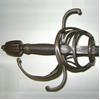
similar pommel
I found in one old thread from Jasper this two pics from two swords with similar pommels from same period ( because of the resolution I'm not 100 % sure but seems to be same polygonal shape
http://www.vikingsword.com/vb/showth...5&page=1&pp=30 |
|
|
|
|
5th January 2016, 06:49 PM
|
#8 |
|
Member
Join Date: Jun 2013
Location: Netherlands
Posts: 543
|
What i gather the frase is that either it is a mix of different languages, or that the person inscribed something he heared of but did not know the correct grammar.
Like "in te eomine sie" could be "in e nomine sie" which would translate to: In the name of so. EDIT: the word Sie in German means "you" refering to either one or multiple persons (beeing one person, Sie with a capital letter is meant as respect mostly to a person older or above you. Sie can also refer to a group meaning "They"). Or just sie meaning she when written in lowercase. hichi es i gucoio might be "Hi Hi es i **coio" which translates to "these belong to **coio" Atached are two symbols of the second line of the first side of the underside of the sentence, thee last word begins with a G? and than a V (made clear by the extra punctuations, so not a U)? Very difficult to see I also did find this sword at the thomas del mar sale, lot number 88 (forgive me if i overstep a boundry here). They state it to be German or Italian. If this is indeed German, the chance of it beeing correct grammatically is very slim (German and Latin are quit different in al sorts of ways. It is also the main difference between German and Dutch, the latter beeing influenced by Latin). Last edited by Marcus den toom; 6th January 2016 at 10:02 AM. |
|
|
|
 |
|
|


 Hybrid Mode
