
|
 28th October 2011, 07:35 AM
|
#1 |
|
Member
Join Date: Jul 2006
Location: Berlin-Paris
Posts: 37
|
 some Paiwan swords
I am pleased to show the last Paiwan knife I purchased. The metal work on the sheath is different from the two others I own and I enjoy these different ways to represent the heads they valued as they were head-hunters. Most sheath are carved but some have the blade covered by a stamped foil of metal.
One of the important collectors in Taiwan told me that the width of the blade show the age of the knife. The thinest are the oldest; I don't know if it true. The sheath is an other indicator anyway, as the blade might be recycled for a new knife. I have seen several times knives traded back from Japan having their blades shortened to forbid any use. It seems that there are still dangerous! Last edited by varta; 28th October 2011 at 08:10 AM. |

|

|
|
29th October 2011, 07:21 PM
|
#2 |
|
Member
Join Date: Oct 2008
Location: between work and sleep
Posts: 731
|
No one has comments?
 How common are the stamped sheath covers? I am more used to seeing metal staples... Also, I thought most of these tjakits had purely conical handles, but these seem shaped better for grip. Thanks for sharing by the way.  EDIT: oh, and how common is it to have a gentle curve to the blades? I heard that was a more recent feature and that the oldest examples were usually totally straight... ? Last edited by KuKulzA28; 30th October 2011 at 12:20 AM. |
|
|
|
|
29th October 2011, 07:47 PM
|
#3 |
|
Member

Join Date: Aug 2007
Posts: 865
|

Beautiful pieces Varta! Thanks for sharing!
|
|
|
|
|
29th October 2011, 09:37 PM
|
#4 |
|
(deceased)
Join Date: Dec 2004
Location: OKLAHOMA, USA
Posts: 3,138
|
THEY ALL APPEAR TO BE GOOD OLD EXAMPLES. CONGRADULATIONS
UNFORTUNATELY MY KNOWLEGE IN THIS FIELD IS SMALL BUT I DO RECOGNIZE THESE AS BEING GOOD WELL MADE EXAMPLES. HOPEFULLY OUR MEMBERS WHO SPECIALIZE IN THIS FIELD WILL CHIME IN WITH SOME GOOD INFORMATION. |
|
|
|
|
2nd November 2011, 09:43 PM
|
#5 |
|
Member
Join Date: Jul 2006
Location: Berlin-Paris
Posts: 37
|
shape of the blades
I don't think the brave Paiwan man owner of this knife would have been excommunicated because the shape of his blade was round sharpened. There are rules and exceptions, little chance for dogma. In any case, these swords are at least from the first quarter of the XX century. One has to remember that the blades were bought or traded, always recycled. Maybe they are sometimes used like they are found, or there are other reasons that I may not know.
|
|
|
|
|
2nd November 2011, 09:58 PM
|
#6 |
|
Vikingsword Staff

Join Date: Nov 2004
Posts: 6,424
|

Speaking of ...... I would love to see the blades of the others you have shown us .
Could we ? I wonder where Yuanzhumin is ?? |
|
|
|
|
3rd November 2011, 09:48 AM
|
#7 |
|
Member
Join Date: Jul 2006
Location: Berlin-Paris
Posts: 37
|
With pleasure!
The proportions of the knives are not respected, sorry. The second one is very long and narrow ( sorry, I don't have the measurements here, but it is easy to compare), when the first one is 47cm x 3,2cm. I do think that sharpening modified the shape of the blades and we should not be too dogmatic when considering a "pure Paiwan shape"… |
|
|
|
|
21st November 2011, 09:07 PM
|
#8 |
|
Member
Join Date: Jul 2006
Location: Berlin-Paris
Posts: 37
|
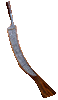
I just found this one on the website of the collection of the National Museum in Taiwan:
|
|
|
|
|
24th January 2012, 05:16 PM
|
#9 |
|
Member

Join Date: Sep 2005
Location: Ex-Taipei, Taiwan, now in Shanghai, China
Posts: 180
|
Dear all,
Good to be back after a while away from the forum! Thanks Rick for asking after me ! Great knives you have there, Victor! Old and very nice ones! I do agree with you that Paiwan knives can have iron staples or a carved metal sheet on their open scabbard side. I noticed that the working knives are mostly with staples and the ceremonial ones with metal sheet. But there are always exceptions. Paiwan blades can be curved or with an angle at their tip. It's mostly depending on the shape of the original blade used/recycled. Definitely, there are more of them with an angle tip But I'm not sure that the thinnest is the oldest, and I think that there is no rule in this matter. But I stand to be corrected. All the best, Nicolas
|
|
|
|
 |
|
|


 Linear Mode

