
|
 17th August 2009, 04:29 PM
|
#1 |
|
Member
Join Date: Jan 2008
Posts: 1,432
|
 Dahomey cutlass ?
Hi
I am hopeful this is from Dahomey, can anyone help me with references about these ? The blade needs cleaning, but otherwise the piece seems in good shape. Many thanks. |

|

|
|
17th August 2009, 04:49 PM
|
#2 |
|
Member

Join Date: Dec 2004
Location: What is still UK
Posts: 6,010
|
Golly what a splendid thing. That is rust not a brass blade? I love it. Look how similar this blade is.
Last edited by Tim Simmons; 17th August 2009 at 05:01 PM. |
|
|
|
|
17th August 2009, 05:02 PM
|
#3 |
|
Member
Join Date: Jan 2008
Posts: 1,432
|
Its iron Tim, the handle is covered with pieces of ray or shark skin, attached with small staples of brass.
That fish-tail end rings a bell somehow, but I can't remember..... |
|
|
|
|
17th August 2009, 05:23 PM
|
#4 |
|
Member
Join Date: Jul 2005
Location: Toronto, Canada
Posts: 1,242
|
Nice one. Zhulfiqar comes to mind
|
|
|
|
|
17th August 2009, 05:50 PM
|
#5 |
|
Member

Join Date: Oct 2007
Posts: 2,818
|
Interesting
Interesting, I too would like to know what it is and where it is from as I saw it in a box lot of auction items a few months back that were labeled Tibetan, nothing like Tibetan I ever saw before.
Gav |
|
|
|
|
17th August 2009, 06:29 PM
|
#6 |
|
Member
Join Date: Dec 2004
Location: What is still UK
Posts: 6,010
|
It look as if it may be a court piece, probably with a dull edge? It may well be Dahomey but the mechete/cutlass ceremonial sabre is quite extensive in West Africa.
|
|
|
|
|
17th August 2009, 07:31 PM
|
#7 |
|
(deceased)
Join Date: Dec 2004
Location: East Coast USA
Posts: 3,191
|
Nice find are you going to clean up the rust?
|
|
|
|
|
18th August 2009, 03:24 AM
|
#8 | |
|
Arms Historian

Join Date: Dec 2004
Location: Route 66
Posts: 10,862
|
Quote:
I think the identifications between certain African weapons and Tibetan or Asian from those regions seem to conflict at times, and I once experienced another instance where a short sword identified as Tibetan turned out to be a Dahomean hwi. I think the main thing is that this example seems to reflect certain types of ram dao, and the use of rayskin on the hilt seems atypical for African weapons, wheras more likely in Asian. The splayed fishtail seems very familiar to me also, and cannot yet place it, but have not found anything to correspond in the reference by Palau Marti ("Sabres Decores du Dahomey ", Objets et Mondes, 1967). It is tempting of course to associate this feature on koras of Nepal and Bengali regions. The decorative motif does seem African though, so looking forward to more views on this. Best regards, Jim |
|
|
|
|
|
18th August 2009, 11:24 AM
|
#9 |
|
Member
Join Date: Jan 2008
Posts: 1,432
|
Hi
Many thanks for the comments on this piece so far. To address the points raised :- The blade on Tim's sword certainly bears a strong similarity to that on mine. But does the handle on Tim's have an Indian look to the decoration ? The blade on my piece is quite sharp. I will clean off the rust in the near future. There was a Tibetan sword in the group of weapons I bought, it also has a shark/ray skin handle which bears a superficial resemblance to the handle on this cutlass. Interestingly, I have just read in a tribal magazine, that the shark was the symbol of Behanzin, last king of Dahomey. I am quite interested in the weapons of the forest kingdoms of West Africa - has anyone seen one of those oversize razors supposedly used by the famous Dahomey "Amazons" ? Please keep the views coming on this. Regards Colin |
|
|
|
|
18th August 2009, 12:18 PM
|
#10 |
|
Member

Join Date: Jan 2006
Location: Kent
Posts: 2,658
|
Hi Colin,
very nice piece  , below is a portrait of an Amazon ...notice the pommel hilt of the sword in the waist band is similar.....not to clear but there seems to be studs in the handle as well...... , below is a portrait of an Amazon ...notice the pommel hilt of the sword in the waist band is similar.....not to clear but there seems to be studs in the handle as well...... You are also correct in the 'symbolism' of the shark during the reign of Behanzin (as was the egg and a 'hanging man'). I believe the picture of this Amazon was taken during Behanzin's reign. However Agoli-agbo is considered to have been the twelfth, and last, King of Dahomey. He took the throne after the previous king, Behanzin, went into exile after a failed war with France. He was in power from 1894 to 1900. All the best David |
|
|
|
|
18th August 2009, 03:37 PM
|
#11 |
|
Member
Join Date: Dec 2004
Location: What is still UK
Posts: 6,010
|
I can see no reason why it is not West African. The only thing remotely Asian is the shark skin to me. The handle of mine did at one time have a brass wire running in the groove spiraling around the handle , you can see in the picture where the remains of this wire is. I did believe this was Dahomey but I have reason to believe it is from else where perhaps Ivory Coast. The projections /guard I have seen on another members African knife but sadly this knife has not been shown again and was not uploaded using this web site system.
I would not hold much store in the fact that you cannot find a picture of the very same example. These pictures are from- C. Spring African Arms & Armour - always a pretty good starting point. As you can see these thing varry slightly. Also my Gubasa which is from Dahomy. This has an edge, the concave curve, but realisticly no way a fighting weapon. Most of all I think you have a really super thing. |
|
|
|
|
18th August 2009, 04:59 PM
|
#12 |
|
Member
Join Date: Dec 2004
Location: Sint-Amandsberg (near Ghent, Belgium)
Posts: 830
|
I have found a knife in Manfred A. Zirngibl's book ' Rare African Short Weapons' (1983) that resembles Colin's knife.
The author shows a picture of a knife with 'forked blade'. This piece is made out of copper. This is what he writes : "The design of the two knives depicted here is sufficient to classify them as cult or currency knives. They were manufactured and used by the Yoruba. Both the knife on the left and the spearhead-shaped one with the strap on the handle were made of brass-like alloys. Surprisingly, the embellishment of both knives is almost identical. The author was able to obtain the knife on the left at an out-of-the-way market on the border between Togo and Benin in 1979. The old merchant seemed to know its exact use and tried to explain it as 'money for voodoo'. Unfortunately, it was not possible to verify this." 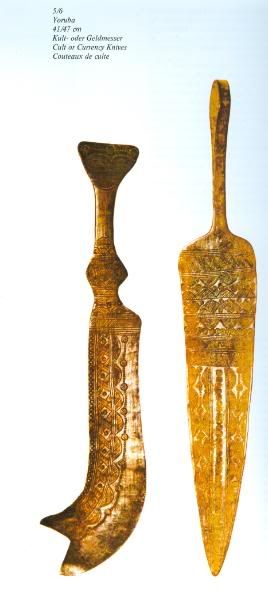 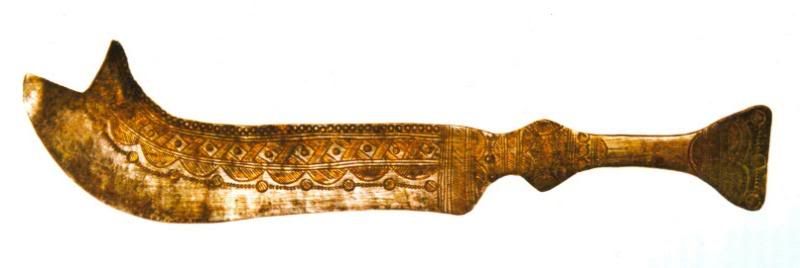
Last edited by Freddy; 18th August 2009 at 06:36 PM. |
|
|
|
|
18th August 2009, 08:54 PM
|
#13 |
|
Member
Join Date: Jan 2008
Posts: 1,432
|
Very many thanks to everyone who contributed on this piece. The accumulation of evidence clinches it as being a Dahomey weapon, I think...
Next project is to find one of those elusive giant Amazon "razors" ! Regards Colin |
|
|
|
|
18th August 2009, 09:24 PM
|
#14 |
|
Arms Historian
Join Date: Dec 2004
Location: Route 66
Posts: 10,862
|
I have really enjoyed spending some time with this, thank you again for posting this Colin! As I was checking possibilities for Tibet/Asia I think I saw where you might have seen the splayed fishtail effect, perhaps in Rawson (?) on p.38, silhouettes of viragal (hero-stone) weapons of c.10th c. reflect this feature, possibly ancestors of the kora (?).
Excellent observations David, and great illustrations with well placed thoughts Freddy. It almost seems that some of the motif and the splayed tip do bear similarity to this piece, illustrating some commonality in symbolism. I believe that this is actually a weapon rather than symbolic item, as I am under the impression the blade is iron rather than yellow metal, also the hafting and grips reflect intention of use. Also, excellent observations on the shark being one of the symbols of Behanzin, in power up to 1900, and it would seem that is likely the period of this sword. It is clear that symbolism is obviously powerfully represented in even the servicable weapons of these warriors, as well as the more elaborate court and ceremonial forms. The use of animist type symbols as a form of symbolic insignia is well described in "This West African Prussia: The Dahomean Army 1840's to 90's" by Andrew Callan (Military Illustrated, Nov. 1990, #30). The use of the crocodile, shark and others appear on headwear, such as 'bayoneteer women'..the officers wore red caps with silver sharks (ref: Burton, 1864) and the 'blunderbuss women' wore red caps with white fishes (ref: Skertchly, 1874). Sir Richard Burton, "A Mission to Gelele: King of Dahomey", London, 1864 J.A.Skertchley , "Dahomey as it is", London, 1874 Concerning the razors, there is no mention of these in the Callan article, but Burton describes them in his 1864 work. He had been sent to Dahomey as amabassador to protest the 'customs', which was the wholesale slaughter of individuals in rituals as well as the ongoing practice of slavery. He went there on the HMS Antelope landing at Whydah (interestingly the name of a well known pirate ship well over a century before) Nov 29, 1863. Burton describes Gezo, the reigning king, and his love of unusual weaponry, noting some with dual blades, like scissors and most notably, his company of Amazons called razor women, from the 'nyek ple nentoh' blade. These women were equipped with "...a steel of 30" rising from a handle of black wood, and kept open by a spring". (Burton, "Book of the Sword" 1884, pp.167-69). Burton compares these to a 'European razor', which implies something like a huge navaja. From this king's love of novelty type weapons, I am under the impression he was trying to impress Burton, and perhaps these were produced specifically for this visit, which must have been preplanned, just my opinion, and perhaps why none of these are known to the best of my knowledge. Returning to our sword, I cannot say for sure, but this looks like rayskin, and very similar to that used on British and many European officers swords. I would suggest that in this later period, around the turn of the century, the use of the rayskin grip covering may well have been used off one of these military swords. If the motif of the shark was intended, this grip cover, which we know was certainly available, would have served well for such a sword for an officer of the kings forces. Just my thoughts, All best regards, Jim |
|
|
|
|
20th August 2009, 02:14 AM
|
#15 |
|
(deceased)
Join Date: Dec 2004
Location: OKLAHOMA, USA
Posts: 3,138
|

JUST A OBSERVATION BUT SOME OF THESE SWORDS BLADES ARE MADE SIMULAR TO A STRAIGHT RAZOR BLADE. THE RAZOR BLADE STARTS WITH A PIECE OF RETANGULAR METAL RUNNING FROM THE FORTE TO WHERE THE BLADE SHAPE AND EDGE STARTS. PERHAPS SOMEONE SAW THIS AND NOT KNOWING OR CARING WHAT THE LOCAL NAME WAS WROTE DOWN THAT AMAZONS CARRIED GIANT STRAIGHT RAZORS. IS THERE ANY WRITTEN REFERENCE NOTEING THESE THINGS FOLDED OR HAD A BLUNT TIP?
 SO YOU MAY ALREADY HAVE AN AMAZONS RAZOR AND I AM SURE SHE COULD GIVE YOU A CLOSE SHAVE WITH ONE LIKE YOURS. 
|
|
|
|
|
20th August 2009, 05:37 AM
|
#16 |
|
Arms Historian
Join Date: Dec 2004
Location: Route 66
Posts: 10,862
|
Hi Barry,
Burton, "Book of the Sword" (1884, p.167-69)...a steel of 30" rising from a handle of black wood, and kept open by a spring....compared it to a European razor. Excellent observation on the shape though!! It seems like these 'razors' must have been like huge navajas (actually this was how navajas began, with barbers). All the best, Jim |
|
|
|
|
21st August 2009, 11:15 AM
|
#17 |
|
Member
Join Date: Jan 2006
Location: Kent
Posts: 2,658
|
I could find little about the Dahomey razor.....in English. As the French had several wars with the Kingdom....I used 'lateral thinking' and googled French equivalent words ie "armee amazone dahomey rasoir"....definately more info....some links are to Google books which are unfortunately in PDF format ...which cannot be translated via Babelfish.
Interestingly there was a seperate 'division' of the Dahomey which specifically used the 'razor' called the Nyekplonentos, also noted is the fact that these were not used against the French as they were not stragectically 'useful'. It would appear that the increased useage of firearms etc saw the demised of the razor....perhaps this is why there are very few, if any surviving today. (often imported Euro blades were usually re-worked by the 'smiths'...it makes sense that 'razor' blades were re-cycled to produce other swords / knives). Below is some translations via Babelfish.... ".....These great razors that can be far wrong to think used by European farmers have been described by mayor as weapons specific to women's regiments, "The Cloucloucaccala" [13]. Father Father Bouche citing this Borghero in 1861 to a military review in Abomey, describes these regiments that Europeans call "Amazons" in reference to ancient Greece: "Over three thousand women, two hundred, instead of rifles, are equipped with large knives in the shape of razors, which handle with both hands, and including a single slice a man in the middle. " Borghero even specifies that it is a "huge knife-shaped blades that can be opened and closed, the race almost a meter long and the blade all" [14]. For other authors, male regiments are also razor. Mayor describes such regiments of men created by King Glélé whose name, Niegpley, would mean "(company) by the razor sharp" [15]. The knives are reworked, they are the swords or razors. Blacksmiths fon - very popular - to adapt the material needs and tastes of their customers: They change the blades and handles supplied by the manufacturers or just the blades, when the metal comes from sales or exchanges of raw bars. Here the imported material may be modified. The assimilation of knowledge of use is coupled with local know-how of transformation. ....." http://motspluriels.arts.uwa.edu.au/MP1600mb.html "......The Nyekplonentos or "mowers" are equipped with large knives in the shape of a razor and slice the enemy in two......." http://www.maisons-champagne.com/bon...l_dahomey.html Regards David |
|
|
|
|
21st August 2009, 05:17 PM
|
#18 |
|
Member
Join Date: Jan 2008
Posts: 1,432
|
Excellent research !
Richard Burton was a meticulous observor of native customs and material culture, with a keen interest in edged weapons. One would think he would try to take a specimen of the Amazon "razor" back with him, from his visits to Dahomey in the 1860s. Here is an extract from Rev Wood's 1874 book "The Natural History of Man, Africa"... Regards Colin |
|
|
|
|
22nd August 2009, 12:34 PM
|
#19 |
|
Member
Join Date: Jan 2006
Location: Kent
Posts: 2,658
|
Hi Colin,
thanks  . .The illustration of the razor, seems 'suspect' to me ....nearly all the descriptions state the blade is almost the same size as the handle. In use the 'razor' is used 'double handed' . The design illustrated does not fit this criteria and looks like an ordinary barbers razor ...but scaled up. The handle is too wide to grip comfortably. After all the blade would not have to be totally enclosed within the handle ....just the edge. A practical 'Amazonian razor' IMHO would be similar to a Panabas ....with a 'folding' abillity. Kind Regards David |
|
|
|
|
24th August 2009, 05:42 AM
|
#20 |
|
Member
Join Date: Jul 2006
Location: musorian territory
Posts: 497
|
the description says it is held with a spering in the handle,, like a slipjoint knife , but the drawing shows what looks like the tang of the knife making it a friction folder.. is there any exsample of these knives in exsistance to see the actuial form ?
|
|
|
|
|
25th August 2009, 12:03 PM
|
#21 |
|
Member
Join Date: Jan 2006
Location: Kent
Posts: 2,658
|
Hi Ausjulius,
I did find a reference (now lost  )that stated that the 'handle' of the razor was like a 'black stick'....which made sense, as it fitted the idea that they were used two handed. )that stated that the 'handle' of the razor was like a 'black stick'....which made sense, as it fitted the idea that they were used two handed.The users of the razors were know as 'mowers'......I'm wondering whether they were positioned behind the 'front line'.....so as the battle continued and the front line advanced, the enemy's dead and dying were decapitated or 'finished off'  by the advancing 'back lines'. A terrifying psychological effect. by the advancing 'back lines'. A terrifying psychological effect.It would explain why they were not used against the French. The superior rifles (most Dahomians had muskets) would, with their superior range and accuracy, prevent any advancement of the Dahomian front line. Below are two drawings of several 'bas reliefs' found on the palaces.... one is ....."represented the throne is the King Kpengla (1744-1789). It is surrounded by a shotgun and a sword whose blade seems an original creation...." The second shows a mound of decapitated heads with the victor ? King? a decapitated foe holding his arms up in surrender? exhaltation to the victors ??standing on top. Could that 'implement' be a representation of a razor ? perhaps half closed to show that its 'work' is now done ???? There is a curious 'apendage' at the rear of the handle...a spring mechanism ?? Regards David . |
|
|
|
|
25th August 2009, 02:46 PM
|
#22 |
|
Member
Join Date: Dec 2004
Location: What is still UK
Posts: 6,010
|
Looks like a Recade.
|
|
|
|
|
27th August 2009, 12:27 AM
|
#23 | |
|
Member
Join Date: Jan 2006
Location: Kent
Posts: 2,658
|
Quote:
I'm inclined to agree with you. It would fit , afterall the Recade is a symbol of status. In Dahomeian society decapitated heads brought both monetary and 'status' rewards. I have re-discovered the description of the razor having a 'black stick handle' .....what is clear from this extract from "Amazons of Black Sparta: the women warriors of Dahomey" by Stanley Bernard Alpern is the various, slightly conflicting descriptions of the razor....20 lbs seems incredibly heavy ".....One of Dahomey’s armes blanches were unique: a gigantic razor. Invented by one of Gezo’s brothers, it simply copied the standard European straightedge but was several times bigger, and is said to have weighed more than 20lbs. A blade about 24-30 inches long folded into a black wooden handle. (Burton put the blade length at about 18”; Skertchly corrected him.) When extended and held open by a strong spring, the razor measured 4-5 feet. It was carried over the shoulder. Vallon, who first reported the weapon, said it was made specifically for the Amazons who wore Bouet’s fireman’s helmets (which somehow had doubled from 50 – 100). He then dubbed them the Reapers. The razor was wielded with both hands, and, according to Borghero (who raised the total to 200 – 300) could slice a mine in half. Skertchly heard they were intended to decapitate enemy kings. Maire claims the razors were not only for heads, but for enemy genitals, and that the Amazons “had to triumphantly bring these bloody and ignoble trophies back to the palace” Burton termed the razors “portable guillotines” and thought if nothing else, “the terror which they inspire may render them useful”......" http://books.google.co.uk/books?id=F...=razor&f=false Regards David |
|
|
|
|
|
27th August 2009, 08:26 AM
|
#24 |
|
Member
Join Date: Dec 2004
Location: What is still UK
Posts: 6,010
|
Hhh, penis envy.
|
|
|
|
|
27th August 2009, 11:40 AM
|
#25 |
|
Member
Join Date: Jan 2006
Location: Kent
Posts: 2,658
|
Many of the descriptions mention that the blade was like a European 'straightedge' with a black stick handle .....so I suppose it looked something like this....
|
|
|
|
|
28th August 2009, 09:02 PM
|
#26 |
|
Member
Join Date: May 2008
Location: Czech Republic
Posts: 862
|
Hello,
Allow me to come back to ceremonial swords from Gulf of Guinea region - just to share pictures. It is concerned Yoruba swords recently acquired in Ibadan (200 kms from Lagos). Except of the one in the centre the blades are embelished from both sides. The blade of upper one is made of very well forged steel, it is stout and springy and also sharp. Regards, Martin |
|
|
|
|
28th August 2009, 09:57 PM
|
#27 |
|
Arms Historian
Join Date: Dec 2004
Location: Route 66
Posts: 10,862
|
Martin,
Absolutely breathtaking examples, and thank you so much for sharing these with the detail of all the decorative motif! This is key to understanding the symbolism important to these cultures. Excellent! All the best, Jim |
|
|
|
|
28th August 2009, 10:24 PM
|
#28 |
|
Member
Join Date: Jan 2006
Location: Kent
Posts: 2,658
|
Very nice Martin
,I especially like the first and last examples....I think the middle one is more recent. I believe the animal motifs on the last one are chameleons..... "....The chameleon was thought to be one of the primordial animals that created the universe. Because of its slow walk and slow character, it was too late in bringing the message of the Great One to all people. So instead, the lizard brings death to the world, dooming every living creature to die....." Regards David |
|
|
|
|
29th August 2009, 07:37 PM
|
#29 |
|
Member
Join Date: May 2008
Location: Czech Republic
Posts: 862
|
Thank you David and Jim.
David, the middle sword is more recent, but it´s blade was so rusty and after mild cleaning so spotted, that I decided to clean it properly (bicarbonate solution + aluminium). On the other side, it was nearly not necessary to touch the one with chameleons....I did not know what to do with the iron blade, as the rust is going very deep - it was cca 2 months in oil. In Ibadan I also saw rests of two old ada swords, but the iron blades were too much damaged with rust (parts missing). The handles were made of copper and one very nice - in the form of small statue of Benin soldier. Regards, Martin |
|
|
|
|
1st September 2009, 09:32 PM
|
#30 |
|
Member
Join Date: Dec 2004
Location: What is still UK
Posts: 6,010
|
Martin.
The examples you show here are superb so much so I have taken the liberty to resize them so to make them easy to understand. Lovely things. |
|
|
|
 |
|
|


 Linear Mode

