
|
 12th May 2026, 12:31 PM
|
#1 |
|
Vikingsword Staff

Join Date: Dec 2004
Location: The Aussie Bush
Posts: 4,722
|
 Silver hilted Moro/Malay kris
A recent purchase, these are the auction site's pictures.
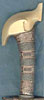
This 19th C Moro/Malay kris has a blade with a central fuller running almost to the tip. That style of blade has been discussed here previously, along with its possible Malay origin. What is somewhat remarkable about this sword is the hilt. The grip area has alternating bands of woven silver wire, segmented with fancy silver bands. The kakatua pommel has engraved silver panels on each side, and silver on the the tips of the beak and crest. A single silver asang asang has been rotated at some point. It gives the appearance of a partial guard, but it is too soft to provide any protection and may simply be loose. I will know more when it arrives. Both the blade and the silver hilt suggest a prestigious sword owned by an influential datu. . |

|

|
|
13th May 2026, 12:47 AM
|
#2 |
|
EAAF Staff
Join Date: Dec 2004
Location: Louisville, KY
Posts: 7,402
|
I almost went for this but school work got in the way. The under bands looks like swassa or copper/bronze.
Congratulations! |
|
|
|
|
18th May 2026, 02:15 PM
|
#3 |
|
Vikingsword Staff
Join Date: Dec 2004
Location: The Aussie Bush
Posts: 4,722
|
Hi Jose.
Sorry to beat you out on this one. Others were interested also. I felt that there was more to be revealed under the surface, so I polished it over the weekend and went to my local friendly jeweler today to get the various pieces of the hilt tested. Having the single asang asang already dismounted, it was relatively easy to remove the hilt with some "gentle persuasion." The testing was fairly simple for both gold and silver. It disclosed that the pommel was largely silver (testing ~95%, which might suggest an origin from Spanish silver coins) with some low grade (~9 K) gold overlays. The overlays tested strongly positive for copper, so I would say these are a form of suassa. The rings spaced along the grip also tested strongly positive for copper and low grade gold (< 9 K). The ferrule at the base of the hilt seems to be just copper. The single asang asang tested much the same as for the rings. The braided wire wrapping tested positive for silver at about 90%. Pictures of the hilt are attached after polishing the metal. They are not great pics because of shadows and lighting problems (it's winter here and hard to get nice natural light). . Last edited by Ian; Yesterday at 06:44 PM. Reason: Spelling |
|
|
|
|
18th May 2026, 02:34 PM
|
#4 |
|
Vikingsword Staff
Join Date: Dec 2004
Location: The Aussie Bush
Posts: 4,722
|
Jose,
Looking at the more golden pommel decorations on the side panels, beak, and below the crest, the designs don't seem to me to be Moro. Also, the undulating bands on the hilt don't strike me as Moro. Do you think we are looking here at Melayu work, or perhaps decorative elements from Brunei? Whatever the origin of this sword, I am pleased with how the hilt has cleaned up. I plan to clean the blade further and etch it. That should be easier with the hilt dismounted. I recently bought a larger blasting cabinet that will accommodate articles up to a meter in length, which should make blade cleaning easier and quicker once I get it together. Regards, Ian Last edited by Ian; Yesterday at 06:43 PM. |
|
|
|
|
Yesterday, 09:41 PM
|
#5 |
|
EAAF Staff
Join Date: Dec 2004
Location: Louisville, KY
Posts: 7,402
|
Actually I've seen a Moro kris hilt like what you are referring. It was owned by Spunger and I did some restoration work on it. It also had silver and swassa on it. It had similar work on the pommel except the side panels. His was an earlier kris.
Yours is amazing! Congratulations! |
|
|
|
 |
|
|


 Linear Mode

