
|
 6th July 2019, 02:51 PM
|
#1 |
|
Member
Join Date: Mar 2010
Location: Olomouc
Posts: 1,720
|
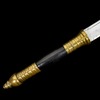
 Nice takouba with 16th century blade
This was acquired for a friend, so I have been documenting it. Nothing we haven't discussed before, but a very nice blade with running wolf and cross and orb with original latten corresponding to the style common to the 16th century with this blade geometry. Might be a little earlier or later but this seems a fairly safe date range.
Nicely balanced hilt, but not the holdest hilt style, so likely early 19th century mounts or late 18th. No brass hilt plates as often seen on these old warriors, the guard was originally leather covered. The whole assembly is nice and tight, still very much a fighter! |

|

|
|
6th July 2019, 03:45 PM
|
#2 |
|
Arms Historian

Join Date: Dec 2004
Location: Route 66
Posts: 10,865
|
This is another amazing find Iain!!!
It is so heartening to see these blades still serving for not only generations but centuries!! It leads to wondering just how long it had been in the Taureg sphere. Was it among those early shipments of blades which came into the Sahara via trade routes described in the Briggs (1965) reference? What is the estimated vintage of the hilt now in situ? So many questions, and it perfectly exemplifys how Briggs brought forth one of the treasured sources of early European blades and makers often referred to in that field of study, via the conduit of Saharan swords. His work stands solid as one of the valuable resources on these blades in Africa. It is interesting seeing this upper centrally situated fuller, to about 1/3 of the blade or slightly longer, as well as the application of the globus cruciger on one side and running wolf in the other, and in latten as often discussed. A perfect benchmark in the study of these European blades, and how native imitations followed in later centuries. Thank you for sharing this!!! |
|
|
|
|
6th July 2019, 05:15 PM
|
#3 | |
|
Member
Join Date: Mar 2010
Location: Olomouc
Posts: 1,720
|
Quote:
The blade likely came into the North African Ottoman sphere very early via alexandria. I would guess in the 16th century where it remained. Shipments from Europe were frequent despite papal bans. 😉 |
|
|
|
|
|
6th July 2019, 06:28 PM
|
#4 |
|
Member
Join Date: Dec 2004
Location: Bay Area
Posts: 1,769
|
It never gets old seeing these takouba with old European blades, thank you for sharing.
|
|
|
|
|
7th July 2019, 04:53 PM
|
#5 |
|
Member

Join Date: Jan 2011
Posts: 1,164
|
Would you consider this type of blade to be a European blade of that age without the marks.
I have one such that arrived dismounted and trashed without even a tang, but otherwise, bar the marks, exactly the same...... |
|
|
|
|
7th July 2019, 06:48 PM
|
#6 | |
|
Member
Join Date: Mar 2010
Location: Olomouc
Posts: 1,720
|
Quote:
Feel free to post it! |
|
|
|
|
 |
|
|


 Linear Mode

