
|
 11th December 2004, 05:31 AM
|
#1 |
|
Member
Join Date: Dec 2004
Location: Singapore
Posts: 1,180
|
 A warrior's keris
A true-blue Keris Sulawesi sepokal made for the purpose of combat, no doubt.
Massive 15inch blade forged from very good steel (maybe European?), with no apparent pamor except for the wengkon. Blade is very sharp, with not much perabots, but it cuts a nice enough profile. This keris cut me when I forgot myself and touched its edges carelessly. It has quite a number of nicks on the edges, especially towards the upper half. If you look at the last picture, you can see the temper mark goes 4/5 of the way down towards the base. Given these characteristics, I hazard that this keris was a warrior's keris, and one who had his fair share of combat. Notice that on the aring end of the ganja, there is an 'x' incised on top. I always associate such notches as being the 'anchor' for applying kinatah. Of course, I have no proof, and there are no gold residue left. The profile of the sampir is typical 'awkward' Sulawesi style, but strangely, when it is put together with the equally 'awkward' batang, hulu and pendoko, it looks 'correct' and 'complements' each other. I'm not sure if you get what I mean -- there are times when you look at a keris and have the feeling that the parts do not fit properly together. Something is 'wrong'. Only when you replace the parts with those from the same region, then does the whole keris look 'correct'. The sheath is made from yellowish-brown kemuning wood which I've grown to associate with Sulawesi. In fact, I'm pretty sure that by looking at the wood, one can tell which region it came from, even if its the same species, like in this case. The buntut is a very 'crude' ivory plug, but with very nice webbed cracks at the bottom only. The sheath is damaged in 3 places, but was repaired expertly a long time ago. I think most of you can only see 1, at most 2, of the spots where the repairs were made. The interesting thing about this sheath is that it is very compact, and when the keris is sheathed in it, it makes one think that it must be an average sized blade in there. Only when the blade is unsheathed does one realize the monstrosity of the blade. 15inches may not sound very much for a keris, but when it is a Bugis sepokal blade, it is massive. There is no excess length or width in the sheath, evey last 1/8in is used to house the blade. So I give very high marks to the mranggi who created this 'optical illusion'. |

|

|
|
11th December 2004, 05:34 AM
|
#2 |
|
Member
Join Date: Dec 2004
Location: Singapore
Posts: 1,180
|

last 2 pics
|
|
|
|
|
11th December 2004, 05:53 AM
|
#3 |
|
Member

Join Date: Dec 2004
Location: Cincinnati, OH
Posts: 940
|
No doubt a very function blade, yet elegant in it's simplicity. I would, of course, love to see it properly stained so that the wengkon line stands out against the blade. I think that would make it appear even more elegant and is, after all, the way the blade was meant to look. I think you may be right about the incised "X" on the aring end. It seems a very plausible explanation.
Beautiful keris! Thanks for showing. Any idea on the age? |
|
|
|
|
11th December 2004, 07:32 AM
|
#4 |
|
Member

Join Date: Dec 2004
Location: 2008-2010 Bali, 1998-2008 USA
Posts: 271
|
The ivory is fossil pachiderm ...
|
|
|
|
|
11th December 2004, 01:59 PM
|
#5 |
|
Member
Join Date: Dec 2004
Location: Kuala Lumpur
Posts: 369
|
Hi Blu,
A very fine keris indeed. I really admire it. I think if the blade is stained properly, it will reveal the wengkon plus perhaps some pulo tirto. (just guessing) I have a keris that seems to be made with almost similar material. It was already stained when i got it from Adni. Due to some reasons, i cleaned the staining and the pamor that were used to be very revealing turned out to have almost no distinguishment with the steel. Attached are some photos prior to my cleaning.    Another thing, if u are ready to do some "experiment with the sheath" (which Raja Muda always tells me not to) i think the grain of the wood can be enhanced with a little application of wood dye. However, it the current finishing are original to the sheath, it is not advisable to do it. (which i know that u wont)  I'll send the pictures of the blade after cleaning on Monday. |
|
|
|
|
11th December 2004, 04:09 PM
|
#6 |
|
Member
Join Date: Dec 2004
Location: Singapore
Posts: 1,180
|
Hi Radu,
The ivory seems to be normal old ivory, not fossilized. I've a couple of ivory handles with that kind of 'webbed' fine cracks. The ivory is still milky white and the grain 'moist' (if I may call it that) and visible. Not the dry stone-like grain of fossilized ivory. Hi Rasdan, Adni had tried to etch the keris twice. It turned jet black except for the wengkon. So we gathered that there's no visibile pamor except for the wengkon. |
|
|
|
|
11th December 2004, 05:50 PM
|
#7 |
|
Member
Join Date: Dec 2004
Location: Cincinnati, OH
Posts: 940
|
Hi Blu. Just curious, if Adni stained this blade for you, why did you remove it. Jet black with just the wengkon line sounds like a really cool look to me.
 And it would be, after all, the proper traditional look for the blade, wouldn't it? And it would be, after all, the proper traditional look for the blade, wouldn't it? 
|
|
|
|
|
12th December 2004, 01:42 AM
|
#8 |
|
Member
Join Date: Dec 2004
Location: Singapore
Posts: 1,180
|
Actually, I got it from Adni like this. When etched, the wengkon was somewhat less visible than when it was unetched, so the warangan was removed for the 3rd time and left like that. Its fine by me -- the grey steely look.
|
|
|
|
|
13th December 2004, 07:24 AM
|
#9 |
|
Member
Join Date: Dec 2004
Location: Kuala Lumpur
Posts: 369
|
Hi Blu,
I think u r right. Initially i thought theres some pulo tirto on the blade. I think blades of this type are more difficult to etch due to the nature of the pamor. Sometimes to me its kinda sweet to leave the blade unetched. It facilitates the examination of the steel fibre and i enjoy that. However there are times that i got bored by the look of the blade and starting to etch it what so ever. Heres some pictures as promised.    
|
|
|
|
|
13th December 2004, 11:35 AM
|
#10 |
|
Member
Join Date: Dec 2004
Location: Cincinnati, OH
Posts: 940
|
It seems interesting that the wengkon would be LESS visible after a staining. I wonder if it is not possible that what has been thought to be pamor wengkon is not really the weld joint between the blade's outer skin and the steel core. This has been suggested to me by a learned associate and it seems a strong possiblility.
|
|
|
|
|
13th December 2004, 02:54 PM
|
#11 |
|
Member

Join Date: Dec 2004
Location: Greenville, NC
Posts: 1,854
|
A real Bugis beauty!
...but I agree; I do not think that the ivory is fossilized, though lovely nonetheless!
|
|
|
|
|
14th December 2004, 01:43 AM
|
#12 |
|
Member
Join Date: Dec 2004
Location: Kuala Lumpur
Posts: 369
|
Hi guys,
Well, i'm no good in staining, but i think to get the pamor up nicely with the correct look is just soooo damn hard. Sometimes it seems that the blade just wont cooperate. Too dark... too light... phew. Theres gonna be a lot of "D'oh!!" before we can get it right.
|
|
|
|
|
14th December 2004, 03:45 PM
|
#13 |
|
Member
Join Date: Dec 2004
Location: Singapore
Posts: 1,180
|
I think it is possible that the pamor is not really a pamor wengkon. Rather, the smith was just concentrating on forging a rough-and-tough sanmai keris blade.
 But I also agree with Rasdan that sometimes, these blades just don't 'co-operate'. But I also agree with Rasdan that sometimes, these blades just don't 'co-operate'.
|
|
|
|
|
14th December 2004, 09:25 PM
|
#14 |
|
Member
Join Date: Dec 2004
Location: Cincinnati, OH
Posts: 940
|
Yes, i've had similar cooperation problems myself.
Never the less, wengkon or not, it is a fine keris which i would gladly welcome into my own collection with open arms.
|
|
|
|
|
15th December 2004, 05:00 AM
|
#15 |
|
Member
Join Date: Dec 2004
Location: Kuala Lumpur, Malaysia
Posts: 100
|
 Bugis Beauty
Once again I have to doff my hat to BluErf for the amazing pieces he owns. My friend, you seem to have a limitless expenses account when kerises are concerned
. Pray tell if you have stock market tips to share.BTW, would you mind giving us a closer look at the pendongkok. Is it original to the piece or a later upgrade? The silver details look promising. |
|
|
|
|
15th December 2004, 03:28 PM
|
#16 |
|
Member
Join Date: Dec 2004
Location: Singapore
Posts: 1,180
|
Hi Raja Muda, I don't have any stockmarket tips; I just work my butt off to earn my salary which I would then bust it on kerises, as Dave and Paul can attest to it.
And I guess I could do so because I'm not married (yet)...  Well, I'm enjoying building my keris collection while I can, and in the meantime, you can call me "gila keris". Well, I'm enjoying building my keris collection while I can, and in the meantime, you can call me "gila keris". 
|
|
|
|
|
15th December 2004, 03:32 PM
|
#17 |
|
Member
Join Date: Dec 2004
Location: Singapore
Posts: 1,180
|
Sorry, as for the pendoko, I its not that fine. Boleh tahan lah... I think it looks best at that distance and size...
|
|
|
|
|
15th December 2004, 05:00 PM
|
#18 |
|
Member

Join Date: Dec 2004
Location: netherlands
Posts: 75
|
warrior keris ivory
i was wondering if it is truly ivory. it doesnt look to old to me and why does it have the "graining" when it is not to old. its also only at the bottom as far as i can see. perhaps something else?
|
|
|
|
|
16th December 2004, 12:30 AM
|
#19 |
|
Member
Join Date: Dec 2004
Location: Kuala Lumpur
Posts: 369
|
Hi,
Forgot to ask, how long is the blade Blu? |
|
|
|
|
16th December 2004, 02:06 PM
|
#20 |
|
Member
Join Date: Dec 2004
Location: Singapore
Posts: 1,180
|
Hi Ronpakis -- The buntut is definitely ivory. There's the unmistakable grain which I cannot capture on camera. But you do raise a very interesting point on the webbing appearing only at the bottom. I have no idea why it is like that.
Hi Rasdan -- the blade is 15 inches long. |
|
|
|
|
16th December 2004, 02:09 PM
|
#21 |
|
Member
Join Date: Dec 2004
Location: Singapore
Posts: 1,180
|
Just an observation -- the ivory has parallel grain, which would suggest marine ivory. Maybe the 'webbing' is the 'marble-like' patterning of the interior of a walrus tusk.
|
|
|
|
|
16th December 2004, 07:08 PM
|
#22 |
|
Member
Join Date: Dec 2004
Location: netherlands
Posts: 75
|
ivory
well blu erf who knows, interesting to think what kind of ivory it could be. im always very sceptic when i hear the word ivory because it can be so many different types of material. once i have had an absolutely very nice maduran ukiran made from ivory. but when i tried to drill the hole deeper to fit my maduran keris it smelled like plastic. i have seen so many real and fakes but this one was a very nice but fake sucker a well it forces you to stay focused on whatever you buy
|
|
|
|
|
16th December 2004, 07:29 PM
|
#23 |
|
Member

Join Date: Dec 2004
Posts: 987
|

I believe Radu is of the opinion that it is fossilized mammoth tooth ivory rather than tusk ivory. The web pattern would thus be the layers of dentin & enamel, and you can see a little "flaw" nearer the left edge that would be the beginning of the nerve channel.
|
|
|
|
|
16th December 2004, 09:59 PM
|
#24 |
|
EAAF Staff
Join Date: Dec 2004
Location: Louisville, KY
Posts: 7,402
|
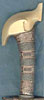
I would call this elephant ivory. Marine ivory is yellower and darker in nature. Fossil ivory has more bands of different colors due to different absorbtion rates of minerals in the different sections of the dentine and enamel. Here is a picture of what I mean. This is the fossil ivory pommel of a datu battle barong I have:
Last edited by Battara; 16th December 2004 at 10:13 PM. |
|
|
|
|
16th December 2004, 10:22 PM
|
#25 |
|
EAAF Staff
Join Date: Dec 2004
Location: Louisville, KY
Posts: 7,402
|
Here is a turkish jambiya I have that has a marine (walrus) ivory hilt. Notice the yellowish hue and yet the solid middle and fragmented sides (and back) that make up the inside of the tooth: (pic sent to Lee for resizing)
|
|
|
|
|
17th December 2004, 11:15 PM
|
#26 |
|
Member
Join Date: Dec 2004
Location: Penang
Posts: 14
|
A nice kris though.. common among the Kelantanese and Trengganu Malays....not much likened by the them due to its simplicity and quality of besi almost equivalent to the Malay Parang of 1940s....not much priced. It looks nice honestly, but I think it has been redressed to look more outstanding ..that what most runners did before selling it to your middleman. I think, Malay forumites must contribute more rather than giving complementary comments. A 20th century keris, not a warrior keris per say but functional to a certain extent. Honestly, I like the dress. Rajamuda..I will provide you my 'insider tips'.
|
|
|
|
|
18th December 2004, 12:05 AM
|
#27 |
|
Member
Join Date: Dec 2004
Location: Cincinnati, OH
Posts: 940
|
Gee, Sakhti, i think we will all look forward to your "insider tips"
Which end of the 20th century do you believe Blu's keris is from? What do you particularly find lacking about the besi in this piece and how much can you tell without really handing the keris? Is simplicity of form really something disliked by the Kelantanese and Trengganu Malays? By comparison to Bali and Jawa keris i find their forms somewhat simplistic, yet there is still a beauty to it. BTW,Where exactly are you from? |
|
|
|
|
18th December 2004, 02:40 AM
|
#28 |
|
Member
Join Date: Dec 2004
Location: Singapore
Posts: 1,180
|
Dear Sakhti,
Thank you for your comments. I'm glad you like the keris. It is my opinion that this is not a Northen Malayan keris; It is not even a Malay keris to begin with. Everything from the sarong to the dapur and besi suggests to me that it is of Sulawesi Bugis origins. I would like to hear your arguments on why this is a N. Malay keris. Malay parangs (which I assume you are talking about those from Pattani, Kelantan, Trengganu) are beautiful works of art, and are status symbol wear, though not as high-status as kerises. The besi used can be of high quality too. Prices of good N Malayan parangs are getting quite high these days. There's nothing spectacular about the dress. Its old, repaired and its a perfect fit for the blade. As for the 'warrior's keris' remark, well, in over a thousand kerises which I have handled, this keris is one of the toughest, tempered for 80% of the length, with attendant clash marks and nicks. I would presume a keris used in combat belongs to 'warriors'. What would your definition of 'warrior keris' be? As for the age of the keris, it could well be 20th century, but probably the earlier part of 20th century. As I mentioned, I think this keris could have been forged from European steel. One of the things that late 20th Century pandai besi fall short on is the appreciation of the 'flow of the form'. They have the technical knowledge, but lesser grasp of the aesthetics. And that is often betrayed in their execution of the keris. Also, they tend to squeeze in as much perabot as they can, as if a more complicated keris is better. A simple form does not make a keris easier to execute well. This keris here has simple form, but its execution is elegant, without compromising functionality. What more do we ask for in a keris of the fabled Sulawesi Bugis? I look forward to hearing from you again. Regards, BluErf |
|
|
|
|
18th December 2004, 04:31 AM
|
#29 |
|
Member
Join Date: Dec 2004
Posts: 125
|

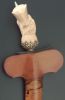
If such keris are common in Kelantan and Terengganu you could have fooled me. Fact is its even pretty unusual by Sulawesi standards - which is what makes the piece so special in the first place. Had I seen the blade bare I would have guessed Northeastern Sumatra. Here's a piece thats similar but dressed in the NE Sumatran style.
Photo stolen  from Artzi. from Artzi.And another from S. Sumatra with a similar blade form but somewhat different, lower quality besi. That said, the dress on BluErf's keris is unmistakably Sulawesi. And incidentally - the steel on this piece's blade is quite similar. Straight keris blades are ubiquitous across the Malay world and are sometimes pretty hard to place. Complicating matters is the fact that many of the cheap Javanese trade blades sold across the archipelago for hundreds of years were straight blades. That said though this blade is clearly no trade blade. the hexagonal cross section is typically Bugis - whether Sulawesi or Straits - as is the besi. To top it all off - the quality of workmanship of Blu's example is certainly one of the best, if not the best of this sort that I've ever seen. None of the examples shown above even comes close. A very fine, certainly high status blade. To denigrate such a piece as "common" and "cheap" (I'm assuming that's what "not much priced" means) is flat ignorant! And for the record, I've spent a hell of a lot of time trying to figure out the identifying characteristics of the keris of the Northeastern Peninsula but if there is anyone on this forum who can prove to me that such keris were common I'll be damned impressed 
Last edited by DAHenkel; 18th December 2004 at 04:49 AM. Reason: Fixing image tags |
|
|
|
|
18th December 2004, 01:44 PM
|
#30 |
|
Member
Join Date: Dec 2004
Location: netherlands
Posts: 75
|
the term "warrior keris"
i'm wondering why everybody is amways very eager to call his or her keris one that is used in combat. the keris is to my opinion a non warrior type of weapon. it is a status and talismanic piece of art compare a keris to a klewang in a battle i would choose the klewang.
i also think that this example is 20th century. perhaps the blade is late 19th century but the dress not, also the selut looks not to old just compare it to the old pieces in museum collections. the wood looks to new to meso i agree to a certain level with sakhti777, in holland these are not hard to find. |
|
|
|
 |
| Thread Tools | Search this Thread |
| Display Modes | |
|
|


 Linear Mode

