
|
 21st October 2009, 11:26 PM
|
#1 |
|
Member
Join Date: Dec 2004
Posts: 1,247
|
 Another stab at flyssa origins
Hi All,
Random thought. I was answering Queequeg's post on that movie scythe thingie, and I looked up Wikipedia's article on the rhomphaia. I'd looked at it before, but this time I got a weird idea: what if the rhomphaia inspired the flyssa? See the pictures below. The blades are somewhat similar, especially the later Byzantine model that was straight. The handles are not similar. The interesting thing is the timing. The Byzantines were using the rhomphaia ("one-edged sword of heavy iron which [the Varangian Guards] carry suspended from the right shoulder") up til 1000 AD, roughly. This is a lot more current than the Celtic swords we were talking about in the last discussion of flyssa origins. Also, the Varangian guards were Norsemen from Sweden and Denmark, and one could hypothesize that they sailed by the Mediterranean coast to and from work in Constantinople. This might have spread their sword designs along the Mediterranean shores, perhaps even into Morocco? I can better believe that the flyssa was inspired by some medieval/byzantine weapon than by celtic sword designs. Wild speculation, of course, but it *is* fun. Comments? F |

|

|
|
22nd October 2009, 02:15 AM
|
#2 |
|
Member
Join Date: Jul 2005
Location: Toronto, Canada
Posts: 1,242
|
Hi Fearn,
I would look closer to the falcatta as a possible antique source. I humbly disagree with the wiki article. Varangians (Swedish and Angles and misc other Scandinavian peoples and a hefty mix of Bulgarian and misc Slavs) did not use the Rhomphaia, a Thracian weapon. There seems to be a lot of confusion in that article. All the depictions I've seen of Varangian and Byzantine equipment show straight "spada"-type double-edged swords, axes and spears. The McBride quote combines the long two-handed rhomphaia with a shield...the Thracian rhomphaia was essentially a pole arm and could not have been wielded with a shield. Everyone is entitled to their opinion, and I'm VERY comfortable discounting the Celtic hypothesis. I tried researching the material history of the Kabyles (of whom the Iflissen - makers of the flyssa - were a tribe) and very little comes up. The many French archaeological digs reveal nothing much. There are very few traces of weapons before the early 19th century and nothing unique or remotely similar to the flyssa. I've more or less resigned myself to accept the yataghan and perhaps certain Caucasian sabres as a most likely source.  We can speculate as much as we want, but there doesn't seem to be any actual corroboration of anything. Camille Lacoste-Desjardins ("Sabres Kabyles" - a great article, I can send you a copy if you read French) had delved into the possibility of indigenous development of the flyssa and had offered some clues in the form of an ancient Lybian stele that depicts a man with something like a concave blade in hand. I saw pictures (granted, they were bad) of said stele and the relief was quite worn and nothing conclusive could be made out. Better pictures might help, or even better, a site visit. Have a look at the Big Flyssa Thread Best, Emanuel Last edited by Emanuel; 22nd October 2009 at 02:28 AM. |
|
|
|
|
22nd October 2009, 02:40 AM
|
#3 |
|
Member
Join Date: Dec 2004
Posts: 1,247
|
Hi Emanuel,
You may well be right, particularly about the history of the Kabyles. Couple more bits of information: --Looking more at the Varangians, the Norse sagas talk about them bringing home apparently foreign equipment. They were, of course, famous for their axes, but conversely, during the Dark Ages, weapons were expensive, and the Norse went to Byzantium to get rich. They were almost certainly equipped partially or wholly with Byzantine weapons. --I'm not clear on whether the weapons referred to as Rhomphaia changed over time, but at least into Roman times, there's a tradition of single-edged long swords, and I wouldn't be surprised if it carried over. Best, F |
|
|
|
|
22nd October 2009, 08:06 AM
|
#4 |
|
Member

Join Date: Mar 2006
Location: Room 101, Glos. UK
Posts: 4,286
|
at the beginning of the 19th c. an iflissan tourist visited sumatra an brought back a souvenir.
 it so impressed his fellow tribesmen that they adopted the design  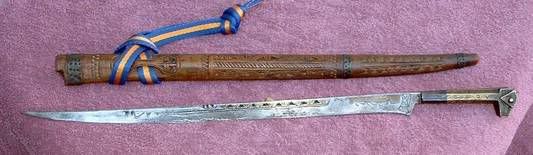
|
|
|
|
|
22nd October 2009, 02:40 PM
|
#5 |
|
Member
Join Date: Dec 2004
Posts: 1,247
|
You nailed it K!

|
|
|
|
|
24th October 2009, 02:48 AM
|
#6 |
|
Member
Join Date: Apr 2006
Location: Australia
Posts: 51
|
Not so far fetched as it sounds!
kronckew, your last post here reminded me of 'The Sinbad Voyage', by Tim Severin. The Islamic influence is spread along North Africa, The Horn of Africa, to Oman/ Yemen/ Saudi Arabia, along the maritime trading routes through to India, Sri Lanka and South east Asia. That cultural interconnection over centuries surely brought stylistic and technological influences from Islamic countries of the Middle east , through to South East asia, (along with some architectural forms, social customs, arabic language, etc etc). It's hardly suprising then that there are similarities in edged weapons where there has been cultural connections since the early middle ages.

|
|
|
|
|
24th October 2009, 05:14 AM
|
#7 |
|
Member
Join Date: Dec 2004
Posts: 1,247
|
Hi Bryan,
So you don't believe that the influence went the other way? For all we know, the blade design came out of Mecca, and spread both ways via the Hadj. Best, F |
|
|
|
|
26th October 2009, 07:50 AM
|
#8 |
|
Member
Join Date: Mar 2006
Location: Room 101, Glos. UK
Posts: 4,286
|
as there is evidence of far more extensive trade during the stone age than we had previously thought, i suspect that there was probably well established bi-directional trade routes between most established cultures millennia before islam. i remember the european clovis points found in north america and spain amongst others. this is of course disputed by the establishment...
|
|
|
|
|
26th October 2009, 04:13 PM
|
#9 |
|
Member
Join Date: Dec 2004
Posts: 1,247
|
Hi Kronckew,
I'm still not sure about the Clovis point connection. The problem there is that points with similar designs show up on opposite sides of the globe, with nothing in between, and different designs before and after. To me, that suggests that the craftsmen making them solved similar problems (i.e. mega-game hunting) the same way, rather than that the design was invented once and diffused out. Using the same logic, I could point out that, in more modern times, Sardinian and Hmong kitchen knives are largely identical (and both look a little like a flyssa and a talibon, oddly ). *Obviously* this means that Hmong and Sardinians trade with each other. It could be that they didn't have a lot of money, and independently came up with the same do-it-all knife design so that they could do all their chores with a single knife. Best, F |
|
|
|
|
27th October 2009, 10:15 AM
|
#10 |
|
Member
Join Date: Mar 2006
Location: Room 101, Glos. UK
Posts: 4,286
|
the sardinian-hmong connection is well known, hmong raiders settled in the mountains centuries ago after raiding as part of a berber contingent in the 8th century, meeting some local girls, and settling down to selling noodles. they were particularly good at raising spaghetti trees and selling the pasta seeds to the italians and the swiss...
the BBC did a documentary on the swiss spaghetti harvest of 1957. little known was that the seeds actually came from the hmong region of sardinia, their plant breeders are legendary in producing uniform lengths of spaghetti... hmong style knives  were quickly adopted as they were uniquely effective in cultivating the spaghetti plants. Swiss spaghetti harvest 1957 <=linky to video in the video they reference the dreaded spaghetti weevil, we see here a sardinian hmong child with one of the newly hatched weevils, which reach up to three feet in length in their late adult lives. spaghetti weevils may live up to 30 years, growing and moulting annually before reaching their full 3 ft. size, they are cooked and eaten like lobster and are a delicacy.  hmong swords are traditionally carried into the fields for dispatching these weevils, which thru their efforts are largely extinct.  a traditional hmong two-sword weevil killer dance ritually performed prior to entering the spaghetti orchards of sardinia.. Last edited by kronckew; 27th October 2009 at 10:49 AM. |
|
|
|
|
27th October 2009, 02:44 PM
|
#11 |
|
Member
Join Date: Dec 2004
Posts: 1,247
|
...and with the spaghetti weevil becoming rare, the people had to switch to eating spiny lobster instead, thus founding the great tradition of Mediterranean pasta and seafood.
With the weevils gone, the Sardinians switched to making smaller knives, such as this folding version. Every once in a while, you find the big old knives sitting in a farmhouse back in the old spaghetti orchards. Last edited by fearn; 27th October 2009 at 02:54 PM. |
|
|
|
|
27th October 2009, 05:38 PM
|
#12 |
|
Member
Join Date: Mar 2006
Location: Room 101, Glos. UK
Posts: 4,286
|
nice knife, by the way.
we now have put to rest that evil venetian propaganda that marco polo, centuries after the hmong resettlement, brought back noodles from the orient in his travels. |
|
|
|
|
27th October 2009, 05:49 PM
|
#13 |
|
Member
Join Date: Dec 2004
Posts: 1,247
|
Thanks. I wish I owned it.
Isn't that whole Marco Polo myth amazing? I can't believe people have believed it so long. Why, Trader Joes was selling raw spaghetti fruit in their produce section about a month ago, and people still insist on buying the dried, processed product. Fresh is so much better! Of course, we're not helping. No one has posted any of the antique spaghetti harvesting or processing knives in way too long. It's a shame, really--they're such weird knives for Europe. Anybody have one? Best, F |
|
|
|
|
27th October 2009, 08:46 PM
|
#14 |
|
Member
Join Date: Mar 2006
Location: Room 101, Glos. UK
Posts: 4,286
|
unfortuneatly the only knife i have that might be sardinian appears to be not hmong. thus probably not for the spaghetti trade.
this one that katana has asked me to not tell him it is wootz... 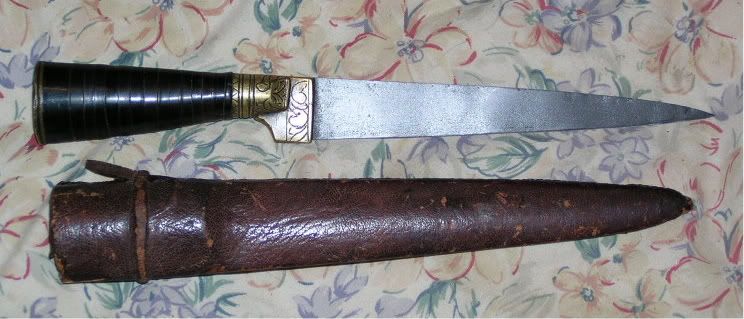 and has been variously described as syrian/balkan/egyptian and/or sardinian. quite likely mediterranean anyway. doubt it is hmong. likely not iflissan either. anyhow, it's the only maybe sardianian one that pops up on a search here on 'sardinia'. Med. knife thread linky we are drifting due to lack of iflissan input i guess.... Last edited by kronckew; 27th October 2009 at 09:07 PM. |
|
|
|
|
27th October 2009, 10:26 PM
|
#15 |
|
Member
Join Date: Dec 2004
Posts: 1,247
|
That's a neat knife too.
As for the one I showed, I'd actually noted the knives the Sardinians were using on an episode of <i>Anthony Bourdain: No Reservations</i> and looked it up on the web. The one thing that *is* somewhat relevant to the flyssa origin story is that these deep bellied, straight backed, long-tipped knives keep showing up in the Mediterranean. The Sards have them as kitchen and pocket knives, the Kabyles have a similar design on the flyssa, the rhomphaia (at least in Roman times) could be similar, and so on. Should we include the yataghan as well? Joking aside, it appears to be a useful design, and I wouldn't be surprised if the talibon and the Hmong kitchen knife weren't independently origins of the design, brought about by smiths trying to make a basic knife more useful by extending the point and deepening the belly. Best, F |
|
|
|
 |
| Thread Tools | Search this Thread |
| Display Modes | |
|
|


 Linear Mode

