
|
 2nd February 2009, 08:31 AM
|
#1 |
|
Member

Join Date: Dec 2004
Location: Sint-Amandsberg (near Ghent, Belgium)
Posts: 830
|
 An Indonesian knife..but what kind ?
I received this piece last week. I've been searching in Zonneveld's book on Indonesion weapons and also in other books, but I couldn't identify this knife.
I don't think it's a sewar as it has a cutting edge on both sides of the blade. Perhaps anyone else can 'enlighten' me ?  The sheath and handle are made of wood. The handle has a horn addition near the base of the blade. I believe the blade itself is laminated. Total length : 32 cm A small part at the bottom of the sheath is missing. Does anyone know what needs to be added there (bone, ivory piece) ? 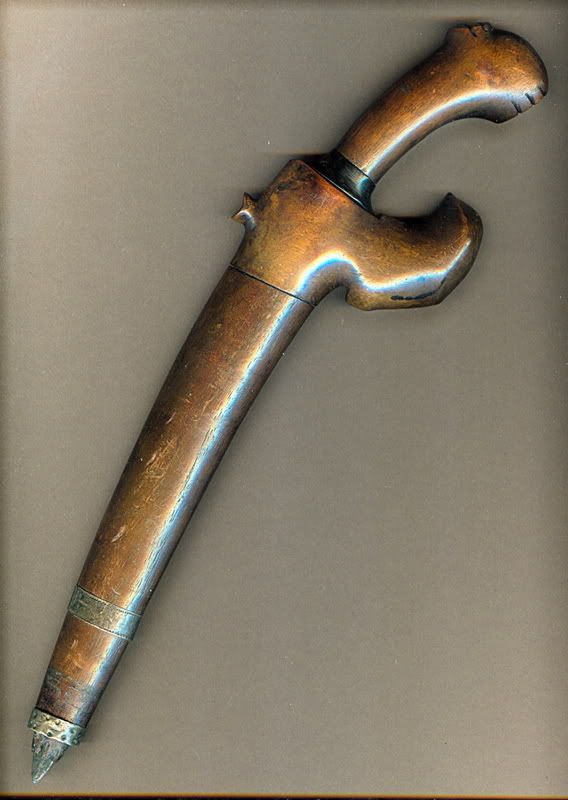 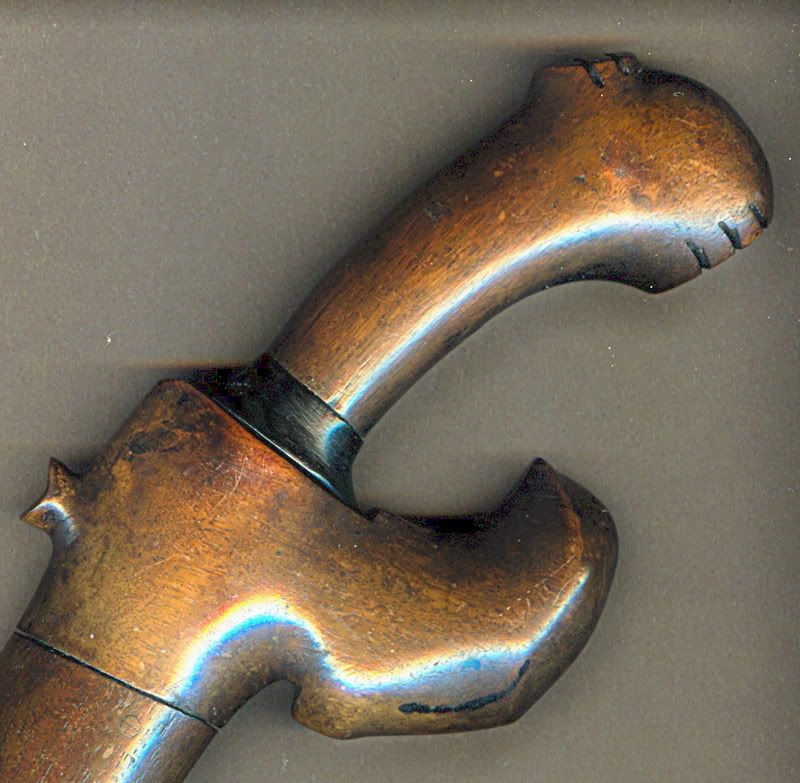 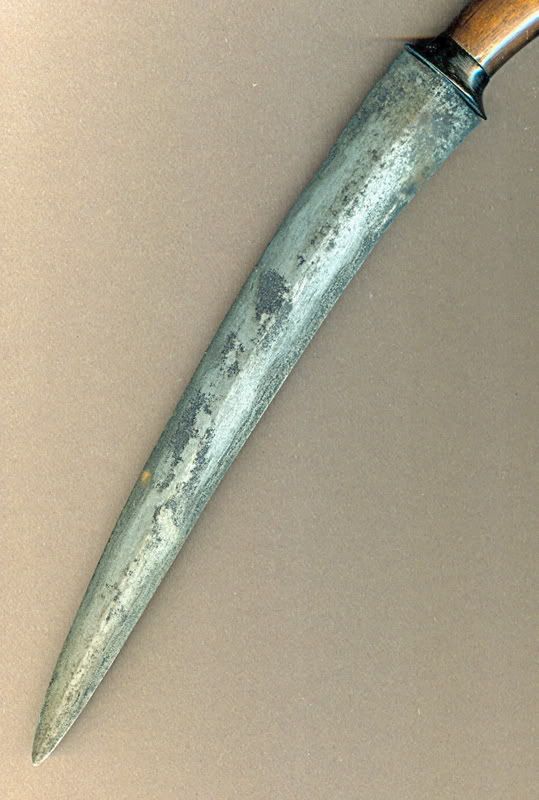 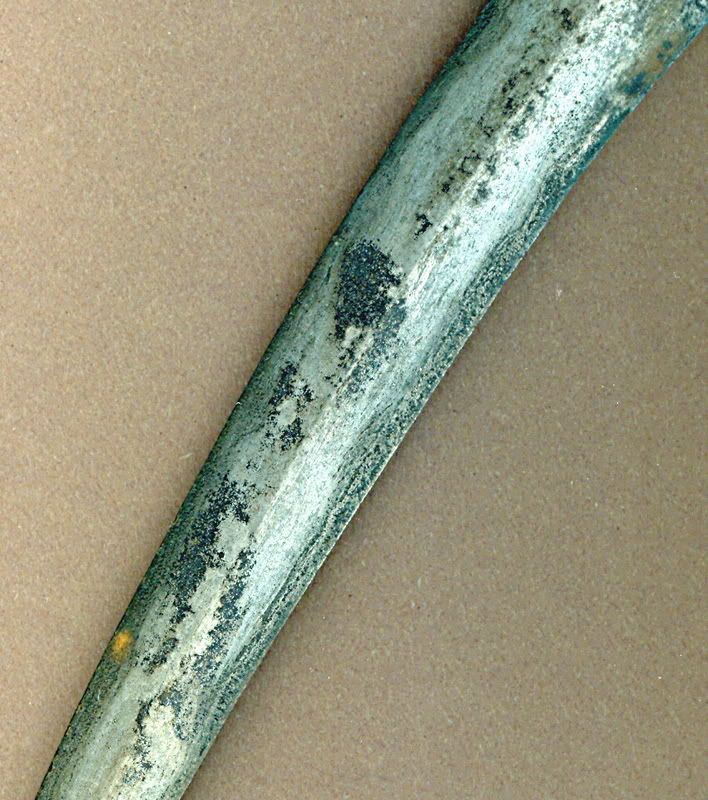 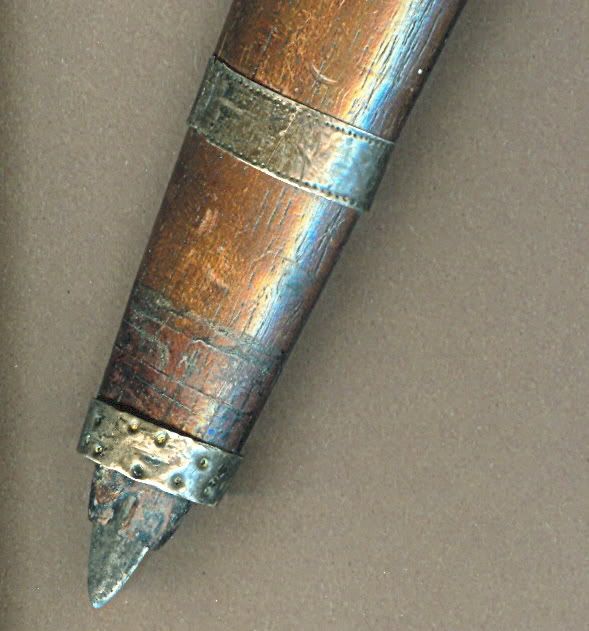
|

|

|
|
2nd February 2009, 05:13 PM
|
#2 |
|
Member
Join Date: Dec 2004
Location: Sweden
Posts: 1,637
|

Very nice and unusual!
It looks like a Sumatran Kuku Rimau (tiger's claw). It's related to the Jambia/Beladau and the Kormabit. On the missing tip I think it's supposed to be the same kind of wood as the rest of the scabbard. Or maybe, not that usual, black horn to match the handle? Michael |
|
|
|
|
6th February 2009, 08:57 PM
|
#3 |
|
Member
Join Date: Dec 2004
Location: The Netherlands
Posts: 1,209
|
I don't know how you manage to get from time to time very unusual items to show us.
I think it could be a badek. A badek has many shapes and appearances, but this blade has the similarities with a badek I own. |
|
|
|
|
7th February 2009, 10:22 AM
|
#4 |
|
Member
Join Date: Dec 2004
Location: Sint-Amandsberg (near Ghent, Belgium)
Posts: 830
|
Henk.....It comes from Holland, like many of my Indonesian pieces.
 
|
|
|
|
|
28th April 2009, 08:38 AM
|
#5 |
|
Member
Join Date: Dec 2004
Location: Sweden
Posts: 1,637
|
Here is another variation of the Kuku Rimau, leaning towards a hybrid with a Korambi.
Anybody else who has other variations to share so we can learn more about this knife? Michael |
|
|
|
|
28th April 2009, 04:59 PM
|
#6 |
|
Member
Join Date: Aug 2007
Location: Germany, Dortmund
Posts: 9,788
|
Nice dagger, Michael will be right with Kuku Rimau and also that the tip could be from horn.
sajen |
|
|
|
|
29th April 2009, 01:31 AM
|
#7 | ||
|
Member
Join Date: Apr 2005
Posts: 3,255
|
Hello Michael,
Quote:
Quote:
BTW, I believe that Michael's piece is fairly recent (e.g. the edge has never been sharpened) and probably not a traditional style. When I first saw fuzzy seller's pics I thought this might possibly be workmanship from around WW2 but upon examination I'm inclined to think that this is more recent and not really made for local use, sorry.  Regards, Kai |
||
|
|
|
|
29th April 2009, 07:02 AM
|
#8 |
|
Member
Join Date: Dec 2004
Location: Sweden
Posts: 1,637
|
Hello Kai,
I have noticed that there is a variation of handles as well as curvature on the blade of the knives within the family of Korambi. I assume that the original version is the one with a ring for the index finger and which originally was a rice-reaping knife. The one with a curved thumb rest I assume was influenced by the Jambiah and was made for fighting more than being an agricultural tool. Then we have the version that was described to me by a local source as a Kuku Rimau (enclosed as reference). It differs from the others by less curvature of the blade, it's much longer and the handle doesn't reach further than the 2nd or 3d finger (= half fist load). Also it has a double edge. This makes me believe that it's a development from the Korambi, and maybe influenced by the Jambiah as well, and made for fighting only. As its features differs so much from the other variations I have kept the name Kuku Rimau to separate this style from the first two categories within the same family of knives. But a name is just a name and the reason for using them is to communicate with other collectors and researchers, not claiming that "all" locals use/-d that name. Like anthropology separates between the function of ethic and emic terms. On the age I agree that both of mine are quite recent. Actually I think the korambi, as a fighting knife, as well is quite recent and I haven't seen any with a documented age of earlier than late 19th C. The style of my first one is a bit nostalgic to me as one of my first Sumatran daggers was of this style, but a sewar, and since then I have had several. None of them pre-WWII. Please try to enclose your reference pictures too when you find time. Michael PS If Freddy's dagger would had deep fullers and thicker, single-edged blade, as well as a slightly different handle and sheath, I would have been inclined to call it a Siraui... Last edited by VVV; 29th April 2009 at 07:39 AM. Reason: grammar |
|
|
|
|
30th April 2009, 12:27 AM
|
#9 | |||||
|
Member
Join Date: Apr 2005
Posts: 3,255
|
Hello Michael,
Quote:
Quote:
 Quote:
Quote:
A single edged version with only the outer edge sharpened - quite akin to a piso raut for rattan splitting but with a less specialized hilt and more of a general utility knife (possibly resembling the Lumad sanggi in EDC function). Then there is what I believe to be a dedicated fighting variant with false edge or double edge and better examples showing fullers or facetted blades. However, the cross section of the blades I've seen clearly shows that the outer edge is still the primary cutting edge. OTOH, the examples of the dagger type discussed here which I handled either had a symmetrical diamond cross section or leaning towards the inner edge being the primary edge. Regards, Kai |
|||||
|
|
|
|
30th April 2009, 07:17 AM
|
#10 | ||||
|
Member
Join Date: Dec 2004
Location: Sweden
Posts: 1,637
|
Hello Kai,
Quote:
Nowadays it's harvested in an "industrial" way with larger sickles and often by contracted men. The grip depends of course of the size of the tool as well as other preferences both for harvesting and fighting. In the Sumatran style of fighting with the korambi as I have been taught the forward grip is preferred, not the reverse as seen in the US magazines and in the movies. Quote:
Quote:
Quote:
Actually you can find a lot of old colonial research on the development of sickles and curved knives in Asia. Michael |
||||
|
|
|
|
30th April 2009, 09:07 AM
|
#11 | |||||
|
Member
Join Date: Apr 2005
Posts: 3,255
|
Hello Michael,
Quote:
 Quote:
Now, was the name originally applied/stated by the Lampung owner, a Sumatran runner, or a seller (say, in Singapore)? Quote:
Quote:
I have only found scattered bits and pieces in the primary accounts (Volz, etc.). Most ethnographic research expeditions with reasonably documented, surviving pieces were done in the late 19th to early 20th century. Finding well documented pieces from the 1st half of the 19th c. or earlier is tough for most types of blades. I'd also posit that there was a bias towards larger or more decorated pieces in the early collecting days (e. g. shown by the European curiosity collections which later evolved into ethnographic research collections). Regards, Kai |
|||||
|
|
|
|
1st May 2009, 09:14 AM
|
#12 |
|
Member
Join Date: Dec 2004
Location: Sweden
Posts: 1,637
|
Hello Kai,
Try Google Scholar for lots of articles and references on the curved knives of all ages and places. It seems like the simpler one, were the blade was set 90 degrees on the center of a palm stick, was an earlier rice reaping knife than the korambi. On the name game I don't really get it. How can Kuku Rimau, that both of us has seen in local use and which has a logical description of the object, risk to be a nonsense label? Michael |
|
|
|
 |
| Thread Tools | Search this Thread |
| Display Modes | |
|
|


 Linear Mode

