
|
 7th November 2008, 07:12 PM
|
#1 |
|
Member

Join Date: Mar 2006
Location: Room 101, Glos. UK
Posts: 4,286
|
 Mexican Presentation Sword?
Found this odd looking mexican sword on ebay
anyone have any idea what it is? billed as a vintage (pre-1970 in ebay-isch) mexican presentation sword. hilt looks well made, blade etchings look well executed, but the odd yelmanesque forward section and rounded tip, aside from the implications it is designed for the cut, is one i have not seen before. 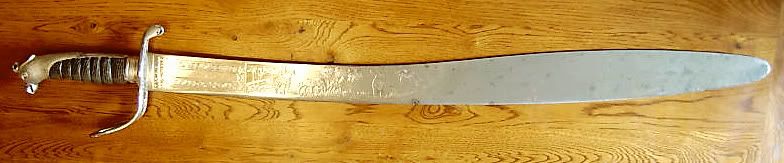 only measurement is blade length 26 in. Blade etching 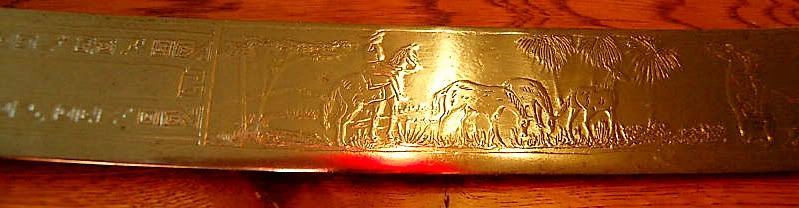 Grip 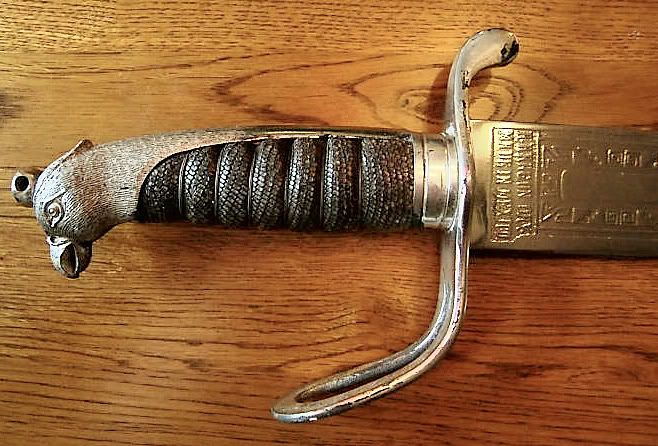 leather under the wire wrap is billed as reptile skin. Ricasso markings 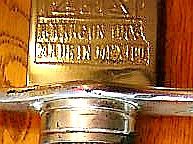 i can make out the lower 'MADE IN MEXICO' but not the upper one. i will have better info when it arrives and i can examine and measure in it more detail. better pics to come after it gets here. 
|

|

|
|
8th November 2008, 03:33 AM
|
#2 |
|
Member

Join Date: Jun 2008
Location: The Sharp end
Posts: 2,928
|
LOL, you do find the goodies!
Why when I look on ebay do I never see any good deals? This is an interesting piece for sure. I have absolutely no idea about this one, but it is well cute! I find myself wondering if the silvering is original? Where I live there is a long established chrome plating works close by, and it's bizarre the amount of things that I've seen over the years that are thickly coated with chrome. Fire axes, swords, daggers, loads of bayonets, seems like it was the thing to do in the 70s and 80s. Your mexican sword looks like its had a silver dip on all the metal parts? I might be showing my ignorancce of Mexican parade swords here of course. And the odd bolo blade totally threw me! Hopefully some of our members a little more geographically close to that area will be able to tell the whole backstory on this one as I for one will also be very interested to learn more about it! |
|
|
|
|
8th November 2008, 03:57 AM
|
#3 |
|
Member
Join Date: Dec 2004
Location: NC, U.S.A.
Posts: 2,236
|
Bolo-style blades on Mexican/S American swords and bayonets seemed to have started around the turn of the century. The Argintine bolo-blade bayonet circa WWII comes to mind. Indeed, a nice find, but I'm inclined to believe that it's tourist (but higher grade than most). When you see "Made in...", its post 20th century. The fact that these words are in English seems to support tourist as well. Interestingly, you do see a lot of roosters/chicken hilted swords from down this way (A Brazilian police sword I used to own had a side image of a crowing rooster on the pommel)...BUT then again, is this hilt a parrot? I always found these bolo blades fascinating and they kind of remind me of fascine knives from the American Revolution onward, kind of "lumpy" blades.
|
|
|
|
|
8th November 2008, 10:58 PM
|
#4 | |
|
Member

Join Date: Sep 2008
Location: PR, USA
Posts: 679
|
It's certainly touristy.
Probably from Veracruz. Bolos descend from the pre-roman spanish falcatas and greek-carthagininan kopis. The Argentinian Bolo follows the tradition of the 1898 Spanish bayonets. used way too effectively by the Legion in Spanish Marruecos. BTW Eley, ...turn of last (XX) century, or 19th? : ) Sorry, couldn't resist! just kiddin'. Time doth passes... Best M Quote:
|
|
|
|
|
|
9th November 2008, 05:44 AM
|
#5 |
|
Member
Join Date: Dec 2004
Location: NC, U.S.A.
Posts: 2,236
|
Arrr! You got me there, Celtan. Keep forgetting we're in the 21st now. Definately getting old!
Even though its a tourist piece, this sword does kind of grow on you, particularly the parrot? hilt. Interesting that the decoration seems to depict a more S. American scene. Are those llamas? |
|
|
|
|
9th November 2008, 06:28 AM
|
#6 |
|
Member
Join Date: Mar 2006
Location: Room 101, Glos. UK
Posts: 4,286
|
i initially passed on this item due to the english 'made in' marking, but it grew on me, the hilt & guard especially looked better made than most tourista junk (that looped lower guard was familiar somehow, but i can't place it), so i risked a small bid, about an hours pay & won it... i'll either consign it to the OOPS drawer or not depending on the blade dimensions and detailing when it arrives. i'll also bill my client an extra hour for working on an email they sent me yesterday
a number of interesting example illustrations i found googling for mexican weapons: Billed as found near a well known east texas battle that occurred in 1836... 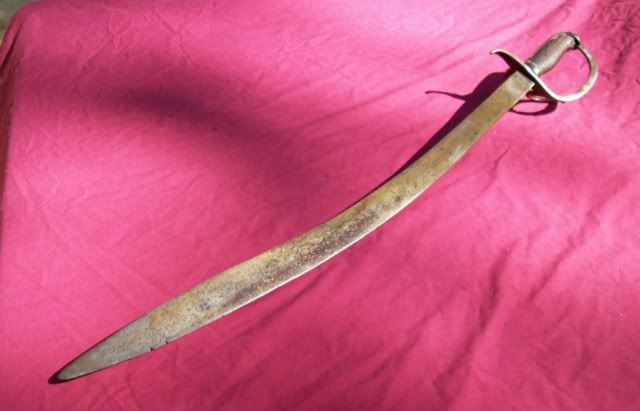 this style may be earlier than prev. mentioned. for scale, this has a 27 in. blade, an inch longer than mine. the perspective of the photo makes it look longer than it appears. from the forum: 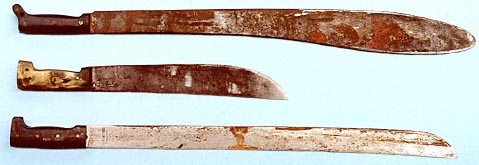 from therion for illustration: 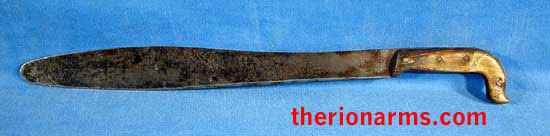 i note that this was described as a 'duck-billed' blade style. Last edited by kronckew; 9th November 2008 at 06:44 AM. |
|
|
|
|
9th November 2008, 07:35 AM
|
#7 |
|
Member
Join Date: Sep 2008
Location: PR, USA
Posts: 679
|
The design is certainly very attractive overall, and the blade is wicked, wouldn't like to face one on the downstroke.
As far as I know, there are no llamas in Mexico, but it might be copying an andean motif, or the animals might be some equine breed. Mules, donkeys, horses, polticians? : ) Best Manuel |
|
|
|
|
9th November 2008, 07:55 AM
|
#8 |
|
Member
Join Date: Mar 2006
Location: Room 101, Glos. UK
Posts: 4,286
|
the animals on the blade in the photo appear to be equine to me, llamas do not have long tails.
  horses tend to have them tho.  the palm trees in the etching also are not very andian. |
|
|
|
|
9th November 2008, 06:14 PM
|
#9 |
|
Member
Join Date: Jul 2006
Location: musorian territory
Posts: 497
|
it is a typical machete sword from mexico.
this style is quite common , recently ive seen quite alot of older versions being sold on ebay.. typicaly the blade has a pointed tip and is sharp for about 20cm along the back of the edge, the swords come in sheaths in the style of a machete not in a typical sword sheath. yours would have to be dated as a product of the last 70 years.. older ones are not normaly saying mad in mexico..and the etching it ushaly of a different style |
|
|
|
|
9th November 2008, 11:05 PM
|
#10 |
|
Vikingsword Staff

Join Date: Nov 2004
Posts: 6,441
|
Machete ?
There is , I believe, an ersatz rendition of an Early machete with a very similar blade profile to the original subject post that has been making the rounds (unsuccessfully) on our favorite (?)
 auction site . auction site .That particular one implies a Cuban provenance . 
|
|
|
|
|
11th November 2008, 06:57 AM
|
#11 | |
|
Member

Join Date: Apr 2007
Location: Nothern Mexico
Posts: 458
|
Quote:
Regards Gonzalo |
|
|
|
|
|
11th November 2008, 03:35 PM
|
#12 | |
|
Member
Join Date: Sep 2008
Location: PR, USA
Posts: 679
|
Naive horses? And you can ID them by appearance?
I wonder how the racy, world-savvy type then look. Red Horse-shoes with tall heels? Just Kidding Gonzalo, couldn't help myself. Interesting the note on the reasons behind the rounded blade... Best regards & Saludos. Manolo Quote:
|
|
|
|
|
|
11th November 2008, 06:01 PM
|
#13 |
|
Member
Join Date: Apr 2007
Location: Nothern Mexico
Posts: 458
|
Manolo, the naive or naif movement in painting (please see the Naive School in the history of art), used to represent figures in a very simple manner, almosto childish, just like on the popular art. The use of the colors was also very simple. The most known painter in this movement was el Aduanero Rousseau (Henri Rousseau). That´s what I meant with "naive horses".
Un abrazo, amigo. Gonzalo |
|
|
|
|
11th November 2008, 06:28 PM
|
#14 | |
|
Member
Join Date: Sep 2008
Location: PR, USA
Posts: 679
|
Good answer!
To me, they just look native, but its probably because of my artistically untrained eye. Or it might be cuz' I'm tres naif myself. Tomate una cerveza fria a mi nombre! : ) Manolo Quote:
|
|
|
|
|
|
11th November 2008, 11:24 PM
|
#15 |
|
Member
Join Date: Mar 2006
Location: Room 101, Glos. UK
Posts: 4,286
|
horsey motif's appear to fairly common decorations, as in this punal which i feel may be Brazilian.
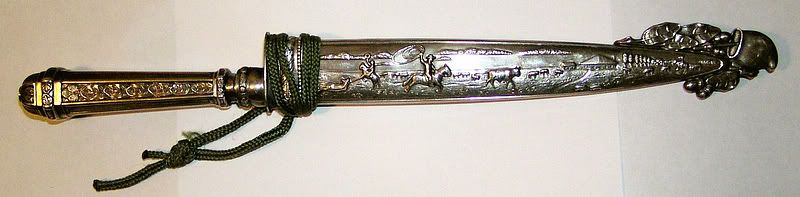 there are also silhouettes of 'naive' horses and cattle etched on the blade. 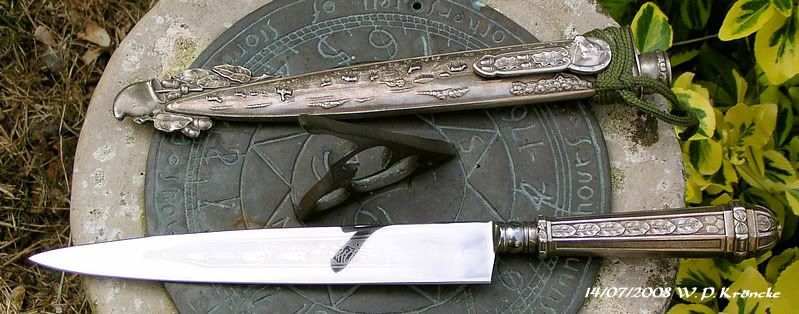
|
|
|
|
|
12th November 2008, 02:43 AM
|
#16 | |
|
Member
Join Date: Sep 2008
Location: PR, USA
Posts: 679
|
Actually, horses and their images were very common motifs in very early galician-spanish lore, weapons and shields. The old celtic religions in Galicia had a horse goddess named Epona, or something similar.
Best M Quote:
|
|
|
|
|
|
13th November 2008, 05:29 AM
|
#17 |
|
Member
Join Date: Apr 2007
Location: Nothern Mexico
Posts: 458
|
Yes, the horse had an important iconographical, social and military role on the old iberic cultures.
The puñal criollo seems to be uruguyan. ¿Eres gallego, Manolo? My best regards Gonzalo |
|
|
|
|
13th November 2008, 07:48 AM
|
#18 | |
|
Member
Join Date: Mar 2006
Location: Room 101, Glos. UK
Posts: 4,286
|
thanks, gonzalo. i figured it was brazilian or uruguayan from the button cover, and was just guessing brazil as it seemed more likely. there is a bugle etched into the ricasso which i assume is a makers mark. uruguayan would be more interesting as i suspect it'd be a bit more uncommon here in the UK
 i'd posted it before & you were kind enough to comment on it as a traditionally made punal, but we'd not discussed where it was from. i'd posted it before & you were kind enough to comment on it as a traditionally made punal, but we'd not discussed where it was from.Quote:
my maternal grandmother was from galicia - however, her's was part of the austro-hungarian empire at the time, it's now divided between poland and the ukraine. celts got around.
Last edited by kronckew; 13th November 2008 at 08:05 AM. |
|
|
|
|
|
13th November 2008, 11:23 AM
|
#19 | |
|
Member
Join Date: Sep 2008
Location: PR, USA
Posts: 679
|
Hi Guys,
Yep, I'm originally Galician. The interesting thing is that there are actually two Galicias, one in Northwestern Spain, and another in Poland/Austria. In fact, there are many toponimical names in Spain which are basically recreations of others in the Caucasus. To me, they represent the cultural footprints of our common ancestors. Yes, the celts migrations are a very interesting subject, they reached China, India and even America, long before Colon. An important detail is that these migrations took place in difefrent time periods, and the celtic groups involved were very different in terms of cultures, religion and even language. There was an old celtic deity, Galeach, the goddes of the earth. From her name arises that of many places and ethnic groups, the Gallegos or Galaics (Galici), the french Gales (Gallics), the Welsh (Wales or Gales). It seems that Celts and Vikings shared languages, since the Vikings that settled in Jakobsland (Spanish Galicia) did so just on account of that. When the local Celts went to confront their arrival, they reported the Vikings spoke an old version of the celtic language, an were thus family. Both sides hence coexisted peacefully. And that's a miracle by itself, since both groups were very war-prone. An interesting point is that the eldest celtic and even protoceltic items found have been in Spanish Galicia, not in the Caucasus. Modern Historians are actually rewriting the hsitory of the Celt's origings based on these modern day findings. Celts had very distinctive metallurgic knowledge and arts, some modern historians claim that the Gladius was not exactly a type of blade, but a type of alloy, and that Romans utilized this term to refer to antenna-type anthropomorphic swords, long swords, and falcatas made in Spain, not limiting same to the antenna-pommeled type exclusively found in La Tene's urn culture/necropolis. Well, nuff'sed... M Quote:
|
|
|
|
|
|
13th November 2008, 10:09 PM
|
#20 | |
|
Member
Join Date: Apr 2007
Location: Nothern Mexico
Posts: 458
|
Quote:
Regards Gonzalo |
|
|
|
|
|
22nd November 2008, 04:13 PM
|
#21 |
|
Member
Join Date: Mar 2006
Location: Room 101, Glos. UK
Posts: 4,286
|
well, it's here. basically as we discussed above, machete style flexible blade, nice decorations both sides, the maker's name is above the 'made in mexico', and is "A. Aragon, Oax.". i gather that referrs to the state of Oaxaca, the state next to guererro where acapulco is.
there is an incscription on the opposite side, it appears to say (some letters were stylised and worn, harder to see): 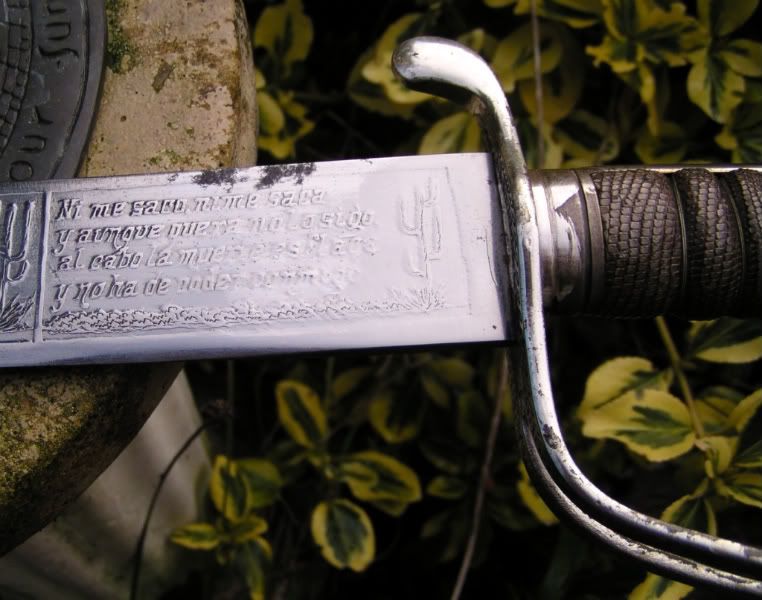 Ni me saco, ni me saca y aunque guera nolo sigo (spelling? i think it may mean guerra, 2nd word 'aunque' or maybe aungue') al cabo la muerte es flaca y no ha de poder conmigo 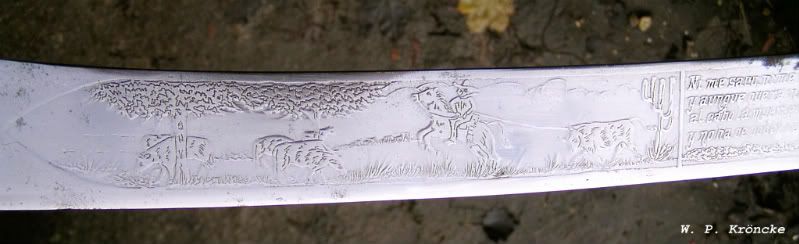 the decoration on this side is cattle being herded and the trees are not palms as on the other side. there is a saguaro cactus there as well on either side of the inscription.  the hilt has whatever it was dipped in worn in a few spots. the tarnish on it is black. the pommel nut is threaded on to a tang, if you look thru the lanyard hiole you can see the threaded hole, i've not taken it loose. the skin appears to be a fine scaled brown snake skin. the front of the guard is decorated in a line of stamped leaves and has the number '10' stamped on it near the top of the teardrop shaped opening in the lower guard. neither the guard or the rest of the metal hilt parts are magnetic at all. i think it may be brass under the silvery coating. the 26 1/4" blade is distal tapered, starting at 0.20 in. (5mm.) at the guard, down to 0.08 in (2mm) 4 in. from the guard, 0.07 in. (1.67mm.) at halfway, and 0.045 in. (1.14mm.) just rear of the tip. blade is 1.5 in. (40mm.) wide at the grip, 2 3/16 in. (55mm.) at the swell. definitely not a stamped sheet steel machete in this one. 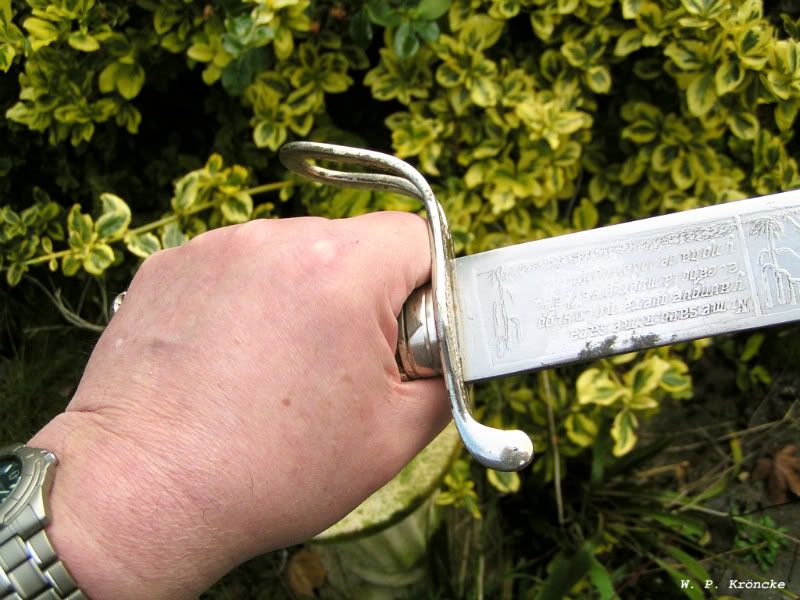 in hand shot for scale: Last edited by kronckew; 22nd November 2008 at 04:49 PM. |
|
|
|
 |
| Thread Tools | Search this Thread |
| Display Modes | |
|
|


 Linear Mode

