
|
 19th May 2020, 11:18 PM
|
#1 |
|
Member
Join Date: Dec 2004
Location: Ann Arbor, MI
Posts: 5,503
|
 Short-bladed Indo-Afghani sabers
The majority of sabers from that area were used by mounted warriors.
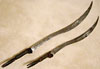
Their blade length was calculated to be: a). sufficient to cover the entire body against a blow, be it vertical, horizontal or diagonal; b). sufficient for the mounted warrior to reach an enemy laying on the ground. Usually, to achieve both goals the blade of a cavalry sword was ~30-33 " long. Here are Indo-Afghani swords that pose a question. The upper two are standard Indian tulwars. Blades 30-31". They are given just to provide a reference point. The " swords of interest" (lower 3) all have blades 25-26" Two of them are typical Afghani, one ( the upper one) is uncertain to me , with a Damascus blade, and I shall be grateful for a more precise attribution. One Afghani and the " uncertain one" have blades wide enough to be defined as Teghas. Dating of all is welcome. My big question: what were they used for? Unless their owners were riding donkeys, they are not long enough to reach the ground without the rider bending over. Were they infantry weapons? European grenadiers were often equipped with shorter and massive swords. This is a rather feeble argument, but it may suggest some parallelism. Sorry, the order of pics is reversed:-( |

|

|
|
21st May 2020, 03:44 PM
|
#2 |
|
Member
Join Date: Apr 2011
Location: Moscow, Russia
Posts: 431
|
IMHO
The normal length of talwar is when a standing person keeps saber lowered and its point does not reach the ground a bit. For average men growth, this is talwar about 90 cm length. If a person is shorter (or Indian horses, which were almost like donkeys), then the saber length accordingly is less, but the mass of the saber must be sustained (about 1-1.3 kg), therefore they are more massive. Infantry talwars should have been less curved than cavalry ones. |
|
|
|
|
21st May 2020, 05:17 PM
|
#3 |
|
Member
Join Date: Dec 2004
Location: Ann Arbor, MI
Posts: 5,503
|
The overall length of tulwar was about 90 cm, i.e. 35". But that includes the handle. I was talking about the blades. Over the past ~10 years average height of an urban Indian man was 174 cm, the rural one 161.5 cm, all-country 166 cm. 200-300 years ago they must have been shorter ( secular trend). Thus, a tulwar with ~30" blade would not fit your criterion for a standing Indian.
Indians imported horses from Arabia and Persia. Those were definitely not " donkey-sized":-). As to the configuration of infantry swords, please see H. Withers "World swords 1400-1945". Both infantry and cavalry European regulation swords were either straight or curved. Last edited by ariel; 21st May 2020 at 05:34 PM. |
|
|
|
|
21st May 2020, 06:53 PM
|
#4 | |||
|
Member
Join Date: Apr 2011
Location: Moscow, Russia
Posts: 431
|
Quote:
Quote:
Quote:
|
|||
|
|
|
|
22nd May 2020, 02:49 AM
|
#5 |
|
Member
Join Date: Dec 2004
Location: Ann Arbor, MI
Posts: 5,503
|
1.You do not have to believe, just Google
https://en.wikipedia.org/wiki/Averag...ght_by_country 2. As to Indian horse height: Arabian 57-61"; Akhal-Teke 58-64"; Marwari ( Malani) , the quintessential Indian horse 56-64". Most horses in India stem from Arabian and Central Asian breeds, they were imported en masse. 3. See famous miniature " Sivaji on the march" ( you can find it in Egerton, Plate II, between pp.26-27). Half of infantry escort carries curved sabers. I did not even mention weights. |
|
|
|
|
22nd May 2020, 12:16 PM
|
#6 | |||
|
Member
Join Date: Apr 2011
Location: Moscow, Russia
Posts: 431
|
Quote:
Tamils, Khonds, hill tribes, nomads, Rajputs, Jains, Gujaratis, Turks, Mughals, Afghans, Tajiks, Iranians, Nepalese, Arabs, Africans and more.... All of them were and are Indian.... the average value ...  Quote:
The criterion may be as follows: a more straightened talwar would be primarily a weapon of a foot warrior, and a shorter curved saber (and heavier) is a weapon of a rider. There may be other assumptions, I do not argue, but I am ready to justify my own, but not here. |
|||
|
|
|
|
22nd May 2020, 11:15 PM
|
#7 |
|
Member
Join Date: Dec 2004
Location: Ann Arbor, MI
Posts: 5,503
|
OK, having spent some time on personal impressions, height of S. Indian tribesmen, average body temperature in the hospital and other profound issues, can we go back to the original question: does the difference in the blade length imply differential use by cavalry/infantry? Short-bladed #3 ( the lowest) has a mail-piercing ( zirah bouk-ish) tip, implying stabbing as its significant function. Any thoughts?
|
|
|
|
|
25th May 2020, 03:12 AM
|
#8 | |
|
Member
Join Date: Mar 2017
Posts: 447
|
Quote:
|
|
|
|
|
|
25th May 2020, 08:30 PM
|
#9 |
|
Member
Join Date: Dec 2004
Location: Ann Arbor, MI
Posts: 5,503
|
You are correct: “ zirah bouk-ish” Indo-Afghani swords ( not daggers!) are very rare. I can recall seeing maybe 3-4, no more. But they do exist. One could entertain an idea that they might have come to Persia/India from the nomads: kind of atavistic feature, akin to our coccyx:-) By many accounts piercing/stabbing was not a part of Indian swordplay.
Were the short-bladed swords merely individual orders for especially short individuals? Why all 3 have very broad and as a result heavy blades? Usually we assume that short-bladed sword from N. Africa/Arabia belong to a “naval” group; tough to include the Afghani ones in it. A whole bunch of open questions. Last edited by ariel; 25th May 2020 at 08:54 PM. |
|
|
|
|
27th May 2020, 02:24 AM
|
#10 |
|
Member
Join Date: Feb 2018
Posts: 90
|
Just to inject another "IMO" in here about sword tips & shapes & all:
In regards to the "zirah bouk-ish" sword I would point out that the blade shape is both in form and decoration blatantly 19th century - which is to say it was made during the "twilight of the sword" when such weapons were more often carried for display & status than for anticipation of combat. Don't get me wrong, of course plenty of people were still using swords to fight and kill each other on every corner of the planet - and this blade is by no means an exception, I'm sure it could be quite deadly when properly used & sharpened - but this use was quite limited by the extensive colonization and use of firearms that defined the era. As a result, I would argue that this Afghan trade blade (as I have seen this particular blade type identified as) was made primarily with show in mind, and not to demonstrate or emphasize any particular martial concept. In regards to blade length and curvature (in general), I would just say "different strokes for different folks." Some people fought more in close quarters, and as a result needed smaller blades. Given the emphasis of draw-cutting in Indian swordsmanship, it makes sense that the curve of these swords - as well as their weight - would be condensed to match their size, so as to not throw off the user when handling them (or at least that sounds like a logical reason for the proportions in my mind). Overall they're just Indian/Indo-Persian cutlasses, not much more to 'em. |
|
|
|
|
27th May 2020, 11:33 AM
|
#11 |
|
Member
Join Date: Dec 2004
Location: Ann Arbor, MI
Posts: 5,503
|
To summarize:
A weapon for close quarters fights , I.e. infantry ? |
|
|
|
|
27th May 2020, 01:27 PM
|
#12 | |
|
Member

Join Date: Jun 2013
Posts: 2,145
|
Quote:
IMHO |
|
|
|
|
|
27th May 2020, 10:56 PM
|
#13 | |
|
Member
Join Date: Dec 2004
Location: Ann Arbor, MI
Posts: 5,503
|
Quote:
Third Battle of Panipat , 1761: 32,000 Rohilla infantry Second Anglo-Afghani War, 1878: 62 infantry, 16 cavalry regiments |
|
|
|
|
|
28th May 2020, 12:46 PM
|
#14 | |
|
Member
Join Date: Jun 2013
Posts: 2,145
|
Quote:
Mmmm it depends if this word "infantry" was used by Europeans/British or in local sources... Then the swords that you posted are not infantry swords, forgive my classic vision of an infantry but to me me the swords should be standardized like the late khyber knives for example. So in fact it depends of your personal definition or opinion about infantry. 
|
|
|
|
|
|
28th May 2020, 03:01 PM
|
#15 |
|
Member
Join Date: Dec 2004
Location: Ann Arbor, MI
Posts: 5,503
|
Infantry: foot soldiers, organized in defined units. Like ( see above) “regiments”:-)
Question: if there were so many foot soldiers in the 18-19 century Afghan armies, why are Afghani “ cutlases” so rare? Last edited by ariel; 28th May 2020 at 03:14 PM. |
|
|
|
|
28th May 2020, 07:30 PM
|
#16 | |
|
Member

Join Date: Sep 2014
Location: Austria
Posts: 1,918
|
Quote:
The shape of the tip is most certainly purely decorative. As with regards to the blades size/weight, cavalry blades tend to be somehow longer and heavier. However, this is valid ONLY when talking about regular, standardized military European units. |
|
|
|
|
|
28th May 2020, 07:41 PM
|
#17 | |
|
Arms Historian

Join Date: Dec 2004
Location: Route 66
Posts: 10,867
|
Quote:
It seems to me that foot soldiers were far more available than cavalry, which obviously required a horse, and like much of the arms etc. were at the expense of the individual so at a premium. Perhaps that is too simplistic a notion? I guess it depends on which Afghan region or demographic, as I know parts of Afghanistan the horsemen are outstanding as well known from the sport of Buzkhashi (cf.polo). |
|
|
|
|
|
29th May 2020, 07:23 PM
|
#18 | |
|
Member
Join Date: Dec 2004
Location: Ann Arbor, MI
Posts: 5,503
|
Quote:
|
|
|
|
|
 |
| Thread Tools | Search this Thread |
| Display Modes | |
|
|


 Linear Mode

