
|
 31st December 2017, 01:30 PM
|
#1 |
|
Member

Join Date: May 2014
Location: Ireland
Posts: 549
|
 Firangi, khanda what do I call it?
Hi
Just picked up the attached sword in my local antique shop. It was quiet rusted when I got it but cleaned up well Nice sword in just the condition I like it with lots of age shown there are some star stamps on the blade but the pictures did not come out great. There is also a small hole in the fuller where I presume a nail once mounted the sword in an old collection, Blade length of 80 cm Found some evidence of previous gold leaf on the handle which was nice to find What I found interesting is the damage on the guard, took a lot of energy to do this, i was going to straighten it out but then I noticed the guard is made of two layers which you can hopefully see in the photo. I would have imagined that the guard would all be made from the one sheet interesting that they took the time to laminate it. Would anyone hazard a guess on the age of this sword? And would yo go Firangi or khanda Many thanks and a happy new year to all. Regards Ken |

|

|
|
31st December 2017, 03:14 PM
|
#2 |
|
Member
Join Date: May 2014
Location: Ireland
Posts: 549
|
Close up on blade stamp, finally got decent shot
Ken |
|
|
|
|
31st December 2017, 04:13 PM
|
#3 |
|
Member

Join Date: Sep 2014
Location: Austria
Posts: 1,919
|
Firangi. 19th century with an older blade....
My two cents. Happy new year!  Marius |
|
|
|
|
1st January 2018, 12:00 PM
|
#4 |
|
Member
Join Date: Dec 2004
Location: Ann Arbor, MI
Posts: 5,503
|
When we had only Rawson, Egerton and Stone the answer would have been much easier: straight blade without widened tip, lack of retaining plates = Firangi when the blade is European or Dhup when the blade is local. With all of the above = Khanda.
Elgood’s book ( the Jodhpur one) threw a monkey wrench into this simple approach: he calls Khanda both straight and curved blades, both with and a without retaining plates, both spoon-like and straight tips, with either basket or Tulwar handles. And all combinations thereof. I am sure he has a reason for it, but I am still at a loss..... |
|
|
|
|
1st January 2018, 03:47 PM
|
#5 | |
|
Member
Join Date: Sep 2014
Location: Austria
Posts: 1,919
|
Quote:
Maybe Elgood had a reason to call this Khanda, but what if his reason was wrong?! 
|
|
|
|
|
|
1st January 2018, 03:52 PM
|
#6 |
|
Member

Join Date: Jun 2013
Posts: 2,145
|
Happy new year all
i think Elgood call them khanda because the hilt is a khanda style. Firangi means only Franks, Crusaders or strangers Because the blades were imported from Europe. But like you Marius I would call this sword a firangi. Ken your sword is very very beautiful, please send us a zoom on the ricasso and also the marks... The hole was used to fix a previous hilt...I'm just kidding. Kubur 
|
|
|
|
|
1st January 2018, 05:12 PM
|
#7 |
|
Member
Join Date: May 2014
Location: Ireland
Posts: 549
|
Hi All
Thanks for information I will hopefully turn up a spatulated tip sword to get a definite Khanda But these have eluded me so far in my hunting. I am v happy all round with this find though and the Indian weaponry collection is expanding nicely. I need more Dhals though here again are in short supply in Ireland I have attached some further pictures but I am unable to get any improvement on the blade markings you will see more of the remenant gold on these images Kind regards Ken |
|
|
|
|
1st January 2018, 07:41 PM
|
#8 | |
|
Member
Join Date: Mar 2012
Posts: 422
|
Quote:
|
|
|
|
|
|
1st January 2018, 07:59 PM
|
#9 |
|
Member
Join Date: Sep 2014
Location: Austria
Posts: 1,919
|
Hello Ken,
After seeing the detailed photos, I would estimate both the hilt and the blade to be 18th century. |
|
|
|
|
1st January 2018, 08:06 PM
|
#10 |
|
Member
Join Date: Dec 2004
Location: Ann Arbor, MI
Posts: 5,503
|
Among many examples there is one with the word “khanda” in the inscription.
But only one. There are several non-spatulated blades without handles, there are several non-spatulated ones with Tulwar handle etc. Can Elgood be wrong? Sure. But he spent years researching the topic and is not exactly a superficial guy:-) I would like to know the reason and the way of his thinking before I disagree with him. Wouldn’t you? |
|
|
|
|
2nd January 2018, 12:53 AM
|
#11 |
|
Member
Join Date: Jun 2013
Location: AUCKLAND,NEW ZEALAND
Posts: 645
|
2 KHANDAS IN MY COLLECTION
HERE ARE 2 KHANDAS IN MY COLLECTION
KIND REGARDS RAJESH |
|
|
|
|
2nd January 2018, 10:51 AM
|
#12 | |
|
Member
Join Date: Sep 2014
Location: Austria
Posts: 1,919
|
Quote:
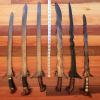
 I believe the blade, not the hilt defines the sword, and a typical Khanda is considered as having a straight blade with wide, spoon or diamond shaped tip. Based on this, I consider the second sword shown by Rajesh a Tulwar. If it weren't like this, then all the swords/knives below would be Tulwars but I would rather call them "Firangi, Tegha, Indian Kukri, and again Tegha." Last edited by mariusgmioc; 2nd January 2018 at 11:45 AM. |
|
|
|
|
|
2nd January 2018, 12:57 PM
|
#13 | |
|
Member
Join Date: Apr 2011
Location: Moscow, Russia
Posts: 431
|
Quote:
|
|
|
|
|
|
2nd January 2018, 08:21 PM
|
#14 |
|
Member
Join Date: May 2014
Location: Ireland
Posts: 549
|
Hi All,
Thanks very much for all the information. I have 4 swords with this hilt type 2 with straight and 2 with curved blades I must get them all out and compare the nuances and complexity. One is a foreign curved blade so is it a Firangi Tulwar , pictures belowI have come across to the world of ethnic Indian arms from the world of British swords and Imperial German bayonets because of the complexity of finding out what you have and the fun of research that goes with such pursuits so I can't complain! I am off to the shop on Saturday as seemingly more items have arrived in which might be of interest. Pity it is January when funds run low but I will just have to grin and bear it. Regards Ken Last edited by Kmaddock; 2nd January 2018 at 08:35 PM. |
|
|
|
|
3rd January 2018, 05:03 AM
|
#15 |
|
Member
Join Date: Dec 2004
Location: Ann Arbor, MI
Posts: 5,503
|
Marius,
You obviously do not belong to the Polish school of classification of swords:-) They consider a handle as the crucial element because it determines the manner of fencing. Indeed, we have a Karabela that is defined as such by a semi- abstract “eagle head” handle but may have very different blades. As per Elgood’s Glossary for the Jodhpur catalogue ( p. 953) ” The khanda is the ancient form of straight heavy sword , the blade swelling toward the point, often with a strengthening strip on the blade”. I am confused by the discrepancy between his own definition and the actual examples. It is possible that different ethnic groups in India might have used the word “khanda” for different swords, each in their own language. Would be interesting to know whether this hypothesis is true. |
|
|
|
|
3rd January 2018, 09:00 AM
|
#16 | |
|
Member
Join Date: Sep 2014
Location: Austria
Posts: 1,919
|
Quote:
Indeed I do not belong "Polish school," neither do I belong any other school, as schools tend to be rigid and dogmatic. Like for example according to the "Polish School" all swords from my previous posting would be Tulwars. Maybe at the other end is another "school" that refrains from using specific terms for swords and instead calls them all "swords" or "sabres" followed by a long and detailed description of the shape. So you end up reading half page of description and still not being certain whar type of sword it is. Therefore, I prefer very much the rule of logic, simplicity and clarity over any school. Ultimately, naming swords would serve absolutely no practical purpose if by naming it, we wouldn't know exactly what it is. We call a sword "Tulwar" in order to know what type of sword it is, otherwise we might simply call it "sword." However, if we start calling "Tulwar" all the swords (like the original meaning of the word "Tulwar" is), then this specific term will loose completely its purpose becoming nothing more than a synonim to "sword." We call a knife "Karud" in order to know exactly what type of knife it is, otherwise we may simply call it "knife" (or if you prefer "Kard"). Regarding the contradiction in Elgood's books, it is called "inconsistency" and I see it as a proof that nobody, not even Elgood, is infailible. Regards, Marius |
|
|
|
|
|
3rd January 2018, 10:51 AM
|
#17 |
|
Member
Join Date: Apr 2011
Location: Moscow, Russia
Posts: 431
|
Actually words "khanda" and "tulwar" (as well "kirch" and a few more) are just synonyms. The reason is in what time the word was using. "Khanda" is a word from old sanscrit and meant "sword" in that time when all swords were stright. "Tulwar" is a word from new Indian languages and was using in the time when sabers begun spread in India.
We can use in the purposes of classification any of these words, but we have to take into account historical and linguistic circumstances without pay a lot of attention how Indians, Egerton or someone else in modern time prefer to use it. Last edited by Mercenary; 3rd January 2018 at 11:11 AM. |
|
|
|
|
5th June 2018, 01:23 AM
|
#18 | |
|
Member

Join Date: May 2018
Posts: 34
|
Quote:
|
|
|
|
|
|
5th June 2018, 04:51 PM
|
#19 |
|
Member

Join Date: Dec 2004
Location: Europe
Posts: 2,718
|
To discuss this subject, is the closest you can come to putting your hand in the fire.
If the hilts are the most important, what about the Teghas - they also have a tulwar hilt, but they get their name after the blade. So why dont we say it is a tulwar with a shamshir blade, or it is a tulwar with a traditional tulwar blade, or a tulwar with a straight European blade? |
|
|
|
|
6th June 2018, 10:10 PM
|
#20 |
|
Member
Join Date: Dec 2004
Location: Ann Arbor, MI
Posts: 5,503
|
In a multiethnic ( foreign and domestic) and multilingual society like India it is inavoidable that same objects would carry different names and different objects would carry same name.
Ideally, to be academically precise, we have to use name given by their original owners. Thus, Mysorean or Hyderabadi Bichhwa should be properly called Baku if it was made in Karnataka and Vinchu if it hails from Maharashtra. Since precise identification of origin is largely impossible, we have a problem. Alternatively, we can use names and specific features reported to us by Egerton and Rawson. That's fine in some cases, but fallacious in others. Pant, despite spending all his professional life in India, just lifted all their entries without thoughtful criticism. Elgood is likely the most reliable, but even he is inconsistent occasionally and his authority may enshrine his errors for generations to come ( like in the case of Stone). So, what are we to do? My personal inclination would be to stick to local terminology whenever possible and avoid obviously Europe- imposed ones like in cases of Khyber knife, Karud and such. The exception to this suggestion would be the case when the original terminology is totally unavailable and we are forced to invent one for communication purposes ( examples: Bukharan saber, Afghani pseudo-shashka). As soon as we know the true name ( example: Yataghan Karadeniz aka Laz Bichaq) we should use it instead. Transcription variability may be ignored ( churra, choora, ch'hura), because no transcription can precisely convey native sounding of a foreign word. Broken English is an international language of science. I realize that some ( many?) would disagree, but this is still a free country, isn't it? |
|
|
|
|
9th June 2018, 09:37 PM
|
#21 |
|
Member
Join Date: Dec 2004
Location: Europe
Posts: 2,718
|
Ok, I am with Ariel.
Think of the books Stone and Egerton wrote, they are 'Bibles' to the collectors to day. They did make some mistakes, I agree, but they have helped a lot of collectors over a very long period. I would like to see the collector, who could write a book like these two did, and do it without mistakes. |
|
|
|
 |
| Thread Tools | Search this Thread |
| Display Modes | |
|
|


 Linear Mode

