
|
 24th October 2017, 10:07 AM
|
#1 |
|
Member
Join Date: May 2008
Location: Czech Republic
Posts: 862
|
 old sabre
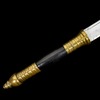
I have never seen this kind of Abyssinian sabre in "photographs with people". I would say it is neither gurade, nor shotel. It is much shorter (the example in the picture is 68 cms long) and also notably heavier (thick blade)and the pommel has always this particular shape. My idea is - either old type which was not photographed too much, or comming from the south (like Sidamo area). I am also enclosing the old pictures of the short sabre of the King Sahle Selassie and one old engraving of Abyssinian cavalryman with similar short sabre.
|

|

|
|
24th October 2017, 06:45 PM
|
#2 |
|
Member

Join Date: Jul 2006
Location: Buraimi Oman, on the border with the UAE
Posts: 4,408
|
The problem is that the evidence is a sketch thus up to the artist what he presented... in this case a possible Shotel either badly drawn with the forte missing ..or is this the result of a snapped sword redesigned more as a long dagger? The blade on the exhibit could be a straight Solingen ...imported then bent into a curve.

|
|
|
|
|
24th October 2017, 07:05 PM
|
#3 |
|
Member
Join Date: Jul 2006
Location: Buraimi Oman, on the border with the UAE
Posts: 4,408
|
The problem is that the evidence is a sketch thus up to the artist what he presented... in this case a possible Shotel either badly drawn with the forte missing ..or is this the result of a snapped sword redesigned more as a long dagger? The blade on the exhibit could be a straight Solingen ...imported then bent into a curve.
Please see below and where I couldnt get a print simply place the string into search
|
|
|
|
|
24th October 2017, 07:12 PM
|
#4 | |
|
Member
Join Date: Mar 2010
Location: Olomouc
Posts: 1,720
|
Quote:
This blade was obviously forged in the shape seen here. A lovely piece Martin, I agree this seems to be part of a subset of shorter curved blades. I find the thickness of the blade quite attractive an obviously well made and old item. The sketch of the king's sword seems to follow a similar profile, a pity the blade is not seen in the illustration. |
|
|
|
|
|
24th October 2017, 07:13 PM
|
#5 |
|
Member
Join Date: May 2008
Location: Czech Republic
Posts: 862
|
Ibrahiim, thank you for the first reaction. What I am 100 % sure: The blade is local, not imported, not made of snapped shotel. It is short, but classical stabbing with it is not too much practical due to its curvature. Except of one case: "to stab from behind". Because of its weight, I think, it is fatal slashing weapon. I already saw more sabres like this. (- as far as the design they are muchness and the length varries +- 5 cms)
|
|
|
|
|
24th October 2017, 07:22 PM
|
#6 |
|
Member
Join Date: May 2008
Location: Czech Republic
Posts: 862
|
Yes, I know classical shotels. Nevertheless their blade is always lighter, flatter and still (enerally) longer. There is also always difference it the hilt and style of pommel ...
|
|
|
|
|
24th October 2017, 07:30 PM
|
#7 |
|
Member
Join Date: Jul 2006
Location: Buraimi Oman, on the border with the UAE
Posts: 4,408
|
This is very interesting Martin, On looking carefully at the sketch I note all three men in front are wearing a weapon like this. Perhaps this is an entirely new weapon?
|
|
|
|
|
24th October 2017, 08:04 PM
|
#8 |
|
Member
Join Date: Jul 2006
Location: Buraimi Oman, on the border with the UAE
Posts: 4,408
|
This is very interesting Martin, On looking carefully at the sketch I note all three men in front are wearing a weapon like this. Perhaps this is an entirely new weapon?
On the other hand ~ It is interesting trying to fathom how this was used except for the fact it looks vicious and it could be stuck into someone...it seems over curved... but on looking at related battle fields was this a special weapon to hamstring horses...? see http://www.victorianmilitarysociety....e-19th-centuryQuote" On the way to relieve General Gordon at Khartoum, Count Gleichen (Guards Camel Corps) after the battle of Abu Klea, described the native weapons lying on the battle field thus: "Arms of all sorts and broken banner-staves were scattered over the field; spears in hundreds, some of enormous length, javelins, knobkerries, hatchets, swords and knives, I even found a Birmingham bill-hook, with the trade-mark on it, in an Arab's hand, sharp as a razor and covered with blood and hair: how it got there I know not, so I confiscated it for the use of our mess."Unquote. of knives it said ~ Quote" Knives offer the greatest variety in shape, decoration and materials used. They were double-edged and maintained at razor sharpness. The hooked blades were for hamstringing horses and transport animals, and were used with great effect against the 10th and 19th Hussars at El Teb."Unquote. |
|
|
|
|
24th October 2017, 08:11 PM
|
#9 |
|
Member
Join Date: May 2008
Location: Czech Republic
Posts: 862
|
I wouldn´t say new ... Nevertheless this specific form was not discussed. I wonder if favourers of Abyssinian staff (Roanoa ?) could add something or post photos ...
|
|
|
|
|
24th October 2017, 08:54 PM
|
#10 |
|
Member
Join Date: May 2008
Location: Czech Republic
Posts: 862
|
The quote is interesting. Thank you Ibrahiim !
|
|
|
|
|
24th October 2017, 09:33 PM
|
#11 |
|
Member
Join Date: Jun 2013
Posts: 2,145
|
This sword is the illegitimate daughter of a shotel and a gile... I will say Afar, in between Eritrea, Ethiopia and Somalia...
a long dagger or a short sword, with a touch of a dharia but Yemen is next door... 
|
|
|
|
|
24th October 2017, 09:41 PM
|
#12 |
|
Member
Join Date: May 2008
Location: Czech Republic
Posts: 862
|
Thank you Kubur. Afar gile is a light weapon in comparision with this (except of of the form of gile used by some Oromo tribes). This is probably not comming from Wollo or Somali regions. But frankly - somehow it is mystery even for Ethiopian antiquarians ...
|
|
|
|
|
25th October 2017, 03:47 PM
|
#13 |
|
Member

Join Date: Jun 2005
Posts: 243
|
I have two similar swords in my collection. Both are quite heavy. Locally made and not re-worked from shortened blades. Fortes are missing from most of locally made shotels. Lengths of the blades (straight line from tip to handle) are 20" and 21.5". One of the pommels is typical, while the other one appears to be the head of a black powder cartridge, maybe a French Gras. Though these swords are Abyssinian, I have no idea which ethnic group they are related to. Galla? Oromo? I doubt they would be from the low lands and desert areas (Danakil, Afar).
Cheers. |
|
|
|
|
25th October 2017, 11:13 PM
|
#14 | |
|
Member
Join Date: Jul 2006
Location: Buraimi Oman, on the border with the UAE
Posts: 4,408
|
Quote:
|
|
|
|
|
|
25th October 2017, 11:38 PM
|
#15 |
|
Arms Historian

Join Date: Dec 2004
Location: Route 66
Posts: 10,862
|
Excellent points! no forte on locally made blades! That one I completely forgot, and is a great indicator. It always amazes me that it seems so commonly held that native makers were producers of crudely made blades, at least to those relatively uninitiated in ethnographic weapons.
It is always interesting as well to see the notion that certain swords or types of weapons were restricted to certain tribes or groups, as well as to certain geographic regions. As Kubur has noted, influences and features of various weapons are often amalgamated into what frustrated collectors often regard as variants. While obviously we can largely classify certain forms to the regions where they have propensity, however movements of ethic groups through diaphanous borders which are the thing of maps remind me of the sage axiom. .... "weapons have no geographic borders". Roanoa, as always, your insight into the weaponry of these regions is great as you have been key in the study of this field for so many years. Interesting use of what may be a cartridge when the use of coins have always seemed to dominate this place on hilts of these regions. |
|
|
|
|
26th October 2017, 06:55 AM
|
#16 |
|
Member
Join Date: May 2008
Location: Czech Republic
Posts: 862
|
Thank you Roanoa for the additional pictures. I will investigate a little bit re. the origin. Till now I was of the opinnion that Galla was old name for Oromo ?
|
|
|
|
|
28th October 2017, 04:12 PM
|
#17 |
|
Member
Join Date: Jun 2005
Posts: 243
|
You are right, Martin. The Galla are in fact Oromo. I tend to use Galla for the more "primitive" clans within the Oromo ethnic group. At least up to and including the Italian invasion of Ethiopia of 1935/36 when many Galla clans (like the Azebo) sided with the Italian.
|
|
|
|
|
1st November 2017, 11:31 AM
|
#18 |
|
Member
Join Date: Jul 2006
Location: Buraimi Oman, on the border with the UAE
Posts: 4,408
|
|
|
|
|
 |
| Thread Tools | Search this Thread |
| Display Modes | |
|
|


 Linear Mode

