
|
 11th March 2006, 10:14 PM
|
#1 |
|
Member
Join Date: Dec 2005
Posts: 692
|
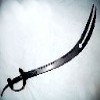
 My first dharb for comment
What do you think about my only and lonely Dha?
The hilt is rosewood wrapped with rattan. Verry well done. Good balance. Blade seems to be folded. |

|

|
|
11th March 2006, 11:25 PM
|
#2 |
|
Member

Join Date: Dec 2004
Location: Inland Empire, Southern California USA
Posts: 160
|

Congrats! Sweet Dha. Don't feel bad. I have only one Dha in my collection too. Your other pieces will keep it company. At least your one and only is a real nice one.
Best, Stephen* |
|
|
|
|
11th March 2006, 11:36 PM
|
#3 |
|
Member
Join Date: Dec 2004
Location: Virginia
Posts: 520
|
Congratulations on your first dha/darb. A word of warning though they are addictive.
|
|
|
|
|
11th March 2006, 11:45 PM
|
#4 |
|
Member
Join Date: Dec 2005
Posts: 692
|
Thanks Guys!
 What can you tell me about the origin? Is it a Thai piece or Burmese? Which tribe? Is it late 19th? |
|
|
|
|
12th March 2006, 01:34 AM
|
#5 |
|
Member

Join Date: Dec 2004
Posts: 987
|
I would say Thai. The slight waist, and the swelling toward the tip, are what you see in blades from Aranyik. Probably not terribly old, but its hard to tell from the photos if it is 5-years-old "not old" or 50-years-old "not old." Is that engraving on the blade, or grinding marks, or just distortion in the photo?
|
|
|
|
|
12th March 2006, 06:46 AM
|
#6 |
|
Member

Join Date: Jan 2006
Posts: 123
|
Looks like a sweet daab for sweet cutting! I use to have one like that, but the hilt was much better made, with thick brass guard and pomal. I heard that thing can pretty dangerous. I've heard of stories like people getting cut from the shoulder down toward the middle of the breast...typical cutting movement...and in the end the person is left with his shoulder and arm hanging from the side. Ofcourse, he would dead from the shear trauma, and maybe shock!

|
|
|
|
|
12th March 2006, 11:48 AM
|
#7 |
|
Member
Join Date: Dec 2005
Posts: 692
|
Certainly not 5 years old.
There are no engravings on the blade. I think that it was extensively cleaned by the previous owner  . There is still some rust on the blade near the hilt. . There is still some rust on the blade near the hilt.I'm attaching better photos. |
|
|
|
|
12th March 2006, 03:01 PM
|
#8 |
|
Member
Join Date: Nov 2004
Location: USA
Posts: 1,725
|
Ouch. That sure has seen too much grinding/sanding.
 Personally, since the blade has been abused so, I would try to polish it out. Personally, since the blade has been abused so, I would try to polish it out. What makes you think the blade has been folded? The blade is typically Thai in profile and, perhaps, our new members Titus and PUFF can confirm this. The handle is a bit unusual in my experience, and I like it. Interesting sword, congratulations. |
|
|
|
|
12th March 2006, 04:51 PM
|
#9 |
|
Member
Join Date: Dec 2004
Location: Greensboro, NC
Posts: 1,098
|
While the blade profile may suggest a Thai origin, might I offer the handle shape and materials used might suggest a Vietnamese origin. The way the handle tapers at the end of the grip makes me envision an ivory tusk that may have been there at one time that you sometimes see in Vietnamese Sabers. Also, the use of thick, heavy rattan is a feature found on some Vietnamese two-handers. Philip, I am sure, could add to the features of Vietnamese saber handles. This might be why the handle shape and materials are not seeming common to Thai swords.
|
|
|
|
|
12th March 2006, 05:35 PM
|
#10 | |
|
Member
Join Date: Nov 2004
Location: USA
Posts: 1,725
|

Quote:
|
|
|
|
|
|
12th March 2006, 06:27 PM
|
#11 |
|
Member
Join Date: Dec 2005
Posts: 692
|
Thank you all for the wonderfull debate
Andrew, I meant forged not folded, sorry. It is obviously hand made and there are some forging flaws to and it is not machine made blade nor it was cut out from a piece of steel. How do I polish the blade? |
|
|
|
|
13th March 2006, 07:51 AM
|
#12 |
|
Member
Join Date: Feb 2006
Location: 30 miles north of Bangkok, 20 miles south of Ayuthaya, Thailand
Posts: 224
|
The blade and handle seems a bit strange too me. The round plate with pins in front of ferrule 's uncommon for Dahb. The rattan 's a little thicker than ordinary Darb. And I guessed that the handle might be reconstructed/restored by local maker. Pictures are not very clear but the little black wrapping just before and after rattan grip looks like rattan rings. Rings are Separated hand-made and put on the handle. Then black resinous glue was applied. This means the handle might be made 40+ years ago.
Like horn and tusk, hardwood 's not material for battle sword. The handle could be made for household usage. May I have another picture for back part of the blade. One picture shows flat back profile with smoothen edges. Is s it tapered or just same thickness up to 3/4 of the blade? Although, the blade seems to be harden and need some polishing. The scratchs suggested that the steel 's fairly hard. I guessed that the material is either old leaf spring or medium carbon steel. IMHO, the blade was made in the post WWII era in Lampang (northern Thailand). It 's also possible that the blade was forged by a smith from another region (look carefully for a possible stamp on the blade) in the mid 20th cent. And the handle might be reconstructed by another maker. Could you please post colse-up of black wrapping and more picture of back profile of the blade. |
|
|
|
|
13th March 2006, 05:18 PM
|
#13 |
|
Vikingsword Staff

Join Date: Dec 2004
Location: The Aussie Bush
Posts: 4,714
|
N. Thai perhaps
I've been slow to get to this one because the hilt is a little strange.
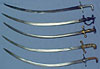
Going back to my own examples of N. Thai/Lao dharb, I found a similar example where the rattan had been wrapped (rather than plaited in rings) around the hilt. So I think this is an example of N. Thai or nearby Lao work. The assembly of the hilt and blade of the sword above is probably not very old. The materials in the handle look recent. The blade may be older. The small metal plate, referred to already, attached by pins to the base of the hilt next to the blade is a feature seen on several recently made Thai dharb, and even on some higher grade, old examples. Not all that unusual. The blade is clearly in the style of recently made Thai dharb, although there are older examples (early 20th C and maybe late 19th C) with a similar blade profile. I don't think this sword is a Cochin saber. The protruding piece of wood at the end of the hilt does resemble that style, but similar features can be found on Thai and Burmese examples also, especially when a terminal ferrule has been lost. Attached below is a picture of two swords. The top one is Lao and the bottom one, which has a rattan wrap similar to the sword that started this discussion, is from Chiang Mai in northern Thailand. Incidentally, both of these swords have small metal plates at the end of the hilt adjacent to the blade. Larger pictures of th Chiang Mai dharb and its hilt are shown. The bare wooden area of the hilt shows where the rattan has broken off and how the binding was attached with black pitch or a similar resin. Ian. Last edited by Ian; 13th March 2006 at 05:42 PM. Reason: Added pictures |
|
|
|
|
13th March 2006, 05:33 PM
|
#14 |
|
Member

Join Date: Dec 2004
Location: What is still UK
Posts: 5,988
|
Hello Puff,
I always thought these were of a common form and construction, many arriving in the UK between 1940s-1950s. Tim Last edited by Tim Simmons; 13th March 2006 at 07:19 PM. |
|
|
|
|
13th March 2006, 05:37 PM
|
#15 |
|
Member
Join Date: Dec 2005
Posts: 692
|
Thanksfor the info Puff, here are the photos.
Everything on that sword is verry quality made. The black wrapping is rope binding. The blade is quite thick -6mm. The blade is 56 cm long. Wideness: 4 cm at the widest point near the tip and 3 cm at the hilt. Overall lenght is 85 cm. I like thatone verry much and the handle is one of the more attractive I've seen on a non silver mounted dha, I'm not an expert thou. From my point of view it is a great fighting weapon (I've chosen it in the home defence post  ) Great balance and nice cutter. It feels verry good managing it. What do you mean by household use? ) Great balance and nice cutter. It feels verry good managing it. What do you mean by household use?
|
|
|
|
|
13th March 2006, 06:44 PM
|
#16 |
|
Member
Join Date: Dec 2004
Posts: 987
|
Puff asked one key question I had on my mind, namely the spine width. From the photo it appears fairly thick near the handle. How much does it taper in thickness toward the tip, and how quickly? It is typical to see a 1/3-1/2 cm thinkness to the blade near the handle, which narrows over about the first half of the length down to just a few millimeters. At the tip the thickness is usually little more than that of the edge itself. This is a very characteristic feature of dha/daab. It looks like yours has a pretty good taper.
I hesitated to make a comparison, but the only daab I have handled with this kind of a handle wrap is one of my own which was one made with a uniformly (more-or-less) thick blade, such as you would see in a nihon-to. My blade was clearly home-made and by someone who was not very well-informed about how one should be made -- a bad e-bay purchase . The uniformly-thick blade makes it very tip-heavy, which is not correct for a daab (the POB on a dha/daab should be just a few inches in front of the grip). It also has the plate attached with four nails. So, I am glad that Ian has seen others with this kind of wrapping which are "legitimate." PS: I think the black wrapping on the grip is cord, not rattan, since it is twisted rather than braided. |
|
|
|
|
13th March 2006, 07:43 PM
|
#17 |
|
Member
Join Date: Dec 2005
Posts: 692
|
The thickness is kind a uniform:
- 6mm at the hilt - 5mm at the first 1/3 - 4mm at the second third - 3mm is max - again 4mm near the tip Yes the wrapping is cord. Tim, yours is verry similar, at least the wrapping, to one in my possesion wich is touristic piece I think. It has nothing to do compared with the other one in quality. pls refer to the fotos 2 and 3. Ian, beautifull pieces! I like thoose.Another thing that I've forgot to mention. all the materials of the hilt seems old to me and the clear ratan binding was painted reddish brown sometime, there is still some little pieces of the laquer falling from it. |
|
|
|
|
13th March 2006, 09:21 PM
|
#18 | |
|
Member
Join Date: Jan 2006
Posts: 123
|
Quote:
|
|
|
|
|
|
14th March 2006, 01:46 AM
|
#19 |
|
Member
Join Date: Dec 2004
Posts: 987
|
Are you saying that the thickness of the blade was greater in the middle (when you look straight down at the edge, I mean)? I have never seen that in a daab. I have always seen them with a thick spine at the handle, some thicker than others, tapering quickly in the first 1/3 or so of the blade, then more gently to the tip.
I'd like to see photos of yours, if you still have it.
|
|
|
|
|
14th March 2006, 03:16 AM
|
#20 | ||
|
Member
Join Date: Nov 2004
Location: USA
Posts: 1,725
|
Quote:
 Quote:
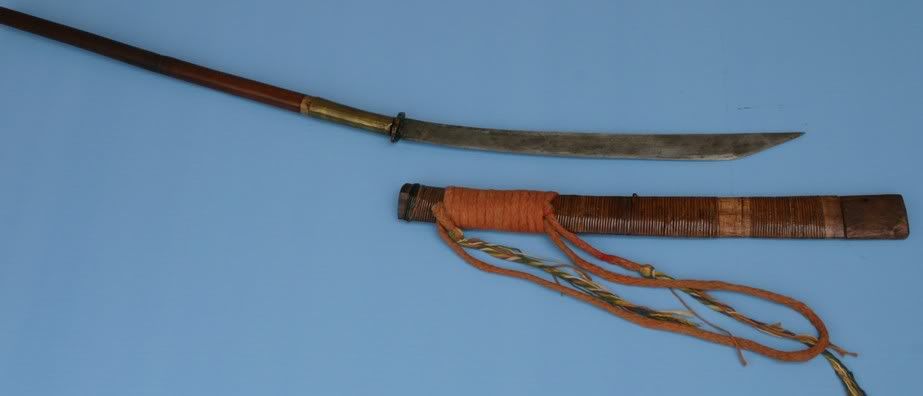
I don't think the end of the handle is missing as we so often see. I believe this is an intentional feature, evidenced by the wrapped cord ferrules flanking the grip. |
||
|
|
|
|
14th March 2006, 06:18 AM
|
#21 | |
|
Member
Join Date: Jan 2006
Posts: 123
|
Quote:
|
|
|
|
|
|
14th March 2006, 04:11 PM
|
#22 |
|
Member
Join Date: Feb 2006
Location: 30 miles north of Bangkok, 20 miles south of Ayuthaya, Thailand
Posts: 224
|
I don't think bottom cap was missing. Here 's an example of a similar handle. The dahb 's from south Lanna (Utaradit province). My "Household Dahb" means "Dahb" for home defence not for army. 
|
|
|
|
|
15th March 2006, 06:24 AM
|
#23 |
|
Member
Join Date: Feb 2006
Location: 30 miles north of Bangkok, 20 miles south of Ayuthaya, Thailand
Posts: 224
|
The matter of spine tapering 's quite important. I 'd studied some speciments with single tapered, double tapered and untapered.
Single tapered blades usually associate with folded steel. Blades has little or no belly which were ID as older blade (early-mid Ayuthaya). More recent one has double tapered spine which are highly tapered at the base (first 1/4 at the base) and then gently tapered from the rest to the tip. This style can be found in late Ayuthaya to Mid Rattanakosin. Many sword have a ring at the middle of the handle. The ring indicates site to put index and middle fingers on. In many case, modern Thai swords could be both untapered or tapered up to any point tip, belly or from 1/2 to tip. Plain steel sheet (HC or spring) are materials of choice. Then belly part 's forged out. This cause thinner blade near the forged out belly. Bigger belly and upward tip style became popular for Krabi-Krabong practice. Since balance 's moved forward, its grip has to move up, close to furrule. Last edited by PUFF; 15th March 2006 at 08:37 AM. |
|
|
|
|
15th March 2006, 05:57 PM
|
#24 |
|
Member
Join Date: Dec 2005
Posts: 692
|
hmmm...
If you are saying that my darb is not pristene, I can say only that I like it verry much and (as you said before for another darb) it trully feels alive in the hands. Mark... Your page is I-MPRE--SS-I-VE I'm not so sure what taper-tapering means... Could someone explain me more precisely? Thanks! |
|
|
|
|
15th March 2006, 09:57 PM
|
#25 | |
|
Member
Join Date: Dec 2004
Posts: 987
|

Quote:
Most blades have what Puff is calling a "single taper," meaning that the thinning of the blade is at a pretty even rate, while most dha have a "double taper" (good terms, by the way -- I definately am going to use them ), meaning that there are different rates of thinning along the length of the blade.Imagine holding a sword straight up, in front of you, with the spine directly towards you and the edge away, tip pointing up. A "single taper" blade will have a profile like a very long, thin triangle, with essentially straight sides. A "double taper" blade will have curved sides, slanted toward each other more at the base of the blade, then gradually gradually becoming more parallel, like the outline of the Eiffel Tower. If you look on my web site I have for many of the swords measurements of the blade thickness in four places: at the forte (base), 1/3 of the way to the tip, 2/3 of the way to the tip, and basically at the tip. You can generally see that the width of the blade decreases a lot in the first 1/3 of the blade, usually by more than half, and by the second third of the length has almost reached the full taper seen at the tip. You can see it pretty well in this photo:  The spine is almost a centimeter wide, 95 mm, at the base, and tapers to only about 15 mm at the tip over a blade length of about 50 cm. But about 3/4 of that taper happens within about 10 cm from the forte. Since dha and daab generally do not have a heavy pommel to counter-balance the weight of the blade, this kind of double taper moves the point of balance back toward the grip instead, actually further back than your typical Western or Japanese sword, which makes the blades very light in the tip and "fast." |
|
|
|
|
|
15th March 2006, 10:57 PM
|
#26 |
|
Member
Join Date: Nov 2004
Location: USA
Posts: 1,725
|

Alright, since this has turned into a show-and-tell, I'm going to split the thread to prevent any further hijacking of Vlajhun's topic.
|
|
|
|
|
15th March 2006, 11:12 PM
|
#27 | |
|
Member
Join Date: Dec 2004
Posts: 987
|
 oops ...
 Quote:
|
|
|
|
|
|
16th March 2006, 02:31 AM
|
#28 |
|
Member
Join Date: Feb 2006
Location: 30 miles north of Bangkok, 20 miles south of Ayuthaya, Thailand
Posts: 224
|
Your Dahb 's supposed to be alive. It was carefully made for home/self defence purpose, not for only practice. From the way he apply black pitch/resin, I think the smith/maker did the best of his knowledge.
Like Ian said, the little metal plate 's not that uncommon. But from my exp. it is usually associated with metal encased handle (for older metro sword) or metal ferrule (modern one). This also shows that the smith put efforts on his craft.
|
|
|
|
|
16th March 2006, 03:13 AM
|
#29 | |
|
Member
Join Date: Nov 2004
Location: USA
Posts: 1,725
|
Quote:
|
|
|
|
|
|
16th March 2006, 03:27 AM
|
#30 |
|
Member
Join Date: Feb 2006
Location: 30 miles north of Bangkok, 20 miles south of Ayuthaya, Thailand
Posts: 224
|
By means of Shan/Metro classification (I 'm quite newbie for your western system
). Do I use it in context? Feel free to correct me  Valjhun, since your sword require higher grip, you will need a right art/technique to use it properly. Modern Krabi-Krabong will do.    
Last edited by PUFF; 16th March 2006 at 04:43 AM. |
|
|
|
 |
| Thread Tools | Search this Thread |
| Display Modes | |
|
|


 Linear Mode

