
|
|
|
 21st July 2016, 09:15 PM
|
#1 | |
|
Member

Join Date: Sep 2014
Location: Austria
Posts: 1,918
|

Quote:
Mine is definitely much younger. Maybe 19th century... |
|

|

|
|
21st July 2016, 11:48 PM
|
#2 |
|
Member
Join Date: Feb 2014
Posts: 468
|
Ibrahiim al Balooshi, thank you for the link to the Caravana collection. I have yet to explore it in any depth, but even a cursory scan is enough to appreciate its value. Breathtaking stuff, the existence of which amazes and confounds.
Much appreciated. |
|
|
|
|
22nd July 2016, 01:08 AM
|
#3 |
|
Member
Join Date: Dec 2004
Location: Ann Arbor, MI
Posts: 5,503
|
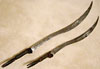
Here is one of my pulouars.
The other one is wootz, but the blade is flat, with no grooves. |
|
|
|
|
22nd July 2016, 02:54 AM
|
#4 |
|
Arms Historian

Join Date: Dec 2004
Location: Route 66
Posts: 10,852
|
Outstanding comments and discussion!
On the 'tears of the wounded' and other descriptions of these blade channels holding bearings, it seems generally held that these were typically 'court or parade' weapons. I have seen references suggesting that these channels would likely compromise the blade in combat situations, though I am sure that might be contested. The term 'pearls' is figurative as these are typically metal bearings. It is great to see these examples of 'paluoar' in their original rugged condition, which to me truly holds the intrinsic frontier character of the regions from which they come. While it is tempting to consider the often crude nature of some of the components and blades of many of these swords as 'fakery', it must be remembered that frontier armourers often used whatever items and skills however limited, to create arms for tribal use. While it seems these were indeed originating from some time in the 18th century, the scabbard with the asymmetrical carry rings (one on scabbard front) is similar to the latter 19th century Anglo-Afghan military swords. The parabolic Persian type shamshir blade on the example Ariel shows reflects the profound preference toward many Persian arms in these regions. |

|
|
|
22nd July 2016, 05:55 AM
|
#5 |
|
Member
Join Date: Dec 2004
Location: Ann Arbor, MI
Posts: 5,503
|
I remember a treatise on the origins of the Afghani " regulation khyber", where this and similar examples were presented as the very last step in the purported "evolution" and attributed to the very last years of the 19th century, the ultimate achievement of the Mashin Khana that was established in 1887. Ironically, the very same communication showed a photograph of a gentleman named Mohammed Yakub Khan dated 1879 carrying a similar sword. Thus, the supposedly final evolutionary step was in fact the earliest one
Darwin would have had a fit:-))) |
|
|
|
|
22nd July 2016, 08:19 AM
|
#6 | |
|
Arms Historian
Join Date: Dec 2004
Location: Route 66
Posts: 10,852
|
Quote:
I recall finding the image of Mohammed Yakub Khan in the book "Northwest Frontier" by Swinson many years ago, and indeed he is wearing a sword with remarkably similar hilt. The paper sought to discover, much as I had, to find the origin of these distinctly European military styled hilts, and that date seemed to place the earliest, though the Mashin Khana examples seem not to occur until later than the 1879 date. So where did that hilt which is in the 1879 photo come from? and why did it not appear in production until advent of that Kabul armoury? It seems that tribal 'Khybers' (salwars) occurred in the interim between 1879 and the noted inception of the Mashin Khana factory with these hilts, but likely quite near it as many of them have the stamp known used by it. At this time, the heavy channeled military type blades began being placed on these. It is believed these 'military' hilted Khybers were probably for some of the tribal levy's in British service in these times. An interesting aside to looking more into the equally and often misperceived paluoars . I guess we here are sort of Darwinian sword whisperers 
|
|
|
|
|
|
23rd July 2016, 08:27 PM
|
#7 | |
|
Member
Join Date: Nov 2009
Location: Russia
Posts: 1,042
|
Quote:
|
|
|
|
|
|
24th July 2016, 03:41 AM
|
#8 |
|
Arms Historian
Join Date: Dec 2004
Location: Route 66
Posts: 10,852
|
My apologies, my notes on the photo I referred to were incorrect.
What I meant was the photo by John Burke at the signing if the Treaty of Gandamak, 26 May, 1879. King Mohammed Yaqub Khan seated at center, on his left is Daoud Shah, his commander in chief......and my notation was to the distinct style of his hilt with the open parallel bar knuckleguard, recurved terminal at top. It is thought that this hilt was possibly a prototype for the military style hilts which were to be produced at the Mashin Khana at Kabul in the early 1890s. As seen in other photos, this style hilt is also to be found on the traditional Khyber blades, often with the 'Mazir I Sharif' stamp of Mashin Khana. The heavily channeled European style blade (also pictured) became the more regularly produced model into turn of the century. Later many of the hilts were in brass, but with this distinctive 'bayonet style' hilt. It seems that these Khyber bladed examples with military style hilts as pictured, may have been for some of the tribal levy's using traditional blades but with these Anglo-Afghan hilts. The styling of the slotted knuckle guard seems to correspond to some styling on a number of paluoars as well as tulwars from these regions in the Northwest Frontier into Afghanistan. The theme of the paper discussed the integration of the traditional blades and military style hilts as well as seeking the origins of the design, with the example of similar style in the sword of Daoud Shah in 1879 representing earliest known placement of its form. As I understood the title noting 'regulation Khyber' referred to the development of these military Afghan swords as well as their use with traditional Khyber blades in the tribal contingents . |
|
|
|
|
22nd July 2016, 06:06 AM
|
#9 | |
|
Member

Join Date: Jun 2012
Location: USA
Posts: 1,492
|
Quote:
|
|
|
|
|
|
22nd July 2016, 07:24 AM
|
#10 | |
|
Member
Join Date: Sep 2014
Location: Austria
Posts: 1,918
|
Quote:
They are straight (more or less) albeit irregular and crudely made. They definitely don't have the curves with very short curvature radius and the drilled holes at the beginning of the groove. Nor they display the obvious variation in depth. Completely different stuff than the grooves in question. The grooves are not remotely close. |
|
|
|
|
|
22nd July 2016, 09:18 AM
|
#11 | |
|
Member
Join Date: Jun 2012
Location: USA
Posts: 1,492
|
Quote:
|
|
|
|
|
|
23rd July 2016, 01:18 PM
|
#12 |
|
Member

Join Date: Jul 2006
Location: Buraimi Oman, on the border with the UAE
Posts: 4,408
|
To magnify and examine The Ethnographic I saw some early photos; Illustrating Afghan swords...The sketch shows some Baluch and Afghan irregulars... armed.... with everything!
Below this the largest/longest photo stars Yakub Khan at the centre with the description below. (The smaller photo of one of his officers is included separately to view better the sword.) For interest The small black and white picture shows the camp at Safed Sang. Quote from....https://commons.wikimedia.org/wiki/F...s_officers.jpg Group. The Amir Yakub Khan & sirdars of Kabul [At Safed Sang]. Photograph featuring Yakub Khan, the Amir of Afghanistan, seated in the centre, and his officers, taken in May 1879 by John Burke at Safed Sang in Afghanistan. The six foot tall Daoud Shah, from the Ghilzai tribe, his commander-in-chief, sits at the Amir's right. To the Amir's left is Habibullah Khan, the moustafi or prime minister. Burke accompanied British forces into Afghanistan in 1878 and covered the events of the Second Anglo-Afghan War (1878-80), becoming the first significant photographer of the country and its people in the process. The British, having defeated the Amir Sher Ali's forces, wintered in Jalalabad, waiting for the new Amir Yakub Khan to accept their terms and conditions. One of the key figures in the negotiations was the military administrator Pierre Louis Napoleon Cavagnari (1841-1879), a half-Irish, half-Italian aristocrat who was appointed as emissary by the Viceroy Lord Lytton. In May 1879, Yakub Khan travelled to Gandamak, a village just outside Jalalabad and entered into negotiations with Cavagnari as a result of which the Treaty of Gandamak was signed whereby the Amir ceded territories to the British and accepted a British envoy in Kabul. Cavagnari took up the post of British Resident in Kabul in July 1879. He was known to be reckless and arrogant rather than discreet and his role as envoy was viewed as injudicious even by some of the British. The situation in Kabul was tense and eventually some Afghan troops who had not been paid by the Amir rebelled and attacked the Residency, killing Cavagnari and his mission in September 1879. The war was far from over despite the treaty and British troops were recalled over the mountains to occupy Kabul, secure it and launch punitive action against the Afghans. Yakub Khan abdicated, taking refuge in the British camp and was subsequently sent to India in December."Unquote. Last edited by Ibrahiim al Balooshi; 23rd July 2016 at 05:43 PM. |
|
|
|
 |
| Thread Tools | Search this Thread |
| Display Modes | |
|
|


 Hybrid Mode
