
|
|
|
 21st July 2016, 08:50 PM
|
#1 |
|
Member

Join Date: Sep 2014
Location: Austria
Posts: 1,918
|

Your arguments appear to hold well, and I trust you guys are more experienced than me (it would be hard not to).
However, you have seen my arguments and explanations from the mechanical point of view. And unless I have another good explanation on how those grooves were made, I will still be convinced it is a recent fake.  The argument there are many blades with grooves like this is not very valid as 1. maybe there aren't that many 2. maybe all that are, are fakes. Indians started faking weapons since 19th century. Anyhow it would be quite boring if we all agree... right?! 
|

|

|
|
21st July 2016, 09:01 PM
|
#2 |
|
Member

Join Date: Jul 2006
Location: Buraimi Oman, on the border with the UAE
Posts: 4,408
|
I have a few pictures to compare with the #1 sword...The two swords at the top can be seen sold on https://new.liveauctioneers.com/item...-afghan-swords
In respect of the lower pictures against a black backdrop ~The webpage says at http://honoomasamune.tumblr.com/ Quote" Pulouar Sword Dated: circa 1676 - 1725 Culture: Indian/Afghan Medium: steel, gold Measurements: overall length 97 cm; blade length 83 cm The Pulouar is an Afghan sword, also used in India, a variant of the Tulwar. It always displays a short guard, curved in the direction of the blade, and a hemispheric pommel without a counter guard. This piece displays a blade in watered steel, curved and with a slight wave in its double edge. Near the hilt a golden cartouche is desplayed with the following inscription: “Akbar Sha al-Sultan Mirza”. The hilt, also in steel, displays a spherical pommel completely covered in an engraved web motif and geometrical patterns. The hand guard features a delicate swan head on the pommel, also engraved, an inscription with the “Ali”, followed by the sentence “nasr min Allah wa il-fath qrabi.”Unquote. Last edited by Ibrahiim al Balooshi; 21st July 2016 at 09:16 PM. |
|
|
|
|
21st July 2016, 09:15 PM
|
#3 | |
|
Member
Join Date: Sep 2014
Location: Austria
Posts: 1,918
|
Quote:
Mine is definitely much younger. Maybe 19th century... |
|
|
|
|
|
21st July 2016, 11:48 PM
|
#4 |
|
Member
Join Date: Feb 2014
Posts: 468
|
Ibrahiim al Balooshi, thank you for the link to the Caravana collection. I have yet to explore it in any depth, but even a cursory scan is enough to appreciate its value. Breathtaking stuff, the existence of which amazes and confounds.
Much appreciated. |
|
|
|
|
22nd July 2016, 01:08 AM
|
#5 |
|
Member
Join Date: Dec 2004
Location: Ann Arbor, MI
Posts: 5,503
|
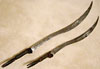
Here is one of my pulouars.
The other one is wootz, but the blade is flat, with no grooves. |
|
|
|
|
22nd July 2016, 02:54 AM
|
#6 |
|
Arms Historian

Join Date: Dec 2004
Location: Route 66
Posts: 10,852
|
Outstanding comments and discussion!
On the 'tears of the wounded' and other descriptions of these blade channels holding bearings, it seems generally held that these were typically 'court or parade' weapons. I have seen references suggesting that these channels would likely compromise the blade in combat situations, though I am sure that might be contested. The term 'pearls' is figurative as these are typically metal bearings. It is great to see these examples of 'paluoar' in their original rugged condition, which to me truly holds the intrinsic frontier character of the regions from which they come. While it is tempting to consider the often crude nature of some of the components and blades of many of these swords as 'fakery', it must be remembered that frontier armourers often used whatever items and skills however limited, to create arms for tribal use. While it seems these were indeed originating from some time in the 18th century, the scabbard with the asymmetrical carry rings (one on scabbard front) is similar to the latter 19th century Anglo-Afghan military swords. The parabolic Persian type shamshir blade on the example Ariel shows reflects the profound preference toward many Persian arms in these regions. |
|
|
|
|
22nd July 2016, 05:55 AM
|
#7 |
|
Member
Join Date: Dec 2004
Location: Ann Arbor, MI
Posts: 5,503
|
I remember a treatise on the origins of the Afghani " regulation khyber", where this and similar examples were presented as the very last step in the purported "evolution" and attributed to the very last years of the 19th century, the ultimate achievement of the Mashin Khana that was established in 1887. Ironically, the very same communication showed a photograph of a gentleman named Mohammed Yakub Khan dated 1879 carrying a similar sword. Thus, the supposedly final evolutionary step was in fact the earliest one
Darwin would have had a fit:-))) |
|
|
|
|
22nd July 2016, 06:06 AM
|
#8 | |
|
Member

Join Date: Jun 2012
Location: USA
Posts: 1,492
|
Quote:
|
|
|
|
|
|
22nd July 2016, 07:24 AM
|
#9 | |
|
Member
Join Date: Sep 2014
Location: Austria
Posts: 1,918
|
Quote:
They are straight (more or less) albeit irregular and crudely made. They definitely don't have the curves with very short curvature radius and the drilled holes at the beginning of the groove. Nor they display the obvious variation in depth. Completely different stuff than the grooves in question. The grooves are not remotely close. |
|
|
|
|
 |
| Thread Tools | Search this Thread |
| Display Modes | |
|
|


 Hybrid Mode
