
|
 17th May 2016, 08:54 AM
|
#31 |
|
Member

Join Date: Mar 2006
Location: Room 101, Glos. UK
Posts: 4,286
|

glad you finally got it. interesting sword. i have a kaskara coming from france to the UK, shipped 5 days ago via colissimo. tracking says it' in switzerland.hope i do better with it's delivery.
here's a cyrillic alphabet from bulgaria - note the nackwards Ns are western Is the 'Z' apears to be an earlier form of the modern cyrillic 'З', ='Ze'. not sure what that last letter would be. could be an early version of whatever. i'm not versed in ancient non western alphabets, of which there are a zillion. i flipped the sword to make it easier to see Last edited by kronckew; 17th May 2016 at 09:37 AM. |

|

|
|
17th May 2016, 01:21 PM
|
#32 |
|
Member
Join Date: Nov 2013
Posts: 456
|
Hopefully someone can make heads or tails of it.
I can't find my good camera but here are two more pictures I took from my phone. Assuming it is Cyrillic, and the backwards N's are I's and the C's are S's, maybe it says Zmissia or Zaissia? That second character could be an A, an M, or maybe a Yus https://en.wikipedia.org/wiki/Yus Last edited by blue lander; 17th May 2016 at 05:54 PM. |
|
|
|
|
17th May 2016, 09:21 PM
|
#33 |
|
Member
Join Date: Nov 2013
Posts: 456
|
Markings on a Takouba-mounted European Backsword
Hi,
I posted this on the ethnographic side, but as the blade appears to be European I've started a thread on this end. The blade only has two markings on it. One is the writing, apparently in cyrillic or a related alphabet. The other is two clusters of three dots. There was probably something in between the dots, but corrosion removed it. Any thoughts on what the blade says or where it came from? |
|
|
|
|
18th May 2016, 07:15 AM
|
#34 |
|
Arms Historian

Join Date: Dec 2004
Location: Route 66
Posts: 10,867
|
Good call to cross post this here Blue Lander! I honestly don't think a lot of the guys on the Ethnographic side read or post over here as they do not see the connection between these fields. The very reason we did start this forum is because of the profound connections between European weapons/blades and ethnographic.
Ironically, one obvious reason for Briggs' outstanding work on European blade markings (JAAS, 1965) is because of their presence in Saharan takouba. First inclinations on this blade is probably Italian, 18th century schiavona blade, in any case certainly European and of that vintage. This is a most interesting marriage of backsword blade to takouba, as obviously the standard was broadsword blades. However, many takouba were mounted in later incarnations with very old blades, which sometimes were military backswords etc. I have seen 19th century blades even by Mole in some, which is uncommon to see English blades in takouba. It seems also that native artisans have sometimes tried to duplicate European lettering in blades acquired, one with awkwardly applied letters seemed to attempt approximating ANDREA (Ferrara) but it is hard to tell as the 'A's are all really discernible. This inscription seems to have a '2' then some letters which could be 'A's (?) and the backwards 'N's are temptingly like Cyrillic letter. However that seems wildly out of context. It seems I have seen a mix of numeral and disconnected letters on a blade in Arabian context seemingly replicating European marks, and numbers of these Italian blades may have entered North African trade routes during their colonial activities in Sudan and Ethiopia end of 19th into pre WWII. I hope someone out there can either recognize this or place a more tangible explanation beyond these speculations 
|
|
|
|
|
18th May 2016, 10:25 AM
|
#35 |
|
Member

Join Date: Jul 2006
Location: Buraimi Oman, on the border with the UAE
Posts: 4,408
|
I note the appearance in this line of capitals of two Majescule A which may be compared with The Odd Sword ,,,marks... http://www.vikingsword.com/vb/showth...ighlight=sword
 As far as I could deduce the letters were A 5 I IJ IJ A with two Majescule A one at each end of the string of letters. Last edited by Ibrahiim al Balooshi; 18th May 2016 at 11:35 AM. |
|
|
|
|
18th May 2016, 11:23 AM
|
#36 | |
|
Member
Join Date: Jul 2006
Location: Buraimi Oman, on the border with the UAE
Posts: 4,408
|
Quote:
Jim there appear to be two A in Majescule gothic style..with a few letters between them and an unusual 2 at the front. This coincides roughly with the sword letters format at Odd Sword which makes me think they could be from the same region/related. I have to say that an awful lot of stuff has been left somewhat stranded on the other forum including very important posts from members ...I don't disagree with posting on European ...quite the reverse... but would it not be better having the whole thread please? Last edited by Ibrahiim al Balooshi; 18th May 2016 at 11:40 AM. |
|
|
|
|
|
18th May 2016, 01:18 PM
|
#37 |
|
(deceased)
Join Date: Dec 2004
Location: Portugal
Posts: 9,694
|
An unsupported theory would be that, there is no cyrillic involved here. The mirror atitude of the N could just be the smith's fantasy ... or illiteracy.
Reading the lettering straight forward, we would have ANCONA which is the name, for one, of a city and province in center Italy, somehow related with Roman era history, ancient weapon archeology and the like. Would there be swordmaking over there during the age of the blade in discussion ? ... Notwithstanding this is a silly approach  . .
|
|
|
|
|
18th May 2016, 08:50 PM
|
#38 | |
|
Arms Historian
Join Date: Dec 2004
Location: Route 66
Posts: 10,867
|
Quote:
Silly? Silly is the editorial page on artwork now reaching classic proportion on the other forum! There are a number of approaches to analysis of markings, and while your observation using Occams Razor is quite viable, sometimes things are not what they seem. |
|
|
|
|
|
19th May 2016, 10:33 AM
|
#39 |
|
Member
Join Date: Mar 2006
Location: Room 101, Glos. UK
Posts: 4,286
|
re: my earlier worry about colissimo. my short takouba sword shipped this last friday p.m. from the paris area, went to switzerland. got a note from the service delivering it last night that they'd deliver sometime today. here bright and early just before 8a.m. so it took about4+ days. colissimo shows it as being at the local delivery co.'s warehouse. guess they've not got the word yet.

|
|
|
|
|
19th May 2016, 01:21 PM
|
#40 |
|
Member
Join Date: Nov 2013
Posts: 456
|
This is the only other marking on the blade. Two triangles of three dots. If there was anything written between them it was already eaten by corrosion. They're right after the ricasso and right before the writing.
|
|
|
|
|
19th May 2016, 02:15 PM
|
#41 |
|
(deceased)
Join Date: Dec 2004
Location: Portugal
Posts: 9,694
|
It looks like the symbol interpreted by some as a "2" could be a "Z", which would make the inscription be ZANCONA, another city in Tuscana Italy.
Surprizingly (or not) blue lander was aware of the "Z" letter assumption, although he has quoted the seller description in the Ethno forum thread as being ZACONA, whereas this (seller) has described it as ZANCONA. Things getting a bit mixed up .
|
|
|
|
|
19th May 2016, 02:20 PM
|
#42 |
|
Member
Join Date: Nov 2013
Posts: 456
|
The seller's description of the blade was "ZACONA TOSCANIA" but I don't see toscania written anywhere on the blade. I don't know where he got that from.
|
|
|
|
|
19th May 2016, 02:34 PM
|
#43 |
|
(deceased)
Join Date: Dec 2004
Location: Portugal
Posts: 9,694
|
No mistery; he has certainly seen in the web, or already knew it himself, that ZANCONA is in Toscania. Joining both names in the announcement was merely a seller trick, i would say
.
|
|
|
|
|
19th May 2016, 02:45 PM
|
#44 |
|
Member
Join Date: Jul 2006
Location: Buraimi Oman, on the border with the UAE
Posts: 4,408
|
There is some notion suggested that the Zancona attribution may be an effort in waffle added by the seller... Notwithstanding that~ I see the interesting design decoration to the cuff at the throat which seems to be a snake style decor... The three dots appear to one side of the blade possibly a Talisman or...??
|
|
|
|
|
19th May 2016, 03:45 PM
|
#45 |
|
Member
Join Date: Nov 2013
Posts: 456
|
I assume those carvings were added when this was converted to a Takouba, but I suppose there's no proof they weren't original...
|
|
|
|
|
19th May 2016, 07:06 PM
|
#46 |
|
Arms Historian
Join Date: Dec 2004
Location: Route 66
Posts: 10,867
|
It seems to me that this well patinated blade is certainly European and in my view of 18th c. That it is a straight backsword with these numerous fullers suggests to me it is Italian. While cavalry blades of the time were straight backsword type, and often Solingen, these triple fullers were usually on sabre blades at the back of the blade, but not that I recall on British or German.
The schiavona was used as a cavalry sword much more widely than often realized, using back sword blades well into the 19th century. The letters used in this inscription seem too disassembled to have been an originally applied marking, and the letters 'N' are backwards, in Italy other inscriptions show the 'N' marked correctly. The triple dots are of course a well known component on European swords in groupings such as the well known 'sickle' marks. The 'snake' with dots is also a known motif on European blades, but usually on the blade only. This area of the blade to me looks like an 'adabal', a metal plate sandwiched at the ricasso of takoubas in many cases, and the application of these European markings along with the letters etc. seem more convincingly a pastiche by a native artisan. While the matching of known Italian names of cities etc, is of course tempting to the unusually formed lettering, it is important to note that there was a long standing penchant with some Italian makers in earlier times to use groupings of incongruent letters in marking blades. In these cases, makers such as Caino and Picinino placed these in arranged sequences, but seemed to make no sense. While these may have been acrostics, as often done with invocations, some have never been interpreted. |
|
|
|
|
19th May 2016, 09:53 PM
|
#47 |
|
Member
Join Date: Nov 2013
Posts: 456
|
between the regular ricasso and the sandwiched bit, the original ricasso on this blade would have been about 5 inches long!
|
|
|
|
|
20th May 2016, 04:34 AM
|
#48 |
|
Member
Join Date: Dec 2004
Location: Bay Area
Posts: 1,770
|
I doubt the letters are Cyrillic.
Sincerely, Teodor |
|
|
|
|
21st May 2016, 02:28 PM
|
#49 |
|
Member
Join Date: Jul 2006
Location: Buraimi Oman, on the border with the UAE
Posts: 4,408
|
Lopoking across the broad variety of alphabets I see that the Majescule A occurs in Coptic. The reverse N in Tuareg and the 3 dots in ...
|
|
|
|
|
21st May 2016, 02:42 PM
|
#50 |
|
Member
Join Date: Jul 2006
Location: Buraimi Oman, on the border with the UAE
Posts: 4,408
|
Lopoking across the broad variety of alphabets I see that the Majescule A occurs in Coptic. The reverse N in Tuareg \tifinaghe and the 3 dots. I seem to get the impression that any sequence of capitals will suffice and letters and numerals from a mixture of countries across the broad sweep of Tuareg domains was possible...
|
|
|
|
|
21st May 2016, 09:01 PM
|
#51 |
|
Arms Historian
Join Date: Dec 2004
Location: Route 66
Posts: 10,867
|
WOW!
Good catch Ibrahiim!! There is that curious N in Tifinagh, and the others. That would explain these lettering anomalies which are found on numerous 'nimcha' blades as well as others in Saharan context. The squiggled lines and dots are found on Sudanese blades in various cases as the snake (python) is key in certain symbolisms. Well done......excellent research, thank you
|
|
|
|
|
22nd May 2016, 12:27 AM
|
#52 |
|
Member
Join Date: Nov 2013
Posts: 456
|
Very interesting angle on the alphabet it might be in.
I cleaned the blade up a bit - it's starting to look like that second character is just an M with a bit of corrosion. Also, I've uncovered two half circles between the clusters of dots. I think they're eyelashes but I suppose the could be half moons. There isn't much left of them. Last edited by blue lander; 22nd May 2016 at 01:36 AM. |
|
|
|
|
22nd May 2016, 03:46 PM
|
#53 | |
|
Member
Join Date: Jul 2006
Location: Buraimi Oman, on the border with the UAE
Posts: 4,408
|
Quote:
|
|
|
|
|
|
23rd May 2016, 10:46 PM
|
#54 |
|
Member
Join Date: Jul 2006
Location: Buraimi Oman, on the border with the UAE
Posts: 4,408
|
This is excellent news showing Latten style inlaid hogsbacks which would usually be European crafted ? .... I'm not sure about the M as it appears to be the Majescule A. Naturally a sword could arrive with marks already completed and then added to by African smiths...
For sure the ADABAL is decorated in snake forms ...commonly seen in these West African decorations...i think in Ashanti design...although it can be imagines that a line up of snakes in front of the crossguard would afford some mystical Talismanic protection to the sword hand... The three dot accompanied in the eyelash or hogs back also happens to be an Hausa letter k . In conclusion it appears that some parallel exists between North African design and the influx of European blades and that Tuareg and others seeing the similarity in design have been inspired to copy in their well known counterparts including some of their decorative alphabet capitals... I illustrate the last point with a chart showing a very similar letter to the European Fly mark...Third row second from the end and the cross and orb on line two... Last edited by Ibrahiim al Balooshi; 23rd May 2016 at 11:35 PM. |
|
|
|
|
24th May 2016, 06:16 PM
|
#55 |
|
Member
Join Date: Nov 2013
Posts: 456
|
Hmm.. the writing on the blade may be latten inlaid too. From a distance it looks like the letters are just rusty, but under magnification they look more yellow. I'll try to get a non-blurry closeup.
|
|
|
|
|
24th May 2016, 07:48 PM
|
#56 |
|
Arms Historian
Join Date: Dec 2004
Location: Route 66
Posts: 10,867
|
I think these letters may have been latten filled, and it seems a good possibility this is a late 17th century cavalry (probably schiavona) blade .
The fact that the latten filled crescent arcs are there suggests more that this blade was inscribed in Europe. These letters are too deeply stamped to have been done in the native perameters, and while the apparently poorly struck letters bear some resemblance to native alphabets, I am inclined more to European origin. Still, this entire assemblage gives us great perspective to the kinds of influences which native armourers experienced, and it is hard sometimes to discern where European style ends and native takes over. Frankly, this places this blade in 'jackpot' category!!! It has become ever harder to find early blades in these contexts. Ibrahiim, your notes and observations continue to perfectly illustrate the close parallels between European influence and these native interpretations. The undulating lines which are known in European context as serpents on blades in Italy and I think Spain in degree surely must have been seen by armourers in the Sahara. In their native folk religion it seems I have seen references suggesting the snake and magic of holy men were synonymous. Blue Lander, again, thank you for sharing this amazing sword here! Last edited by Jim McDougall; 24th May 2016 at 10:43 PM. |
|
|
|
|
24th May 2016, 10:06 PM
|
#57 | |
|
Member
Join Date: Jul 2006
Location: Buraimi Oman, on the border with the UAE
Posts: 4,408
|
Quote:
http://www.academia.edu/7634962/The_...nd_West_Africa... Hello Jim, This is certainly jackpot country ... Insignias, capitals and marks on blades across North Africa have a huge pedigree and I can only note firstly that the snakes of which there are 5...are absolutely in the Islamic tradition...Fortunately this falls into the style of work both in Hausa, Tuareg and Ethiopian form since they also drew on Arabic decorations... So the 5 snakes were done in North Africa but what about the rest? 3 dots are straight off the alphabet form ... More difficult to argue since we see 3 dots in blades Latten filled but not on the side of the blade ...Apparently it is the small letter k. The letter string is hugely difficult but if it does indeed say ZANCONA it may well have been done in Europe... However, in terms of the North Africa Smiths (and there is vast evidence to support the import of European trade blades through hubs like Kano see reference below ) the Hausa, Tuareg and Ethiopian artisans were about as close to magicians as possible in peoples eyes as were the folk who wandered the country giving potents for medicinal purposes and magic signs to be placed on jewellery and swords. These weird folk who were apparently Jewish in days of old look the same now as they did then and it is quite startling when you encounter one today ...often in a Moroccan souk...they appear in all their traditional regalia and look 200 years old and instantly ready to whip up a spell !!..... No doubt the art of the alchemist in Europe also knew these dark symbols ... though because the North African palette was so large hundreds of symbols could be called upon from Roman, Arabic through all the local dialects and mixed and muddled... It is quite interesting that some of the inscriptions had some meaning but often they had none... I think to drive us all mad !! See the following link for an idea of the blade trade entering North Africa and flushing across the regions and imagine the trading stations they crossed Africa by... Here then is the hand of Trade stepping across Saharan regions as far as the Red Sea and the link in style on blades by local smiths setting down puzzles that in some cases cannot be answered fully. https://books.google.com.om/books?id...mports&f=false Last edited by Ibrahiim al Balooshi; 24th May 2016 at 10:57 PM. |
|
|
|
|
|
24th May 2016, 10:10 PM
|
#58 | |
|
(deceased)
Join Date: Dec 2004
Location: Portugal
Posts: 9,694
|
Quote:

|
|
|
|
|
|
24th May 2016, 10:43 PM
|
#59 | |
|
Arms Historian
Join Date: Dec 2004
Location: Route 66
Posts: 10,867
|
Quote:
|
|
|
|
|
|
25th May 2016, 11:06 AM
|
#60 |
|
Member
Join Date: Mar 2010
Location: Olomouc
Posts: 1,720
|
Interesting discussion. However I think it's important to keep in mind two things.
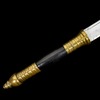
1. The markings on the forte plates was certainly done locally, it is engraved, not stamped as is typical and the mount was done within Africa. The symbols are typical and similar can be seen in the sword attached (formerly in my collection). 2. The blade marks are stamped deeply. I have zero doubts the blade stamps were done in Europe, it is my understanding these would be stamped while the blade as hot. Doing this after the blade left Europe would destroy the temper. Engraving over stamping is quite typical when you see local additions to older blades within the context of takouba. Often fairly lightly scratched, or in the case of forte plates like this, a bit deeper. The difference to European stamps is quite clear when you handle these in person. As for the meaning of the letters, I can't claim a better idea than any of the others posited here, however to my eyes the As are clearly Ms and one is badly stamped. I would doubt a clear meaning will ever be forthcoming from this inscription but that in do way hurts the appeal of this honest, hard working and quite old sword. I also favor a 17th century dating for this blade, likely originally a schiavona. |
|
|
|
 |
| Thread Tools | Search this Thread |
| Display Modes | |
|
|


 Linear Mode

