
|
|
|||||||
 |
|
|
Thread Tools | Search this Thread | Display Modes |
|
|
 20th January 2016, 09:15 PM
|
#1 |
|
Member
Join Date: Dec 2004
Location: Ann Arbor, MI
Posts: 5,503
|

[QUOTE=mahratt]"1.
It is so pity that you are not familiar with the Russian Oriental studies. It is on a par with French or English Oriental studies. ---------------------------- Russian historians/archeologists are unsurpassable in the field of "nomadic" and "Caucasian" studies.There are some good contributions to the Ottoman and ( less) Persian field. India was not their cup of tea. Except for occasional travellers ( Nikitin, Saltykov) they never ventured there and made no original contribution to the field. The only systematic Russian book about Indian weapons is a relatively new, semi-popular, book by Nosov, with heavy borrowing from Elgood, Pant and Rawson. Comparing Russian contributors to French and, especially, British researchers is impossible. After all, Brits controlled India de facto or de jure for... what? 300 years non stop? Built universities there, sent scientists, published books to no end, assembled collections, had public exhibitions...... Come on, let's not engage in patriotic fantasies:-) __________________________________________________ ______________ About the Kshatriyas. Of course I agree with you. It is exactly the author of the article in catalog mixed in one pile Kshatriyas with Rajputs, Jats, Dogras and Gurkhas with Coorgs. ----------------------------- Please, all of us can read here:-) __________________________________________________ ______________ "2. About the chakras. There are description of the use of chakras by ascetics in 16th. No metaphysics. They just throw it into the Portuguese who fired at them from muskets. They do not even have prayed before. ---------------------------------------- That is exactly your problem: you equate the act of "releasing" the mukta with the damage it inflicts. Try to understand their metaphysics. __________________________________________________ _______________ "3. On the same page ("Kauthiliya Arthasastra", transl. by R.P. Kangles ( Motilal Banasidass, Delhi, 2003. ISBN: 81-208-0040-0) Vol 2, p. 132  said about "an axe with a trident at one end or both ends". This axe and your "hastivaraka" both are real weapons or only "hastivaraka" is real? said about "an axe with a trident at one end or both ends". This axe and your "hastivaraka" both are real weapons or only "hastivaraka" is real?------------------------------ Where is the mention of a word "axe" in relation to hastivaraka or hataka? Please do not assign to me any words that I did not even utter. __________________________________________________ _________ 4. Prince Saltykov died 157 years ago. And it was amazing man. https://en.wikipedia.org/wiki/Aleksey_Saltykov --------------------------------------- Yes, a traveller and a dealer in Indian antiques. And ( based on his letter to his brother) not somebody I would care to invite into my house:-))))) |

|

|
|
21st January 2016, 06:02 AM
|
#2 | |
|
Member
Join Date: Nov 2009
Location: Russia
Posts: 1,042
|
[QUOTE=ariel]
Quote:
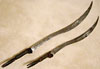
2. About the axe. Please see picture bellow. 3. Prince Saltykov never was a dealer. You should have read about it carefully. He was a collector and patron of the arts (philanthropist). There is a difference between the patron of the arts and the dealer. "At home he always had some eccentricities, went to the Persian or Indian costume (hence his nickname "Indian"). His apartment always looked like a Museum of curiosities and was furnished in the East. Everywhere he lived as a hermit for whole days engaged in painting, which had a big love, and "invited them to his house only a good painter, because he was not the last." Gloucester candlestick the beginning of the XII century from the collection of A. D. Saltykov now adorns London's Victoria and albert Museum The comments from those who knew him, Prince Saltykov "was one of the rare people gifted with a pleasant character, without the slightest pride, and charlatanism and moreover modesty" in dealing with others was always extremely soft, gentle and helpful. One of his contemporaries recalled that Saltykov was featured elegant and aristocratic appearance, in external manners he was reminiscent of Chopin; in forty years he had a youthful flexibility and features of his thin, oblong face had a melancholic good-natured expression[1]. He died on 23 March 1859 in Paris, where he lived as a hermit and invited them to his house only artists." |
|
|
|
|
|
| Thread Tools | Search this Thread |
| Display Modes | |
|
|


 Hybrid Mode
