
|
 21st December 2013, 05:13 PM
|
#121 | |
|
Member

Join Date: Jul 2006
Location: Buraimi Oman, on the border with the UAE
Posts: 4,408
|

Quote:
Salaams Atlantia, We have just brought on a couple of hilts made of rock crystal... They look pretty stunning but are very weighty... twice the weight of a normal hilt . I suspect they would shatter if dropped..especially on a marble or concrete floor...Anyway it is interesting.  Regards, Ibrahiim al Balooshi. |
|

|

|
|
23rd December 2013, 12:49 PM
|
#122 |
|
Member
Join Date: Jul 2006
Location: Buraimi Oman, on the border with the UAE
Posts: 4,408
|
Salaams ~Now here's a funny thing !his hilt has a very nice feel to it... but I cannot decide what it is made from since the edges seem to be going white... or light... as happens with Rhino but this has a feel more of Bakelite or carbon(plastic) or resin ..yet it seems to be horn. The old chap that brought it has said it is half Rhino... meaning he thinks it has Rhino in it... tiny shavings mixed in the mix ...so to speak... but I have me doubts !! Very expensive though !!
 Regards, Ibrahiim al Balooshi. |
|
|
|
|
23rd December 2013, 08:23 PM
|
#123 |
|
Member
Join Date: Dec 2004
Posts: 1,712
|
Looks like cheap layered plastic.... quite likely to be translucent at edges...
I understand many such are made in the Yemen & as with so many sales products you've informed us about, there then imported into Oman to be sold by the dodgy dealers , who always have a tale on their lips... To quote a Yemini trader... Al-Ozairi uses his expertise and years of experience to not only sell jambiyas, but also provide free-of-charge consultation for clients. “Many customers come to my shops asking us to evaluate the price of their jambiyas.” Many people cannot tell the difference between the original and plastic jambiyas and Al-Ozairi likes to set them straight. “Thos who make fake, plastic jambiyas have swindled many people out of a lot of money, convincing many customers that their jambiyas are unique,” he said, taking it as a personal affront on his beloved profession. “They deserve the severest punishment from the government for deceiving people and destroying the reputation of jambiya trade.” Despite the “plastic invasion,” Al-Ozairi is optimistic about the future and continued legacy of one of Yemen’s most notorious weapons. “Original jambiyas are an important part of our legacy. It will not fade away as many people say. It will prevail,” he said. Ref....linky! Of course ground rhino horn would also be too valuable to ad to a cheaply made handle like that,The Jambiya makers have re sold there offcuts & adulterated sawdust to the Chinese for at least 25 years! & besides ground human toenails would add the same keratin product & translucency even if without the allure & magic of the last remaining {just.] dinosaur on the planet. Hope you didn't really pay much for that? I think your a sharper man than that. Spiral |
|
|
|
|
24th December 2013, 10:44 AM
|
#124 | |
|
Member
Join Date: Jul 2006
Location: Buraimi Oman, on the border with the UAE
Posts: 4,408
|
Quote:
 There are some reasonable "allowable bone" handles on the market ...for European knives and I always wondered why Mamoth tusk never made it here. Thanks for the post and the great linky.. Regards, Ibrahiim al Balooshi. |
|
|
|
|
|
25th December 2013, 03:30 PM
|
#125 |
|
Member
Join Date: Jul 2006
Location: Buraimi Oman, on the border with the UAE
Posts: 4,408
|
Salaams all... My workshops team had a bit of a giggle at the 3 stone hilts at #121 and confirm they are only for presentation framed khanjars and certainly not for wearing.
Regards, Ibrahiim al Balooshi. |
|
|
|
|
31st December 2013, 03:34 PM
|
#126 |
|
Member
Join Date: Jul 2006
Location: Buraimi Oman, on the border with the UAE
Posts: 4,408
|
Salaams All; Note to Library; Old chaps like these often drop in for a chat ... and they make the best bargainers in the business...Some allow pictures...like this fine gentleman, today, (Awadth Kareeb al Kuwaiti from the U.A.E. He used to work for the late ruler!)
Regards, Ibrahiim al Balooshi.
Last edited by Ibrahiim al Balooshi; 31st December 2013 at 03:57 PM. |
|
|
|
|
8th January 2014, 04:15 PM
|
#127 |
|
Member
Join Date: Jul 2006
Location: Buraimi Oman, on the border with the UAE
Posts: 4,408
|
Salaams All ~ This is quite an unusual shot which I downloaded from the web showing the dagger style often carried in Dhofar with the Straight Omani Sayf, (dancing sword) and Terrs Shield. The dagger is virtually identical to the Yemeni style ... not surprising as the border is quite close by and tribes common to both countries straddle that.
Regards, Ibrahiim al Balooshi. |
|
|
|
|
10th January 2014, 06:56 PM
|
#128 |
|
Member
Join Date: Feb 2010
Location: switzerland
Posts: 299
|
latest find, opinion pleas
hello Together
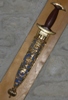
here is my latest find. this is a royal Khanjar? how old is he about? the handle is rino horn, the light is beautiful yellowish translucent. I would like to hear your opinion about it, especially your Ibrahiim. the Khanjar not heard me, must first be agreed with the seller over the price. regards Chregu |
|
|
|
|
11th January 2014, 08:24 AM
|
#129 | |
|
Member
Join Date: Jul 2006
Location: Buraimi Oman, on the border with the UAE
Posts: 4,408
|
Quote:
Salaams chregu, #45 and #46 refer to similar hilts and #1 gives some details on provenance of this HILT DESIGNED BY THE WIFE OF A PREVIOUS RULER .. THIS IS THE BUSSAIDI KHANJAR STYLE. THE SCABBARD IS LIKE ALL ROYAL DAGGERS THE SAME AS THE MUSCAT KHANJAR WITH 7 RINGS. Designers name ... "Sheherazad" ... Origimal style designed in about 1840. Wife of Said Sultan; ruled 1804 to 1856 (when he died).. She actually designed two things ... The hilt and the royal turban. (The royal hiltstyle was also adopted onto the Omani Battle Sword at the same time). See #8 on http://www.vikingsword.com/vb/showthread.php?t=16482 In your case the decoration below the belt has gone; typical of daggers which have been in the Salalah region. It has the benefit of a two piece hinged small belt section, though, the long belt is missing. Short hinged belts are rare now. The small net shaped device just behind the toe or crown on the scabbard end has also gone. Nevertheless a good example and probably 1960 or 1970 ...that area. Regards, Ibrahiim al Balooshi. Last edited by Ibrahiim al Balooshi; 11th January 2014 at 08:36 AM. |
|
|
|
|
|
11th January 2014, 05:41 PM
|
#130 |
|
Member
Join Date: Feb 2010
Location: switzerland
Posts: 299
|
hi ibrahiim
Thank you for your quick response. I had the age of the dagger much older estimated before 1900? because from my experience for blades and the patina of the grip material. well as the signs of wear of the silver decorations may include a higher age. what are your reasons for dating 1960-1970? greeting Chregu |
|
|
|
|
12th January 2014, 07:41 AM
|
#131 | |
|
Member
Join Date: Jul 2006
Location: Buraimi Oman, on the border with the UAE
Posts: 4,408
|
Antique Omani Khanjar.
Quote:
Salaams Chregu, The decorative tiny detailed silver work in the hilt and upper scabbard is of a later provenance and actually there is little damage or hard wear caused by age in either the blade or the silverwork other than a couple of missing bits as outlined. I am probably at the outer limit by quoting around the 60 year marker..Silver is very soft...it wears out fast because not only is it worn where wear is quite agessive but because of the vigourous oxidation (and constant cleaning) of the icon.. The blades, if used regularly, will also degrade nicely and for 1900 I would expect a relatively battered steel ... not so on this. In regard to an aprox. 1900 Khanjar I would expect a very worn almost smooth silver patina... The difficulty on khanjar age estimation is compounded because the trend has been to replace worn parts!! So my "point" about blades has to be "tempered" with the assumption that the blade is original...when it may not be. The belt cannot be used either on age estimation. In this case however there is no way that it is older than 1950 and absolutely not 1900... That is way out of line on age. To view khanjars of 100 years or more I would need to be in a Museum as no such weapons exist other than there or private collections...I was looking at http://www.christies.com/lotfinder/a...tails.aspx#top for examples even for first half of the 20th C .. but even with those examples I would say they were 1940 or 50... Pushing the envelope back to 1900 is not easy. Your dagger... I would be happy with 1960. Regards, Ibrahiim al Balooshi.
Last edited by Ibrahiim al Balooshi; 12th January 2014 at 08:10 AM. |
|
|
|
|
|
12th January 2014, 08:21 AM
|
#132 |
|
Member
Join Date: Jul 2006
Location: Buraimi Oman, on the border with the UAE
Posts: 4,408
|
Antique Khanjars.
Salaams All... Note to Library. I illustrate 3 of the oldest Khanjars I have seen on web...I consider these as circa 1900. Readers may note that it was the Hilt that dignified a Khanjar as "Saidiyya" (Royal) in style though generally that hilt is seen on the 7 ringer form scabbards but wass equally allowed upon 4 ringers as below right.. (7 ringer form was the design seen on Muscat Khanjar scabbards see #79) The Muscat weapon being on the doorstep when the Saidiyya hilt was invented must have thus been ideal as the candidate for copying the 7 ring style.
The older silver style is clearly seen on the two 7 ringers. Regards, Ibrahiim al Balooshi. Last edited by Ibrahiim al Balooshi; 12th January 2014 at 08:38 AM. |
|
|
|
|
12th January 2014, 11:58 AM
|
#133 |
|
Member
Join Date: Feb 2010
Location: switzerland
Posts: 299
|
hi ibrahiim
thanks for your answer. I'm amazed that I was so wrong with my assessment! I noticed that I still have much to learn about Khanjar! as I said, the Khanjar is not me, but would like to buy it. what do you think is a fair price for it? greeting Chregu |
|
|
|
|
13th January 2014, 06:02 AM
|
#134 | |
|
Member
Join Date: Jul 2006
Location: Buraimi Oman, on the border with the UAE
Posts: 4,408
|
Quote:
Salaams Chregu... Its rather like being asked ones age... Have a guess.  Regards, Ibrahiim al Balooshi |
|
|
|
|
|
13th January 2014, 06:58 PM
|
#135 |
|
Member
Join Date: Feb 2010
Location: switzerland
Posts: 299
|

ok
thank you anyway! greeting Chregu
|
|
|
|
|
19th January 2014, 05:17 PM
|
#136 |
|
Member
Join Date: Jul 2006
Location: Buraimi Oman, on the border with the UAE
Posts: 4,408
|
Three Finger Lift.
To decide if the blade is worthy there are a number of tests locals use including the ring test, the smell test, and the taste test. There is another which I describe as the three finger lift.
Lightly take the end of the khanjar blade up in two fingers and a thumb and slowly lift the item vertically ... If there is resistance and the dagger falls away its a good one ... If you can lift it easily its not so good...This happens as a blend of tests and may be done several times to satisfy the buyers mind..and looks like a complete load of jiggery-pokery but the locals swear by it... Regards, Ibrahiim al Balooshi.
|
|
|
|
|
21st January 2014, 10:06 PM
|
#137 |
|
Member
Join Date: Dec 2004
Posts: 1,712
|
So physical speaking, more weight than average & enough curve to the blade to put a sideways pull in rather than a straight linear pull is required? so that it pulls free?
Or to my mind, if as sharp as a cut throat razor would work as well?  But would colour your fingers perhaps... But would colour your fingers perhaps...Spiral |
|
|
|
|
22nd January 2014, 02:43 PM
|
#138 | |
|
Member
Join Date: Jul 2006
Location: Buraimi Oman, on the border with the UAE
Posts: 4,408
|
Quote:
Salaams Spiral~ I have the distinct impression it is more to do with the square root of the wily grin on the customers face divided by the depth of his pocket !! Regards, Ibrahiim al Balooshi. |
|
|
|
|
|
22nd January 2014, 05:14 PM
|
#139 | |
|
Member
Join Date: Dec 2004
Posts: 1,712
|
Quote:
That's sounds esoterical rather than physical! So its all a salesmans con trick, to lighten the customers weight realy?  So not truly a worthy test? spiral |
|
|
|
|
|
22nd January 2014, 05:29 PM
|
#140 | |
|
Member
Join Date: Jul 2006
Location: Buraimi Oman, on the border with the UAE
Posts: 4,408
|
Quote:
Salaams spiral... Nothing to do with the salesman and everything to do with the customer.. They come armed with techniques to prove the good or poor blade. These things are hard wired into the Bedu and frankly most of the potential local buyers.. The smell and taste test, tweak and flip, the ring test and this one holding the blade by the tip. These are the traditional ways... Regards, Ibrahiim al Balooshi. |
|
|
|
|
|
22nd January 2014, 05:34 PM
|
#141 |
|
Member
Join Date: Dec 2004
Posts: 1,712
|
Fascinating!
Spiral |
|
|
|
|
24th January 2014, 02:36 PM
|
#142 |
|
Member
Join Date: Jul 2006
Location: Buraimi Oman, on the border with the UAE
Posts: 4,408
|
The Funoon and the Khanjar. The Bar'aa
The Bar'aa
Salaams All.. In Dhofar in particular and more often (though dancing with Khanjars is also done in the North) the Bar'aa dance is performed. The Bar'aa is performed as a celebration of youth by two dancers, each holding a Khanjar dagger in his right hand and his shal, fixed at the waist, in his left hand. The characteristic movement of the Bar'aa is a powerful one-footed leap into the air. The two dancers move in a synchronized series of steps, advancing and retreating while they both make full circles. At a particular moment, both dancers bow down before the musicians to allow the soloists to come forward and sing. Regards, Ibrahiim al Balooshi. |
|
|
|
|
26th January 2014, 03:32 PM
|
#143 |
|
Member
Join Date: Jul 2006
Location: Buraimi Oman, on the border with the UAE
Posts: 4,408
|
Salaams All, Note to Library,
Correction to past threads on the Habbaabi Khanjar form of the Saudia Arabia Asir regional dagger. The Name of the weapon appears as Habbaabi but is probably from Abha and either there is a silent letter at the front which has become muddled in the sound ... Abha is the capital of the Asir thus it is there that I think the name has sprung from. Abhaabi which sounds like Habbaabi. It is this Muscat Khanjar that was "copied in" as a style of weapon into the then Yemeni region now part of the Saudia Asir region... likely imported there by Omani/Yemeni ships trading between Red Sea Ports, Zanzibar and Oman. I show below the grainy old picture from what is an epic pamphlet on Omani Silver by Ruth Hawley. of the original form of Muscat Khanjar... whose design of scabbard became part of the Royal Khanjar by Sheherazad in about 1850. (It may be remembered that she designed the Hilt ...and also the Royal Turban). With that please see http://www.vikingsword.com/vb/showthread.php?t=360 by Congre...for the Abhaabi dagger details also brought to the pictures below; A map of the Asir is included. Regards, Ibrahiim al Balooshi.
Last edited by Ibrahiim al Balooshi; 26th January 2014 at 04:08 PM. |
|
|
|
|
30th January 2014, 06:19 PM
|
#144 |
|
Member
Join Date: Jul 2006
Location: Buraimi Oman, on the border with the UAE
Posts: 4,408
|
The Royal Khanjar.
Designer Sherazad in circa 1850. The later finer intricate work inspired after about 1970... and could be called the modern design. This dagger however is a very meaty example and heavily ornate about the hilt which is all covered in silver and known here as "Tams". This is a huge 7 Ringer. The entire scabbard arrangement influenced by the Muscat Khanjar and integrated by the designer with a hilt of largely Indian form/decorative style. Regards, Ibrahiim al Balooshi. Last edited by Ibrahiim al Balooshi; 31st January 2014 at 09:34 AM. |
|
|
|
|
21st February 2014, 03:29 PM
|
#145 |
|
Member
Join Date: Jul 2006
Location: Buraimi Oman, on the border with the UAE
Posts: 4,408
|
Salaams all; Note to Library;
Brought from Rostaq; This khanjar is of good quality though for some reason the black Rhino hilt is not considered comparable to the clear Rhino...  The Khanjar sports a tight pattern of Baatinah style below the belt and has excellent design in silver pin form on the hilt with a full silver back. The blade is good with a dull thudding resonance and smells like sweaty socks and herbs !! A good sign. The belt is fine being silver stitched on leather and no expense is spared on its quality buttons and buckles. The Khanjar sports a tight pattern of Baatinah style below the belt and has excellent design in silver pin form on the hilt with a full silver back. The blade is good with a dull thudding resonance and smells like sweaty socks and herbs !! A good sign. The belt is fine being silver stitched on leather and no expense is spared on its quality buttons and buckles. Regards, Ibrahiim al Balooshi. |
|
|
|
|
12th March 2014, 10:35 AM
|
#146 |
|
Member
Join Date: Jul 2006
Location: Buraimi Oman, on the border with the UAE
Posts: 4,408
|
|
|
|
|
|
16th April 2014, 03:31 PM
|
#147 |
|
Member
Join Date: Jul 2006
Location: Buraimi Oman, on the border with the UAE
Posts: 4,408
|
A couple of designs just encountered ~ I particularly liked the parallel line silver decoration ..The Khanjar with gilded buttons has been reworked...as many Khanjars have these days...and to include some gold pins. The dagger with the black leather scabbard is from Salalah and closely related to a Yemeni style already discussed on these pages.
Comments welcome folks !! Ibrahiim al Balooshi.
Last edited by Ibrahiim al Balooshi; 16th April 2014 at 03:40 PM. Reason: art |
|
|
|
|
9th May 2014, 02:49 PM
|
#148 |
|
Member
Join Date: Jul 2006
Location: Buraimi Oman, on the border with the UAE
Posts: 4,408
|
Salaams All... An example of a reworked Rhino Horn Hilt on a newer Khanjar ...Another Baatinah style with the owner residing in Rostaq . I think the use of gilded buttons and spot gold wash is very attractive. The back of the hilt is pure silver platework often seen on expensive hilts. The blade is slightly loose and out of kilter....It's wonky.
Regards, Ibrahiim al Balooshi. Last edited by Ibrahiim al Balooshi; 10th May 2014 at 09:41 AM. |
|
|
|
|
14th May 2014, 04:26 PM
|
#149 |
|
Member
Join Date: Jul 2006
Location: Buraimi Oman, on the border with the UAE
Posts: 4,408
|
For a broad background into Khanjars of Oman etc see http://www.klm-mra.be/icomam/downloads/issue07.pdf
|
|
|
|
|
23rd May 2014, 05:13 PM
|
#150 |
|
Member
Join Date: Jul 2006
Location: Buraimi Oman, on the border with the UAE
Posts: 4,408
|
Some of the styles of hilt using carbon or nylon material are very good(called generally "Americky" here))... Here is a hilt with all the pins and looking like wood grain ..etc...They don't break when dropped and are easy to work on....and reasonably priced.
Last edited by Ibrahiim al Balooshi; 23rd May 2014 at 05:24 PM. |
|
|
|
 |
| Thread Tools | Search this Thread |
| Display Modes | |
|
|


 Linear Mode

