
|
 28th December 2013, 07:33 PM
|
#1 |
|
Member
Join Date: May 2006
Posts: 7,263
|
 When is a keris legitimate?
This thread has been started at the suggestion of David, our moderator.
In another thread:- http://www.vikingsword.com/vb/showth...d=1#post164584 I raised the question:- exactly what is it that makes a keris a legitimate keris? why can one keris be considered legitimate and another keris be considered to be not legitimate? David suggested that a greater degree of participation in discussion might be generated by opening a new thread directed specifically at this question. This is a genuine query. It is not a set-up, I'm not digging holes and covering them with branches. I am interested in trying to understand just what it is about a keris, any keris, that causes people to decide that it is a genuine, legitimate, real keris, and of course why they pass judgement on another keris and determine that it is not "real", or legitimate. We're still in the middle of the festive season, New Year is just around the corner, but if we have a few sober members out there, perhaps they might care to comment. |

|

|
|
28th December 2013, 10:50 PM
|
#2 |
|
Vikingsword Staff

Join Date: Nov 2004
Posts: 6,442
|
Hi Alan, I'm thinking that we probably have at least two schools of thought on the subject; those of people living in keris bearing societies and everyone else on the outside of that culture .
I have a feeling there might be some difference in viewpoint to be found . |
|
|
|
|
28th December 2013, 11:27 PM
|
#3 | |
|
Keris forum moderator
Join Date: Aug 2006
Location: Nova Scotia
Posts: 7,303
|
Quote:
 
|
|
|
|
|
|
28th December 2013, 11:58 PM
|
#4 |
|
Member
Join Date: Aug 2005
Location: Australia
Posts: 375
|
The concept of legitimacy is a difficult one as to a great extent it is dependent on who is discussing the issue and what they decide legitimacy is. Please note that in my reply to Alan’s question I will only address the idea in relation to objects.
We have a number of layers to consider when we are looking at objects. In some circumstances legitimacy of an object is conferred by the object being definitively signed by the maker, as in some art works. We can read the signature, accept that the object is made by a specific creator and have a concept of why it was created. Whether we actually understand why it was created may be debateable. Of course there are those who would take advantage of that by producing objects ostensibly but not actually signed by the maker eg fake paintings by Vermeer, (see for instance http://www.essentialvermeer.com/misc/van_meegeren.html). When faced with this problem we turn to ‘experts’, that is to say those who have devoted time, energy and money to developing insight into a particular group of objects. In this (the fake signature) and other circumstances we the public accept that certain people have developed sufficient expertise to differentiate one object from another by some other relatively concrete means even if we cannot do it ourselves. Perhaps they can read symbols in another language, for instance Japanese seals or they are able to interpret various makers marks for instance the silver and gold assay marks typical of English precious metal objects or perhaps they have just looked closely at the brush style of Vermeer. The problem here is that experts may be mistaken and if the mistake is not corrected it becomes ‘truth’ in the public domain. I have successfully discussed mis-attributions of art works in the British Museum and the Rijksmuseum with their curators. The curators are vastly more expert than the amateur but they still make mistakes. Then we move into the area of non-marked or non-specifically marked objects. Here legitimacy is conferred in a number of ways (importantly we are no longer just talking about attributing an object to a specific maker). 1. Those who create the object determine that the object is legitimate for their purpose. The purpose may be singular or multifaceted ie it may have a specific function (carrying water) or it may have many (it carries water to the ceremonial place in order that the rains will arrive to ensure crops thrive) and it may change over time (it becomes part of the legitimate regalia of the ruler). An object may serve as a token for another object and still be regarded as legitimate (noting the paper keris may be a legitimate token for a metal one in one circumstance eg at a wedding but not in another circumstance eg trying to cut a throat in a dark alley). The creation group determines legitimacy. 2. Those who create the object do so for a purpose other than their own needs, but recognise it fulfils a need outside of their own group and provides the second group with a desirable object. The creation group do not necessarily benefit directly from the object but do benefit from the trade purpose of the object. The creation group may use a generic mark to show that it is legitimate eg by marking it ‘Toledo steel’ or ‘Made in Japan’. They may simply create a facsimile of an object they use themselves but in a manner that they would not chose to use, eg a plastic replica of the Leaning Tower of Pisa. Most facsimile/souvenir items would fall into this group. The creation group creates an object that an external group accepts is a legitimate product of the creation group and the external group does not try and change the objects purpose. 3. Those who fetishize the object (for example the monk with the holy relic or the collectors with the only examples of a particular plastic object that is green) decide that this object is a legitimate example of the desired object. Desired is the key word. They may create a status ranking for objects based on ‘desirable features’ such as size, rarity, % content of elephant dung or even that most deceptive of beasts ‘provenance’. Their concept of legitimacy is often at odds with that of the originators’ of the objects concept. For example the original manufacturer of the green plastic object may have found that it was an unpopular colour and hence dropped it from the product line very quickly. It only becomes rare because of its unpopularity with the original audience but the later audience will fetishize it because of its rarity or because green has become fashionable. I say ‘fetishize’ because this group are generally providing another purpose for the original object to that of its original intent. (I would argue that this group also frequently fetishize signed and marked objects because they appreciate, use and rank them in manners not necessarily intended by their original makers and consumers). The fetishizing group determines that an object has a legitimate purpose independent of that of the creation group. You will note that the definition of legitimate is a somewhat slippery one and changes over the course of this post. I am confident there are many holes and overlaps in the suggestions I have made, but having spent an hour or so on them I am comfortable with them being a starting point for one particular view. The key message is that the needs of the creation group are different to the needs of the fetishizing group and hence the determination of legitimacy lies with the group discussing the object. Legitimizing an object is a long way from understanding an object. DrD |
|
|
|
|
29th December 2013, 12:33 AM
|
#5 |
|
Member

Join Date: Nov 2006
Posts: 37
|
I originally posted this in the thread that spawned this thread.....
Here is my 2 cents on this topic...as a collector I focus on true antique weapons. I want them as original as possible (noting that variations/adaptations/additions added over the life of the weapon). Now, with that said I know many folks that collect new pieces or recreations of old pieces (money concerns or personal preference for newer). Many of these pieces are made in the traditional manner using traditional means...I would therefore interject that a piece made with correct materials and made in a traditional manner would still be classified as a "true" albeit modern version. Now where does that place blades that are produced for the souvenir or modern use trade? If using morphological standards alone and not material/manufacture as a means to define legitimacy of a weapon type then yes, they would be legitimate (note any wavy bladed knife, sword, or dagger being classified as a keris...same with barong, parang, bolo ect) albeit modern and not traditional. I truly think that any weapon made with the correct materials should be referred to as at legitimate" but not antique. All others that fall into the correct morphological form and made of untraditional materials should just be classified as modern...most of these are made for the souvenir market, however many are being used by current practioners of traditional martial arts whom can not afford true antique weapons or do not want to chance damaging true artifacts...I refer to them as modern. Technology has changed the process of how all things are made to one extent or another ie: the use of hand held grinders in keris making, air hammers for forging/folding ect. Modern, modern/traditional, or antique, I think that is how they should be classified for what it's worth. May you all be blessed with a happy, healthy and prosperous 2014! All my best, John |
|
|
|
|
29th December 2013, 01:37 AM
|
#6 |
|
Member
Join Date: May 2006
Posts: 7,263
|
Thank you for your contributions gentlemen.
I do hope that others will see fit to share their thoughts with us. I very much like what I am reading here. I gave a lot of thought to the way in which I posed this question. You're looking at what is probably something like draft 10 or 12 or maybe more of the question. The word "legitimate" was my final choice from a number of other words. The idea of "in", and "out" of keris bearing society is one factor, but possibly there is more to it than that. Many people in the keris bearing societies that I know best do not hold particularly traditional sets of values, on the other hand some people in western post-industrial societies try in-so-far as they are able, to hold very traditional sets of values in respect of the keris. I personally do not see any answers to this question as either right or wrong. I see the answers as only a contribution to our better understanding. There is perhaps one factor that needs to be considered when formulating a response to my question, and that is the nature of the keris:- what is a keris? I do not intend this as another question, merely as something we should ask ourselves before we decide what the word "legitimate" might mean. |
|
|
|
|
29th December 2013, 01:28 PM
|
#7 |
|
Member
Join Date: Jun 2008
Location: Jakarta - Indonesia
Posts: 114
|

Hi Alan,
When you say : what is a keris, the we are talking about Pakem. Keris can be called Keris if its follow certain rules/or known knowledge amongs the rulers, ie Kraton. It will be called work of arts or keris keris-an if its not flowing with the Pakem. In short to call the keris is a legitimate keris, could be: 1. Follow the Pakem set by Kraton standard according to the era / tangguh of the Keris itself 2. A group of knowledgeable Keris seniors agreed about the Keris quality of workmanship and flow with the Tangguh. ( subject to neutral opinion... ) Another point, for newly made Keris, if acceptable by majority people and sold with High Price... can we call it a legitimate Keris? Regards Rasjid |
|
|
|
|
29th December 2013, 07:35 PM
|
#8 |
|
(deceased)
Join Date: Dec 2004
Location: OKLAHOMA, USA
Posts: 3,138
|
THE FIRST TIME I SAW A DAGGER REFFERED TO AS A KRIS IT WAS A NEW POORLY MADE KNIFE WITH A WAVEY BLADE SAID TO BE A THROWING KNIFE. IT WAS A MONOSTEEL BLADE SHAPED WITH A POWER SAW WITH CRUDELY GROUND BLADE EDGES A CRUDE GAURD AND A WOOD HANDLE PAINTED BLACK WITH A GOLD PAINTED DRAGON DESIGN ON THE GRIP. A REAL PIECE OF JUNK
 BUT IT HAD A WAVEY BLADE SOMETHING NOT SEEN OFTEN, I ASSUMED IF ALL WAVEY BLADES WERE EITHER A KERIS OR A FLAMBU (FLAME SHAPED BLADE). BUT IT HAD A WAVEY BLADE SOMETHING NOT SEEN OFTEN, I ASSUMED IF ALL WAVEY BLADES WERE EITHER A KERIS OR A FLAMBU (FLAME SHAPED BLADE). I HAVE LEARNED MUCH SINCE THEN AND HAVE FOUND THE KERIS IS MUCH MORE COMPLICATED THAN JUST A WAVEY BLADE . MANY YEARS LATER I FIND I MAY BE A NOVICE AT BEST, BECAUSE THERE IS SO MUCH TO LEARN ABOUT THE KERIS. I JUST DABBLE AND DON'T PUT IN THE NECESSARY TIME NEEDED TO ADVANCE AND OFTEN TEND TO FORGET WHAT I LEARN AS I DON'T STICK WITH IT AND HAVE TOO MANY OTHER IRONS IN THE FIRE.  I MOSTLY COLLECT WHAT I FIND ASCETICALY PLEASING TO ME AND DO ENJOY READING THE POSTS HERE THOUGH I DON'T HAVE THE KNOWLEGE TO ADD MUCH. A FEW THOUGHTS. THE BLADE IS WHAT MAKES A KERIS A KERIS. 1. KERIS BLADES ARE DOUBLE EDGED AND HAVE A SEPARATE PART TO THE BLADE NEAR THE FORTE. (A SINGLE EDGE AND A ONE PART BLADE DOES NOT A KERIS MAKE) 2. THERE ARE SEVERAL DIFFERENT VARIATIONS IN SHAPE TO KERIS BLADES STRAIGHT AS WELL AS WAVEY. 3. THE MANY BLADE PATTERNS SHOW REGION , MASTERY OF FORGEING AND HAVE DIFFERENT MEANINGS OR DENOTE VARIOUS POWERS. THIS IS JUST VERY BASIC AND I HOPE NOT INCORRECT OR MISLEADING THE MORE I WRITE THE MORE I FEEL I DO NOT KNOW MUCH SO WILL STOP HERE BEFORE I GOOF UP TOO BAD. AND LEAVE IT TO THOSE MORE DEVOTED TO THE KERIS TO LAY THE INFORMATION OUT.
|
|
|
|
|
29th December 2013, 08:47 PM
|
#9 |
|
Member
Join Date: Mar 2012
Posts: 422
|
Since "keris" is a conventional taxonomic label, we are not free of collective opinion. For something to be a "real" keris, it must meet the requirements of the definition; some of these have been noted by Vandoo above. But here there is some plasticity.
1. Does a keris need to be forged? If the maker grinds the blade from a slab of steel, can it be a real keris? 2. Can anybody make a keris? Can a keris be made everywhere in the world, or only in certain places? I.e., does "keris" have similar status to "nihonto" ("real" Japanese sword)? 3. What degree of variation is permitted before it ceases to be a keris? From a weapons-collecting point of view, a key point is functionality as a weapon or bladed tool. This provides no answer for the three questions above. So it is insufficient for keris. (It is also insufficient for "nihonto".) Where the type of object in question is still in modern use, but the main use is not as a weapon or cutting tool (i.e., the main use is not actually cutting or stabbing things, or training to cut/stab things), perhaps physical function can mislead us. Based on physical function, I would not call a Bali tourist keris with an unsharpened sheet metal blade with painted-on "pamor" a real keris. To a weapons collector, it isn't "real" - it isn't a weapon. But perhaps it could be to a modern keris user. I don't know the answer, but am interested. So: 4. Can a "non-weapon" keris be "real"? |
|
|
|
|
29th December 2013, 11:30 PM
|
#10 | |
|
Member
Join Date: Apr 2005
Posts: 3,255
|
Hello Timo,
Quote:
If anything, a keris being weapon is currently the least acknowledged (if not downright disputed) function/meaning by the general populace in today's "keris-bearing" societies. A toy-like prop is good enough to represent as a wedding keris; even if you can afford more you better spend it on gifts, food, offerings, etc. Regards, Kai |
|
|
|
|
|
30th December 2013, 12:13 AM
|
#11 | |
|
Member
Join Date: Apr 2005
Posts: 3,255
|
Hello Alan,
Quote:
Even if limited to Orang Jawa in today's society of central Java, I'd posit that "legitimate" (or any of the other "definitions/descriptions") keris will mean very different things to different sectors of society and even individuals. I'm not sure if this helps the discussion a lot. However, I have no problems to accept that some toy-like props serve as "legitimate" keris in societies of origin (even if falling way short of any academic definition of keris) and, arguably, may have a place in a comprehensive keris collection. Unless limiting the definition to Keraton pakem quality pieces (which would exclude some 99% of keris from discussion), there are also always lots of keris conforming to any less restrictive definition that most of us would agree being of crappy craftmanship (despite "traditionally" worked). Regards, Kai |
|
|
|
|
|
30th December 2013, 12:54 AM
|
#12 |
|
Member
Join Date: Apr 2005
Posts: 3,255
|
I, for one, feel quite happy in applying a sliding scale when deciding what to obtain for my collection and don't have any criteria written in stone that define what is IMHO legitimate, genuine, nice, untouched/complete, old, etc. and which need to be met by any new family member...
I'd be enthusiastic about any antique high-quality blade (even damaged and/or without any fittings) and may also be more than happy about an antique village keris of fairly crappy quality if deemed a "complete, original combination", from a rare origin, or, possibly, even special provenance. Heck, I may even go for a current era keris if it speaks to me... From a practical POV, much more relevant than trying to define what makes a keris "legitimate" would be to ascertain that I don't fall prey of any misrepresentations that abound with things keris (from ol' myths/exaggerations like meteoric metal to downright lies and forgeries). Regards, Kai |
|
|
|
|
30th December 2013, 04:04 AM
|
#13 |
|
Member
Join Date: Dec 2004
Location: Kuala Lumpur
Posts: 369
|
G’day Alan,
I’ll try to give some insights on this. Haven’t done much research, but here’s my call on this subject. Many of the following are actually my quick guess. There are probably dozens of loopholes in it and can be quite sticky. IMHO, a keris that is perceived as “legitimate” differs with time and culture and at current time, the definition is really up to our perception. In order to identify a “legitimate” keris , we first must define the physical characteristics of a keris then distinguish the functions and the development of the functions of a keris. The definition part we already passed in previous discussions –asymmetric etc. The keris IMHO, initially have 2 primary functions; starting out primarily as a weapon (in buda form) with religious symbols. I would imagine that it is not an item that exclusively used in religious rituals since it is quite a normal practice at that time where most items will bear some sort of religious symbolism. During this a “legitimate” keris is a keris that is a weapon that forms the unique physical characteristics of a keris. Only nobles have keris as it is still a luxury item. As the keris developed into the modern keris, it is then accepted as a pusaka in a sense that it is a symbol of regency/office of a certain group of people where still, in this time, only nobles owns or were given a keris. During this time, a “legitimate” keris is probably a keris that was manufactured according to the official purpose and the status and of its owner- a keris that is a weapon AND a pusaka. During this time also, the keris culture as a pusaka weapon spreads to other places and kingdoms. Keris can also be a gift from one regent to another and the particular keris is then regarded as a pusaka of the kingdom - a symbol of a bond/relation. This is why we normally found that a pusaka keris in many kingdoms outside of Jawa are actually of Javanese origin. As in any type of items that are related with power/authority, the manufacturing quality must be superior subjected to the time period and the artistic qualities/symbolism of this type of keris must be set according to the artistic and symbolic viewpoint of the authority that starts that culture. It is probably during this period also, other kingdoms such as Palembang started their own pusaka keris culture which really inspired by the Javanese culture. These locally made keris soon becomes a pusaka weapon of that particular kingdom and the concept of a pusaka keris soon flourishes in that kingdom. Over time, as iron becomes common and more pande are able to forge keris and the economic conditions of the general public improves, the use of the keris as a weapon becomes widespread and the general public throughout the archipelago had started to have the means in acquiring a keris. It now had evolved into culture and also a functional item of dress. However, the keris owned by the general public at this time is nothing more than a weapon. While it can be considered a pusaka once it is being passed down to the next generations in a loose sense, but it is probably not a pusaka in a sense where it have the binding power of a regent/chief where it is a symbol of authority over a certain group of people. The symbols are still preserved on the blade, but the meaning of the symbols was changed to fit the belief of that time. The concept of a pusaka that binds/authority was also maintained. During this time, depending on our perception, there are 2 types of “legitimate” keris. Keris that are a weapon AND a pusaka (from the previous and the current era – still being made by an empu) and also kerises that are just weapons from that current era made by smiths (pande). Both types of keris can be a functional item of dress. However, although some weapon grade keris have reached a reasonable quality it is not infrequent that these keris does not meet the requirement of a pusaka grade keris that was set by the authority which is the palace of that particular culture. We now reach the current era, where a large number of pusaka grade keris and weapon grade keris of the previous ere were passed down to newer generations. The only way to distinguish the pusaka grade to the weapons grade keris is using tangguh knowledge (for Javanese culture) or to have some knowledge to identify a quality keris – as pusaka grade keris would rationally have a high quality. I am unsure if we say that a pusaka grade keris is still being made at this day. Weapon grade keris, however, are still being made to a large extent and the quality now are significantly higher than its predecessor and in some cases it meets the specification of the older pusaka keris as well. It had become a platform purely for displaying artistic skills while maintaining its features as a weapon and a cultural item. However, in the current era the function of a keris as a weapon is greatly reduced. Now, a keris that is an item of dress does not have to be a functional weapon. This breeds a new type of keris, where it is very hard for it to be considered a weapon (where it does not have a steel cutting edge). These are what we normally call “tourist keris” - a keris that serves a non-functional item of a cultural dress. Coming back to our original question, what is a legitimate keris? The answer to this question IMHO lies in our perception towards the function of the keris. Does a keris must be a pusaka weapon- a weapon symbolising power and/or office- a weapon that is manufactured according to the specification specified by the ruler, or do we only require it to be just a weapon made according (or not) to the specification, or whether we will accept it as a keris as long as it looks pretty much like a keris – doesn’t matter if it does not serve as a weapon, what more a pusaka. The keris started out as a weapon. It later evolves to an item that serves two purposes, a weapon and a pusaka. These are the 2 basic functions of a keris. Although there is a concept of a pusaka keris is not a weapon, I’m not sure if it is possible for us to accept that. A keris that is made as a cultural item, serves only as an icon of a culture displayed as an item of dress. It does not satisfy the 2 basic functions of a keris. It is not a weapon and not a pusaka. Therefore IMHO, at a minimum, a legitimate keris should be a keris that at least satisfy at least one of its original purpose- that it’s to be a weapon. A weapon that bears the unique physical attributes that forms a keris. Now we need to define keris that serves as a "legitimate weapon"..
|
|
|
|
|
30th December 2013, 04:59 AM
|
#14 |
|
Member
Join Date: May 2006
Posts: 7,263
|
I very much appreciate the thought and the effort that has gone into the opinions given above.
I do not intend to give any opinion for the moment, because I asked the question, and as I have said:- I'm interested in how others may think. "how others may think", and it seems fairly clear that there are various shades of meaning for various people. But Rasdan's opinion has raised another question. He has focused much of his attention on the "pusaka" character that can be attached to the keris, so Rasdan, could you please clarify for us exactly what you mean by "pusaka" and under what circumstances a might a keris become "pusaka". How could we recognise a "pusaka keris" if we were not aware that it was one? |
|
|
|
|
30th December 2013, 09:34 AM
|
#15 |
|
Member

Join Date: Dec 2009
Posts: 335
|
I always remember (and have also written of this a couple of years ago in another thread) that 15 years ago I found in an antique arms shop in Liverpool an apparently perfect Bali kris, with well executed pamor (ngulit semangka or wos wutah). The only odd detail was the ganja welded to the blade. I was told that it had been made by a skilful local smith (later I discovered that he is also making Japanese-type blades with a similar mastery). This said, I am asking myself if that kris - apart from the ganja problem - could or not be considered a "legitimate kris". In my opinion it could, since the raw materials and the production process are the traditional ones, the dapor is identical to that of an old Bali kris, the prabot is executed with masterly skill, and the pamor is exactly as one expects to find on an original blade.
I think therefore that the basic question (legitimate kris or not) cannot be simply answered and that one should find a solution on a case- by- case basis, taking into consideration the basic parameters listed above (dapor, prabot and pamor). Who knows how many "western-produced kris" are circulating today among collectors ? |
|
|
|
|
30th December 2013, 12:53 PM
|
#16 |
|
Member
Join Date: Dec 2004
Location: Kuala Lumpur
Posts: 369
|
double post deleted
|
|
|
|
|
30th December 2013, 12:56 PM
|
#17 | |
|
Member
Join Date: Dec 2004
Location: Kuala Lumpur
Posts: 369
|
Quote:
Actually my take on that is embedded in the post above. I’ll reiterate what I mean. The word pusaka can be translated into 2 words in the English language. One means “regalia” and the other means “inheritance”. It can be related where regalia may be inherited, but an inheritance may not be a regalia. Here’s my guessing part. A keris is a regalia when it is made to symbolise the authority of a king over a group of people or when it is a gift to a person authorising that person as an authority over a specific area for example. I would imagine that a normal person cannot simply acquire a pusaka keris as it would require a source of power (like a country’s constitution in modern time) to authorise this. In old Hindu times, the source of power is their God and a King I guess is supposedly God’s representation on earth. (Not sure). Let’s call this type of keris Type A. Then there are probably nobles and rich people that may acquire high quality keris made by the empu that makes regalia type keris. These keris are not regalia, but have a very high quality. These are Type B keris. There are also keris that were made by smiths. Some have a good quality, some not very much. Let’s call these Type C keris. Going back to the second definition of pusaka – an inheritance. Type B and Type C keris will also be a pusaka where it is a keris that is inherited by a person that is not originally made to symbolise power. So, according to the second definition of pusaka these types of keris can be any type of keris as long as it fits the physical characteristics of a keris. It can be made by an empu or a smith (type B or C). Type B and perhaps Type C keris also however, have a chance to become a Type A or maybe I should call it a “Type A” keris as the owner is elevated to a higher status in life or perhaps become a king where he may regard his keris is a regalia of his country or area of authority. Weather this act can be regarded as “legitimate” or not, I guess it is related to that particular area concept of “source of power/authority” (which normally goes back to religion) at that particular time. Regarding quality. I would imagine the main identification characteristics of a regalia keris is quality. For Javanese keris, the tangguh knowledge is a must. However, I think, the tangguh knowledge would be insufficient to differentiate between Type A and Type B keris as both may be made by the same empu and therefore have rather similar quality. Type C keris I would imagine can easily be distinguished as someone acquires the knowledge in determining a quality keris. For kerises from other areas, the only way to go is to look for signs of quality and old age (if desired) using conventional wisdom as keris manufactured outside Java are probably manufactured with a different specification. Therefore it is quite impossible to apply the “tangguh like knowledge” to these kerises. As I see it, the concept of pusaka/regalia is created by us. We create and elevate it and regard it as a symbol of authority. Without our recognition, any regalia would only be an object. Most likely an expensive object. For collectors, it is very unlikely for us to differentiate Type A and B keris unless a keris have a very good provenance. Type C keris on the other hand also can have a very good quality. Therefore, the only reasonable way to go for collectors is quality. Whether a keris is really a Type A, B or C most likely in many cases will never be known and in my opinion, are the stuff of dreams. Last edited by rasdan; 30th December 2013 at 03:37 PM. |
|
|
|
|
|
30th December 2013, 04:22 PM
|
#18 |
|
Keris forum moderator
Join Date: Aug 2006
Location: Nova Scotia
Posts: 7,303
|
Very interesting thread so far. As i expected, also some difference of ideas, some which i agree with and some which i don't. But i am not sure that we can really have too many "wrong" answers on this question as much of it will depend on personal preferences and ideas.
I certainly agree that the question of what is a "real" keris cannot be answered without also answering "what is a keris". 1. A cultural icon and a symbol of manhood. 2. An asymmetric double edged dagger (i do still consider keris sepang a legitimate keris form. Most of the ones i have seen are not perfectly symmetrical anyway). 3. The blade has a gonjo, either true or implied as in gonjo iras blades. 4. The blade if forged and often pattern welded with contrasting material to create a pamor pattern, though the use of contrasting material is not mandatory. 5. The blade may be straight or wavy (so obviously any blade with a wavy blade cannot automatically be considered a keris). For me there are two things that have no real bearing on legitimacy for me. The first is weapon readiness. While i am of the mind that the keris first developed as a functional weapon (and i have many examples that fit that bill quite nicely), there are many keris that were forged solely to serve an esoteric function such as keris sajen and keris picit. The second thing that has no bearing on legitimacy for me is quality. If a keris has been made within the culture to serve the cultural purpose of a keris it is still a keris to me even if it is not particularly well produced. It still does need to fit the other requirements, but it doesn't need to be a "good" keris to be a "real" keris. This doesn't mean that i necessarily want to add poorly conceived keris to my collection, but i would still count such keris as "real". I don't image that too many of us have many truly Mpu made keris in our collections. I know most of what i have collected was made outside the keraton. Some of those are still very nicely conceived blades. Some perhaps are more imperfect, but they contain a character or "spirit" that suits me personally that i find attractive so i collect it. Certainly some of the more esoteric blades that i have collected are not great examples of highly skilled keris work. They are still real, important and valued parts of my collection. For me a really important part of legitimacy relates to my first specification for what makes a keris. For what intent and purpose was the keris created? I personally find it impossible to remove the keris from it's cultural context. So to use GIO's example i would not consider the "Bali" keris made in England to be a legit keris. I might still like it and consider it collectable, but removed from its context as a cultural icon it no longer meets my personal requirements of legitimacy. For me a cultural icon must be made within and for use within that culture. In 2005 UNESCO proclaimed the keris a "Masterpiece of Oral and Intangible Heritage of Humanity". I think a "real" keris should probably be able to live up to this designation in some way. |
|
|
|
|
30th December 2013, 09:25 PM
|
#19 |
|
Member
Join Date: May 2006
Posts: 7,263
|
Thank you for your response Rasdan.
My feeling is that we are gradually building a foundation of opinions here that may help us clarify the way in which people who have responded to my question determine whether or not a keris is legitimate in their eyes. I am hopeful that some more of our regular participants in discussion will share their thoughts with us. |
|
|
|
|
31st December 2013, 05:18 PM
|
#20 |
|
Member
Join Date: Dec 2009
Posts: 335
|
Reading the last few lines of David's post, I'm afraid I didn't well express my opinion.
Should the "English made kris" have had the ganja separated from the blade, have a nice uwer and hilt and a finely made sheath, I assure that anybody with a good experience in the field would have considered it a real (or legitimate) kris. It is starting from this preliminary statement that I RELUCTANTLY have concluded that the English kris is a legitimate kris, though I would never have purchased it. Probably none of the kris in my collection was made by an empu, most probably by a common village smith with some skill. What is the difference between a skilled smith living in Indonesia and one living in England ? After all only the geographical position. What I have expressed is only my personal opinion. I would welcome with interest any comment on my thought. Happy New Year to everybody !!!! |
|
|
|
|
31st December 2013, 08:33 PM
|
#21 | |
|
Keris forum moderator
Join Date: Aug 2006
Location: Nova Scotia
Posts: 7,303
|
Quote:

|
|
|
|
|
|
1st January 2014, 11:31 AM
|
#22 |
|
Member
Join Date: Dec 2009
Posts: 335
|
Yes, David. I fully agree with you, and that is the reason why I would have never purchased the English made keris. My opinion was based only on the physical aspect, and yours on the cultural background. But when we see a keris without knowing where it was made it is only on the physical aspect that we base our appreciation. It is a bad notice, but we can do nothing.
|
|
|
|
|
1st January 2014, 03:26 PM
|
#23 |
|
Member
Join Date: Jan 2013
Location: Netherlands
Posts: 188
|
A difficult question to answer, to be sure. I'm also of the belief that there is no correct answer to this question, and that the answer will depend on one's own beliefs and preferences.
To me, personally, I do believe that the blade should meet a certain standard of quality and that the maker of the keris should have put a certain amount of good effort into creating the blade. This standard of quality is not - and cannot be - a fixed point as it is dependent on the maker as well as the region in which the keris was produced. As such, I do consider kampung keris to be perfectly legitimate but hold a rather dim view of cheap blades that were rushed to market for the sole purpose of providing tourists with cheap souvenirs. Equally, I wouldn't consider pieces of simple metal dressed up in a wrongko for the express purpose of being used at a wedding or other occasion to be legitimate keris either. For these categories I am also partial to designating these as keris-like objects (KLOs) rather than as keris. According to my own standards, I have no qualms about kemardikan blades (although I do have qualms about some of them being passed of as old blades). In fact, I enjoy how they are yet another step in the evolution of the keris. What matters to me is that they were created with care and that the maker tried to bring out the beauty of the blade to the best of his (or her) ability. |
|
|
|
|
2nd January 2014, 07:11 AM
|
#24 | |
|
Member
Join Date: Dec 2004
Location: Ann Arbor, MI
Posts: 5,503
|
Quote:
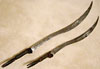
Any object of art should be judged by: A. Its historical significance and B. Its artistic merit. This being the case, any contemporary bladed weapon in the form of a historical one ( I am not talking about "ninja swords", utility knives, hunting implements etc) is not a legitimate one. This pertains equally to modern-made katanas or kindjals as well as to modern-made kerises. To wiggle out of this argument by stating that Keris still fulfills some cultural functions in this-day Indonesia is to ignore its original role as a weapon and to re-define it as a bauble, akin to bow-tie or wedding tiara. The artistic merit of any thing is judged on its own and does not depend on its place of manufacture or, - even more so, - on the ethnic origin of the master. Some of the best contemporary katanas are made by the Westerners and are commanding huge prices among Japanese collectors. Wootz ( bulat) originally was an Indian invention, and the most valuable examples were made in the 17-18th century Persia. However, at the present time , the best bulat blades are made by the Westerners, especially in the former USSR. As an example, here are contemporary saber and close-ups of bulat patterns made by Zaqro Nonikashvili and Gotscha Lagidze from Georgia. Can one find me a comparable example made by modern Indian or Persian bladesmiths? Any collector would dearly love to have pieces fulfilling both criteria. This is as a rule affordable only by very rich museums. Thus, we are forced to choose only one. I, for example, want to have only old swords. Other may go for the esthetic merit. But modern mediocre example made "within the culture and for the culture" is still a mediocrity. "Legitimate mediocrity" sounds even more insulting:-) |
|
|
|
|
|
2nd January 2014, 07:11 AM
|
#25 |
|
Member
Join Date: May 2006
Posts: 7,263
|
Analysis of the responses to date seems to indicate that most people here believe that the question of whether a keris can be considered to be legitimate or not can be decided by personal or group opinion and that the reasons that form this opinion of legitimacy can vary.
Amongst the reasons that can form a basis for a decision on legitimacy we can find:- Physical form, functionality as a weapon, quality of workmanship, symbol of authority, point of origin. Both the right to make a decision (group/personal determination), and the reasons that help form that opinion can be subjected to extensive analysis and argument, however, my intent in asking this question was not to generate debate where a show of hands would indicate the agreement or otherwise with any opinion. My intent was and is quite simply to gain a better understanding of how the people in our little group here regarded the matter of keris legitimacy. Since the question of keris legitimacy cannot be separated from an understanding of the nature of the keris, the answer to the question of legitimacy also provides an answer to the question of understanding. It may be argued that only one concept of legitimacy is valid, and that concept is the one held by the owners of the keris, the people who own the culture which created the keris. It is possible to mount a convincing argument both for and against this point of view, but for the purpose of discussion here I feel that this restrictive point of view is best not pursued, as the intent of my question was to seek a broad range of opinions, not necessarily opinions that can be supported as being correct. The keris is a multifaceted object that can be considered in many different ways:- It is primarily a symbol of the masculine element (Nawanatya), extended to "the essence of the world" (Sukuh inscription +/-1437) But it is a symbol in the form of a weapon, and it possesses a symbolic as well as a weapon function. The symbolic function was extended beyond the masculine symbolism and incorporated elements that in their entirety could be read as cosmic symbolism:- the Gunungan, the Naga, the ties to ancestors, the tie of ruler to ruled, the binding of previous to present generations of a kin group, the symbol of authority binding a tributary ruler to his lord. It is also a part of formal dress, and a store of wealth. The keris originated within the framework of early Javanese society, and it fulfilled and developed its cultural function within that society. By the time other societies in Maritime South East Asia had adopted the keris it was already incorporated into Javanese Islamic society and it was received into these other societies as an object that was only partially understood in its original context by both the originating culture, and by those who adopted the keris. Thus, if we wish to address the question of legitimacy we need firstly to specify the period of time, the place and the facet of the keris that we wish to declare to be either legitimate or illegitimate. Additionally we must understand exactly what we mean by “legitimate”. The word “legitimate” can be understood in a number of different ways, and each of these different ways can give legitimacy to a type of keris, or to anything that has a pretense to being any representation of the form of a keris. Thus, if we wish to declare that a keris is “legitimate”, or “not legitimate” we need to specify the parameters within which we wish to place that keris and declare its legitimacy. As an example of this, a keris that could be regarded as a legitimate for use as an item of dress may not necessarily be regarded as legitimate as a store of wealth; similarly, a keris regarded as a legitimate store of wealth may not necessarily be regarded as legitimate for use as a weapon. I would suggest that when we consider this question of keris legitimacy we need to answer these questions:- “legitimate for what?” “legitimate when?” “legitimate for whom?” Since the answers to these questions will cover a broad expanse of time, geographic location and cultural orientation, perhaps we should then consider if all opinions are equal, or does any opinion have its own relevance within the group that has given rise to that opinion? Careful examination of the responses above seems to indicate that most people are at least sub-consciously aware that the idea of “keris legitimacy” is not as clear cut as it might appear to be. It is just not an easy question to answer, any attempt to answer this question does in my opinion need to be fairly carefully qualified. This now brings me to the concept that gave rise to my question. The concept of the notorious "Tourist Keris". There seems to be a predisposition amongst many collectors to classify any keris that varies from a self-determined norm of quality to classify this variant keris as a "tourist keris". We cannot deny that there are keris that have been prepared specifically for sale to tourists. In general terms such keris present with hilt and scabbard that do not conform to societal norms, and with blades that can vary from flat iron to fairly decent antique blades. In one case I can recall seeing a Bali Tourist keris that had no blade at all, only a dowel that projected from the top of the scabbard to accept a hilt. I do not know of any endeavour amongst the makers of keris at any level to produce keris blades specifically for sale in the tourist markets of Indonesia. Yes, during the current era, as in times past, keris blades have been produced in various levels of quality, and the level of quality dictates the price. These keris blades are produced primarily for local consumption, and from my first hand observations, are purchased mainly by Indonesians, not by people from outside Indonesia. There is an ongoing need to supply keris as an item of dress, and as with any other item of dress in any society, people buy according to their means. Just because a keris is of poor quality that does not make it a tourist keris. Sales of keris at any level into the western world from Indonesia are only a drop in the bucket. If keris makers focused their attention on the occasional tourist who buys a keris as a souvenir of his visit, they would all starve to death. Makers of keris are as pragmatic as any other people engaged in trade and manufacture:- they produce goods that have the widest possible market base. The population of Indonesia exceeds 247 million people; during 2012 about 8 million tourists entered Indonesia. Is it good economic strategy to pin one's hopes on a very small, fluctuating and uncertain market, when there is a massive local market with continuing demand? I really would like to see the myth of the "Tourist Keris" buried with full honours. It would be very nice if we could look at every keris presented for comment and give as accurate an appraisal as possible, without dubbing it a "Tourist Keris", a term that inevitably conveys very little information to the enquirer, but surely leaves him feeling a little less enthusiastic about our shared passion. Do we wish to add to our numbers, or is it preferred that we remain a small niche group of enthusiasts, a group that will inevitably become smaller with passing time and eventually disappear? |
|
|
|
|
2nd January 2014, 07:33 AM
|
#26 |
|
Member
Join Date: May 2006
Posts: 7,263
|
Ariel, I do agree that an argument can be mounted to support your opinion, however, if we were to apply this argument to the keris it would make every keris made after the Early Javanese Classical period a non-legitimate keris.
If we moderated our criteria just a little and took the stance that we were really only thinking in terms of the Modern Keris, that is, the keris in the form it gained in about the 14th century, then we would need to label as non-legitimate every keris that was made after Islam became the dominant religious system in Jawa. If we were readers of Raffles "History of Java" we might decide that any keris that was made after about the mid-18th century in Jawa was indeed, non-legitimate. Moving into the 20th century we could give due consideration to the methods of manufacture used by many current era makers and determine that since such methods were at variance with the methods of the pre-industrial world, keris produced by such methods were non-legitimate. However, if we were to adopt any of the above points of view we would be placing our opinion above the opinion of the people of the culture that owns the keris. It is a simple fact that the nature of the keris has changed over the +1000 years of its existence, but it is still today a cultural icon in the culture that gave it birth. I do find that I can agree with the concept that as a collector who is not a part of the originating culture, we can all establish our own criteria for the addition of keris, or other objects, to our own collections. However, we cannot take it upon ourselves to dictate the legitimacy or otherwise of a cultural icon to the people who are a part of that culture. The keris as an art object is most certainly one of the facets of its character, but it is by no means the only facet, nor even the most important facet. |
|
|
|
|
2nd January 2014, 09:41 AM
|
#27 |
|
Member
Join Date: Dec 2004
Location: Ann Arbor, MI
Posts: 5,503
|
Alan,
Perhaps the word " legitimacy" is confusing in this aspect. By definition, its roots come from the Latin lex, law, or legitimare, to make something in accord with the law. What "law" can be applied here? Nothing was ever universally codified, nothing was divinely or democratically approved by the legitimately ( Ahem:-)) established authorities. Local traditions, tastes, beliefs and superstitions ruled the coops. Applying different time points further confounds the issue, as we can specify an almost endless number of them, with each excluding a percentage of examples from the discussion. The "military" purpose of keris vanished quite some time ago. Should we use this time point as our yardstick? Industrial nickel was introduced only at the end of 19th-beginning of the 20th century. Should we exclude anything not of Prambanan or Luwa ( BTW, which one?) connection? Even more provocative: should a good looking Keris made by an Englishman in Birmingham and intended to grace a wall of a Japanese collector be viewed as " illegitimate"? Would the situation differ if the Birmingham master or the new owner were ethnic Indonesians? My point is that there are as many collections as collectors and as many criteria of "legitimacy" as features. It is just what each of us prefers: history, age, tradition, level of perfection, wealth of decor, particular pamor.... you name it :-) Certainly, we cannot impose our criteria on Jawanese natives, but they in turn cannot impose their definitions ( and there are more than one cares to consider:-)) on the non-Jawanese collectors. If I am in the "Balinese camp", the "Surakarta lovers" may cringe at my poor taste and .... go and stuff it:-) Legitimacy may be codified in narrow, isolated and well-defined groups, but its confines weaken and blur the further we move away from them. BTW, why polygamy is legitimate in Yemen and illegitimate in Iceland? Why do you , an Australian, drive on the wrong side of the road? Why can't I show soles of my shoes to a Saudi or pat a child on the head in Thailand? Why did Nixon's "V-sign" provoke embarrassment in South America? Why does a child of an unwed mother is perfectly fine in the US and is an "illegitimate bastard" with no rights or prospects for future marriage in so many societies? Why was the latter true even in the US until some 50-70 years ago ? What effected the change in the criterion of his/her "legitimacy"? What I am driving at is that the "legitimacy" of Keris is a function of individual or societal taste, place and time, and those have a tendency to change :-) |
|
|
|
|
2nd January 2014, 12:38 PM
|
#28 |
|
Member
Join Date: May 2006
Posts: 7,263
|
I do agree with you Ariel that the word I chose to use could be a confusing one, however, I did take quite a long time to consider which single word I should use to express the essence of my question, and I chose the word "legitimate" precisely because of its wide range of application, and the foundation of the word, as you so correctly point out is in the concept of law, which is also the foundation stone of the existence of the keris.
I would like to address only the existence of the Modern Keris in the context of its foundation in regulation. When the Modern Keris was born from its ancestor form that we now call the "Keris Buda", there appears to be a solid argument to support the idea that this was not a process of illegitimate birth, but rather a legitimate and planned conception for a specific purpose. The birth of the Modern Keris seems to be rooted firmly in the law of the Javanese-Hindu hierarchical system. Then there is the system of regulation that defines what can, and cannot be considered a proper form for a keris. I do appreciate Ariel, that you are not deeply involved with the keris, but contrary to what you believe, the keris is rooted in law and regulation. One of the natures of the keris is as a societal regulator, a nature that can hardly have force in the absence of law. When we consider the multitude of other ways in which the word "legitimate" can be applied we have a word that can provide a descriptor for almost any concept of legitimacy that we wish to apply to the keris. The point I wish to make is this:- although "legitimate" may have its roots in "lex", in current usage it can be applied in a very much broader sense. This was the usage I was aiming for, as I did not wish to constrain discussion to that tired old parade of opinions on why each of us think some particular elements of something or other make it a fitting addition to our personal collections. I wanted to move away from the collector-centric thought process. A quick search of an authoritative dictionary will reveal that "legitimate" can be taken as :- lawful, conforming to rule or law, proper, normal, regular, of a standard type, logically admissible, justifiable. My preferred source is the Oxford on Historical Principles, but I believe any major dictionary will provide a similar list of applications. So you see, my choice of words was not perhaps as haphazard as it may have appeared at first glance, and in fact it demands a proper consideration of the actual applications of the word "legitimate". I am relatively certain that nobody grabbed their favourite dictionary before writing a response to my question, but even so, it seems that virtually everybody has responded in a sense that legitimises the use of the word "legitimate". In your response you have touched on the fact that time alters perception, and that any individual or group of people can determine for themselves what it is that establishes the parameters of legitimacy. Your summing up is precisely in line with the opinions of other respondents, and also with my opinions. However, although "--- we cannot impose our criteria on Jawanese natives, but they in turn cannot impose their definitions ( and there are more than one cares to consider:-)) on the non-Jawanese collectors---" In respect of the keris, and most particularly in respect of the Javanese keris, it is essential for us to recognise that we are dealing with much more than a simple weapon, or even a totemic symbol. We are dealing with what is arguably the major icon of a culture, and that icon is no less so today than it has been at any time in its past. Its nature may have altered, but its iconic status is living and remains intact. Collectors of anything invent their own rules of legitimacy, rules which very often have no relevance at all to the legitimacy of the cultural owners of that which they collect. Dr. David has brought this out very clearly and concisely in what he has contributed to this thread. So we have a situation where the ideas of collectors, especially collectors who are outside Javanese society, are not at all relevant to the values of the Javanese people who are most closely associated with the cultural values of Jawa. However, the collector must be at least somewhat aware of the values of those Javanese people, for if he fails to gain such an awareness he has negated any claim to knowledge of that which he collects. Put simply:- the values of collectors of keris are of less than no importance to the Javanese, but the Javanese are of immense importance to collectors of keris. |
|
|
|
|
27th February 2014, 06:06 AM
|
#29 |
|
Member
Join Date: Feb 2014
Posts: 472
|
“ . . .the values of collectors of keris are of less than no importance to the Javanese, but the Javanese are of immense importance to collectors of keris.”
An elegant and pithy statement which summarises the nature of the question of legitimacy regarding the keris, yet it still begs questions which the author had previously addressed, namely legitimate for what, when, and for whom. It seems obvious that Mr Maisey’s definition of legitimacy is intimately bound to the culture and people whose iconic device is the center of this discussion, and he has presented his case thoroughly and with insight, to the extent that I feel it cannot be disputed, but it might still be refined, if that is the word I’m looking for, or perhaps expanded. It seems therefore that legitimacy conferred on a keris would perhaps vary according to its chronological place in a cultural continuum. That is to say, a keris found legitimate in pre-Islamic Indonesia would have to remain legitimate in the eye of an outsider as well as a native Javanese; but would a keris made in the current millennium be seen as legitimate according to the lights of such a pre-Islamic Indonesian? Cultural perceptions shift, and my miniscule knowledge concerning Javanese culture leads me to suspect it is perhaps even more fluid than most. It cannot be denied that the culture of Indonesia has been influenced by centuries of contact with the rest of the world. Can that influence be seen to be of importance to the values of the Javanese, and how might it influence their perception of the iconic nature of their keris? While the concept of a “tourist keris” might seem, in the light of the relatively small numbers of tourists compared to the native population, tourists still number in the millions annually. The keris being obviously iconic to the culture, it is not unreasonable, although it might seem offensive to one intimate with that culture, to assume that at least some of these objects were made for purely financial reasons confined to the tourist trade. I speak as one who has never toured Indonesia, and who is nearly totally ignorant of the culture, so you may value my statement accordingly. But if it were so, I feel that this would impact on the concept of legitimacy. “The values of collectors are of less than no importance to the Javanese” being taken as given, it seems that even the “tourist keris” would have some form of legitimacy, but it’s hard to say, as I’m unable to speak for the Javanese regarding their perception of the situation. If they confer legitimacy on such an object, who am I to object? But I do not wish to focus on the tourist concept; the whole question is so open to consideration. Indeed, it is so open that ultimately there can be no answer such that it can be said to have been resolved to everyone’s satisfaction; or even, perhaps, to anyone’s satisfaction. As such, it is a delicious topic of exploration. Part of me wonders whether such a thing is reflective of an aspect of Javanese culture itself? As a nearly virginal collector of keris myself, my few choices have been made on the flimsiest of bases; exposure to a large number of photographs of such objects, coupled with some reading regarding the keris and the Javanese culture. In very fact, the heaviest influence has been photographic. This permits me to hold forth in a forum of individuals who have been involved with this subject for a sum total of centuries, if not millennia; my opinions will doubtless be taken with an eye toward their intrinsic worth. Nevertheless, the level of exposure that a forum such as this, and the various sources of visual input such as auction sites, is unprecedented, and perhaps confers some small level of legitimacy to the development of an eye with which to judge the worthiness of a purchase. It has been noted by Mr. Maisey that an ever-narrowing focus by a diminishing number of interested parties might not be a desideratum, which has prompted me to respond in these pages to his initial query; if it be considered too bold, I apologise; I have no wish to offend anyone’s sensibilities, nor do I feel that my insights are of major value to anyone beside myself. That said, my few choices of keris to collect has been formed by a fair amount of visual input, and nearly no hands-on experience. The number of keris that one can find to handle in any major Western city is not high; in fact, the number approaches zero asymptotically. So how to decide whether, and with what, to begin a collection? My focus was on the blade, as I saw it to be the heart, if not the soul, of the keris. To my mind, older was better, as being more likely to have, yes, legitimacy. Additionally, attractive pamor or unusual appearance was of interest; something out of the ordinary might be a false trail, but just as easily might be worthy of interest for its own sake. Tuition in this sort of school must be paid, and negative information is still, after all, information. I have no doubt that my study of the field has no chance of amounting to much, given the decades that will have been spent by others in their pursuit of knowledge of the subject, and the little time remaining to me to engage in such study. Despite that, I’m not yet deterred from further exploration. I see that I have done little to address the subject of legitimacy; really there’s not a lot to be added to what has gone before in this thread, especially from one so far outside the subject. While I suppose it is a legitimate area of inquiry for a collector, I sense that it can only really be addressed by those within the culture being studied; even so, I’m not sure that those within said culture concern themselves with such matters. Do fish concern themselves with water? Only to the extent that the medium itself might force the matter. |
|
|
|
|
28th February 2014, 03:11 AM
|
#30 |
|
Keris forum moderator
Join Date: Aug 2006
Location: Nova Scotia
Posts: 7,303
|
Welcome to the forum Bob. An eloquent introductory post.
|
|
|
|
 |
| Thread Tools | Search this Thread |
| Display Modes | |
|
|


 Linear Mode

