
|
 16th December 2013, 01:32 AM
|
#1 |
|
Member
Join Date: Nov 2013
Posts: 456
|
 Noth African sword
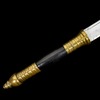
The seller described it as an Asian saber, but it looks too much like a Takouba style blade to be anything but North African. It's going to be awhile before it arrives here but I thought I'd post a few pictures from the auction.
Judging from the odd shape of the end of the blade and the way the fullers look truncated at the tip, I'm guessing this was cut down from a larger blade. The handle looks like it's riveted on, which is odd. Since the fullers look forged and the moon and crosses on the blade look stamped, is it safe to assume this was a European blade made for export to North Africa? The maker's mark is a man in the moon with three crosses on each side. I found a Nimcha with similar markings, 4 crosses instead of three though, here There's no sheath with it, so I'm not sure If it's possible to determine exactly where it came from. Any ideas? Or what I should call it? Was it a Nimcha at some point? Is it possible to tell where the blade was manufactured or how old it is? I got a pretty good price on it and nobody bid against me, so I hope I didn't get another dud. Last edited by blue lander; 16th December 2013 at 12:03 PM. |

|

|
|
16th December 2013, 12:39 PM
|
#2 | |
|
Member

Join Date: Jul 2006
Location: Buraimi Oman, on the border with the UAE
Posts: 4,408
|
Quote:
Salaams blue lander... Looks OK to me! Some may be forgiven for thinking this is a snapped sword ... at both ends... but have a look at http://www.vikingsword.com/vb/showthread.php?t=3985 Oh I see you have already spotted that ... Nice... In particular I think #7 by Jim McDougall is worthy of note. I looked up the reference to Sandiago Cross and that was interesting. Regards, Ibrahiim al Balooshi. Note; For other Cross shapes related to The Cross of St James (Santiago) see http://en.wikipedia.org/wiki/Cross_of_Saint_James I have added the famous sword hilt detail of the last Emir Abu `Abdallah Muhammad XII (c. 1460 to c. 1533), known as Boabdil (a Spanish rendering of the name Abu Abdullah), was the twenty-second and last Nasrid ruler of Granada. He was also called el chico, the little, or el zogoybi, the unfortunate. Son of Abu l-Hasan Ali, he was proclaimed sultan in 1482 in place of his father, who was driven from the land. Please note the 4 crosses on the hilt. (In Islamic terms, usually, the cross was used to signify light (candlelight), although, there may be another significance attached to this design) Last edited by Ibrahiim al Balooshi; 16th December 2013 at 01:59 PM. |
|
|
|
|
|
16th December 2013, 12:59 PM
|
#3 | ||
|
Member
Join Date: Mar 2010
Location: Olomouc
Posts: 1,720
|
Quote:
Quote:
|
||
|
|
|
|
16th December 2013, 03:12 PM
|
#4 | ||
|
Member
Join Date: Nov 2013
Posts: 456
|
Quote:
Thanks for the link on the Cross of St. James. In the Moorish application are there always 4 crosses? Mine has only 3. The half moon on his nimcha is a little different than mine too, it's facing a different direction. Speaking of the half moon, I think I saw a picture of a Takouba with a nearly identical half moon on, but now I can't find the link. Quote:

|
||
|
|
|
|
16th December 2013, 09:43 PM
|
#5 |
|
Arms Historian

Join Date: Dec 2004
Location: Route 66
Posts: 10,862
|
Blue Lander, far from a dud!!!!
While of course 'rough' it is a sound example of a blade which has probably been in circulation for a considerable time, and as noted, has been rather radically reprofiled. The hilt corresponds to certain Maghrebi forms, loosely of the type often seen on s'bula from Moroccan regions, and which have ranged in diffusion all the way to Zanzibar on trade routes. The use of wood brings to mind certain Tunisian hilt forms as Iain has mentioned. Returning to the blade, these distinct cross forms, particularly in the quadriform configuration seem to correspond to other examples seen occasionally on koummya if I recall correctly . The blade I would take for probably an 18th century German trade product and I suspect many of these to have ended up in the Maghreb. It seems that 'nimcha' sometimes have similar and on European origin blades of these forms which continued in production well into the 19th c. Often trying to definitively classify ethnographic weapons by a typological term is pure folly, as these blades not only were recycled and remounted from one generation to the next. The term 'Berber' of course covers an immense scope across Saharan regions, but may be considered broadly in descriptions while remaining correctly applied . I would consider this to be a Saharan knife with radically re profiled heavy sabre or cutlass blade of German import and probably as now mounted with tribal origins along Berber inhabited regions from Maghreb to Tunis. The blade likely latter 18th into 19th. |
|
|
|
|
16th December 2013, 11:25 PM
|
#6 |
|
Member
Join Date: Nov 2013
Posts: 456
|
Well I think that answers all of my questions. Thank you! I'm glad I finally got a blade with some significant age to it.
|
|
|
|
|
16th December 2013, 11:38 PM
|
#7 |
|
Member
Join Date: Nov 2013
Posts: 456
|
Whoops, thought of a couple more questions: do you think the blade is crucible steel or blister steel? Should I etch the blade or should I just coat it in museum wax and call it a day?
|
|
|
|
|
17th December 2013, 01:49 AM
|
#8 | |
|
Arms Historian
Join Date: Dec 2004
Location: Route 66
Posts: 10,862
|
Quote:
It is a trade blade from Solingen which has nothing to do with those kinds of steel or forging, and a true antique with probably an amazing history. It is not a museum showpiece, but that blade has well earned that dark patination. In my opinion, out of respect, I would suggest stabilizing and only light cleaning with WD40 or comparable. It is terrible to see the garish, over cleaned items often seen these days which have been stripped of the valuable patina and its inherent charm. |
|
|
|
|
|
17th December 2013, 02:04 AM
|
#9 |
|
Member
Join Date: Nov 2013
Posts: 456
|
I'll wipe it down and then give it a nice coat of WD-40. Thanks again.
|
|
|
|
|
17th December 2013, 08:50 AM
|
#10 | |
|
Member
Join Date: Jul 2006
Location: Buraimi Oman, on the border with the UAE
Posts: 4,408
|
Quote:
The reason for 3 crosses not 4 is probably because of the fullers preventing a 4th stamp being put. Three is a very powerful talismanic construct...in different regions including the Fleur de Lys 'Trio in Juncta' and Islamic forms. Regards, Ibrahiim al Balooshi. Last edited by Ibrahiim al Balooshi; 17th December 2013 at 09:01 AM. |
|
|
|
|
|
17th December 2013, 09:06 AM
|
#11 | |
|
Member
Join Date: Mar 2010
Location: Olomouc
Posts: 1,720
|
Quote:
It is a man in the moon, or half moon. These are very common in the region and consist of the curved back of the crescent, the face, often with a pronounced nose and the eye. This particular one is a little more rudimentary than some, but still of the general form. |
|
|
|
|
|
18th December 2013, 05:50 AM
|
#12 | |
|
Member
Join Date: Jul 2006
Location: Buraimi Oman, on the border with the UAE
Posts: 4,408
|
Quote:
Salaams Iain, I am aware of the numerous moon inscriptions generally seen on swords in the region but wish to point out that there are two distinct versions (generally). The first is the Peter Munch full obvious moon face and the second what I describe as the new moon basically struck. The moon in #1 is clearly struck with 3 inner new moon shapes. I think this became the style on African and Arabian(mainly Red Sea) blades copied from Europeans. I also think that although Peter Munch is considered to have struck the moons as some sort of majic association it was without the realization that this could indeed be a strong Talisman in other regions. The full faced man in the moon are struck at source whereas the more rudimentary forms are done in local workshops. My main point is that these may not be considered as half moons in Islamic areas since the half moon has little significance whereas the new moon is an entirely different subject. For a couple of examples of copied moons see http://www.vikingsword.com/vb/showth...ttara+comments #326. Regards, Ibrahiim al Balooshi. Last edited by Ibrahiim al Balooshi; 18th December 2013 at 08:10 AM. |
|
|
|
|
|
18th December 2013, 08:55 AM
|
#13 | |
|
Member
Join Date: Mar 2010
Location: Olomouc
Posts: 1,720
|
Quote:
|
|
|
|
|
|
18th December 2013, 09:41 AM
|
#14 | |
|
Member
Join Date: Jul 2006
Location: Buraimi Oman, on the border with the UAE
Posts: 4,408
|
Quote:
Salaams Iain ~ Thank you for your diagram illustrating the moon relating its so called facial character. A lot of folks reading into arms of these regions will have no idea about the Talismanic or other marks on swords...but as you say (and I agree) "Of course talismanic symbols from Europe can take on different meanings in various regions". If the moon is copied (onto African and Arabian Sword blades) Does the feature then take on another meaning altogether ? ... Is it then a man in the moon or something else? I suggest the latter... In which case it is not a man in the moon .. It becomes a Talismanic object reflecting a new moon in the sense of the region in which it now resides...something very different to its original application and meaning. In the same way the cross may well have changed to a star or even a dot.. * . and the cross becomes a sign of light (the candle) The dot an indicator of the centre of the Universe... For a couple of examples of copied moons see http://www.vikingsword.com/vb/showth...ttara+comments #326. Regards, Ibrahiim al Balooshi. 
Last edited by Ibrahiim al Balooshi; 18th December 2013 at 09:59 AM. |
|
|
|
|
|
18th December 2013, 10:04 AM
|
#15 | |
|
Member
Join Date: Mar 2010
Location: Olomouc
Posts: 1,720
|
Quote:
A new moon as far as I'm aware in Islamic art is not illustrated with a face... As seen in the one example you linked an image of where it is simply a crescent. In the context of African blades the mark retained much of its original form because it was a hallmark of quality and not merely an illustrative symbol. In short, marks can take on multiple meanings, sometimes outside of their original context. But when this much of the form is retained it speaks volumes as to the influence of the original application. |
|
|
|
|
|
18th December 2013, 10:22 AM
|
#16 | |
|
Member
Join Date: Jul 2006
Location: Buraimi Oman, on the border with the UAE
Posts: 4,408
|
Shedding some light on the New Moon..
Quote:
Salaams Iain, So you agree that what we have here is quite an interesting linkage back to perhaps Juan Martinez, Toledo mid 16th C or Peter Munch Solingen 1595-1660, thus, a European Sword mark which has been transmitted onto trade blades and copied by local smiths all over the African region and Red Sea, Yemen etc in the last 250 years. The precisely named "man in the moon" insignia being copied and as a mark of excellence onto blades in the region and beyond. Originally probably placed with a magical quality being inferred... and reflected somewhat in the Islamic sense of Talismanic protection in the crescent moon illustration...with and without nose eyes mouth... Thus it becomes a new moon in the afro/arabian sense from an original European man in the moon design. Regards, Ibrahiim al Balooshi. Last edited by Ibrahiim al Balooshi; 19th December 2013 at 08:37 AM. |
|
|
|
|
|
18th December 2013, 10:30 AM
|
#17 | |
|
Member
Join Date: Mar 2010
Location: Olomouc
Posts: 1,720
|
Quote:
I don't agree it necessarily becomes a "new moon" in the African context. That's an over simplification in my opinion. |
|
|
|
|
|
18th December 2013, 02:49 PM
|
#18 |
|
Member

Join Date: Dec 2004
Location: Greenville, NC
Posts: 1,854
|
You may find this picture helpful. The flintlock rifle style suggests this picture was taken in Morocco, but does not necessarily limit that style of sword's usage to that area alone.
|
|
|
|
|
18th December 2013, 04:26 PM
|
#19 | |
|
Member
Join Date: Mar 2010
Location: Olomouc
Posts: 1,720
|
Quote:
|
|
|
|
|
|
18th December 2013, 04:41 PM
|
#20 |
|
Member
Join Date: Nov 2013
Posts: 456
|
Thanks, that hilt looks quite similar although it doesn't seem to have the leather "bolster" mine has.
Does anybody have an example of what this blade mighty have looked like before it was cut down? Maybe something like this Gurade? http://www.vikingsword.com/vb/showthread.php?t=10460 |
|
|
|
|
18th December 2013, 05:10 PM
|
#21 |
|
Member
Join Date: Dec 2004
Location: Greenville, NC
Posts: 1,854
|
Iain,
I think if we can imagine the original sword in the thread with its complete, undamaged stylized "I" hilt as in the version below it could easily fall into the s'boula category. It seems as if this sword's lower hilt, or guard, uses leather as covering where they would more typically be brass covered. The hilt certainly seems closer to that to me than, say, a kaskara or takouba....don't you think so? Also note the mid hilt bolt that is generally universally seen on s'boulas and compare the zig-zag carving midway on that example to the carving on the wooden portion of the hilt below. The blade is, indeed, wider than the example below, but it has been cut down, clearly. Perhaps it was an attempt to mimic the s'boula??? Last edited by CharlesS; 18th December 2013 at 05:31 PM. |
|
|
|
|
18th December 2013, 05:25 PM
|
#22 | |
|
Member
Join Date: Mar 2010
Location: Olomouc
Posts: 1,720
|
Quote:
|
|
|
|
|
|
18th December 2013, 05:32 PM
|
#23 | |
|
Member
Join Date: Jul 2006
Location: Buraimi Oman, on the border with the UAE
Posts: 4,408
|

Quote:
Salaams blue lander, Very interesting blade form. Clearly a reworked European blade but from where I wondered may it have originated. I thought Falchion. Metropolitan Museum Quote."Falchion refers to a type of curved sword that was used in Europe from about 1200. This one BELOW is one of the few to survive from the late fifteenth century. Its long narrow blade and interlaced decoration on the hilt suggest the Middle Eastern influence that was an important feature in Venetian and Spanish art''.Unquote. Transmission of Nimcha and associated weapons throughout the Mediterranean is well known.. I see this as possibly the potential design origin of your weapon at #1. Any ideas anyone? The crosses look similar to those at http://www.vikingsword.com/vb/showthread.php?t=3996 on #3. Perhaps it is attributable to that specific tribal group? Regards, Ibrahiim al Balooshi Last edited by Ibrahiim al Balooshi; 18th December 2013 at 06:35 PM. |
|
|
|
|
|
18th December 2013, 05:35 PM
|
#24 |
|
Member
Join Date: Dec 2004
Location: Greenville, NC
Posts: 1,854
|
Just curious Iain....do they fetch very much at French auctions??? I am guessing not. The style in general won't win many blade beauty contests!

|
|
|
|
|
18th December 2013, 05:56 PM
|
#25 |
|
Member
Join Date: Nov 2013
Posts: 456
|
One other thing - the hilt appears to be decorated on only one side. Here's two more pictures from the auction. It looks like the seller shipped it out yesterday so hopefully I'll have it in a week or two.
|
|
|
|
|
18th December 2013, 06:05 PM
|
#26 | |
|
Member
Join Date: Mar 2010
Location: Olomouc
Posts: 1,720
|
Quote:
|
|
|
|
|
|
18th December 2013, 06:07 PM
|
#27 |
|
Arms Historian
Join Date: Dec 2004
Location: Route 66
Posts: 10,862
|
It is interesting to see the great developing discussion here especially pertaining to the markings, which of course have been a key fascination of mine for more years than I can say. I am also glad to see agreement in my notes (post #5) suggesting the s'boula hilt connection, which as noted could place this refurbished blade in many regional contexts throughout the wide Berber sphere. As Charles has noted, the occurrence of a weapon in a certain place or with a particular ethnic or tribal individual does not necessarily establish that as its indigenous provenance. The diffusion of ethnographic weapons through trade, warfare and often nomadic movements makes such classifications not only typically unlikely, but profoundly speculative.
Returning to the markings, especially the 'man in the moon' (known as dukari in Saharan parlance usually in pairs on takouba and occasionally on some kaskara in Sudan)....I think it is well established that this image or device has been adopted rather universally in native symbolism. While the original 'moon' character was part of a type of talismanic motif that evolved from various occult and magical followings, believed to have originated probably in Spain, it was soon widely used in Germany. As trade blades from Germany (the preponderance of volume) entered various centers and diffused into other regions via caravan routes, clearly the presence of such marks were emphasized by merchants to signify the quality of the blades. As these blades dispersed into tribal elements, the markings became often seen in the visual perspective of the folk religion symbolism. There can of course be many interpretations of what these might be as perceived temporally by these typically highly superstitious and not necessarily highly educated tribesmen. What is key is that the presence of these symbols became a matter of imbuement rather than distinct imagery or iconography. What was important was what the marking or its presence was supposed to induce in the blade, not what it was necessarily supposed to be. Over time these typically paired 'man in the moon' became degenerated in form to the point of being unrecognizable, but still their placement served its purpose . I think the occasion of these kinds of markings often appearing only on one side of the blade could signify apotropaic importance as protection from evil or malevolence was a prevalent concern in tribal cultures. The outer or 'exposed' face of the blade (sometimes scabbards as well) would have talismanic devices to ward off these forces. The flyssa is a good example of such geometric devices but it is on both blade faces. I think that the images in Briggs note similar mark grouping on a nimcha on one side only . On many Arab swords, the 'aghreb' (=scorpion) appears only on outer side to deflect evil eye. Last edited by Jim McDougall; 18th December 2013 at 06:20 PM. |
|
|
|
|
18th December 2013, 06:12 PM
|
#28 | |
|
Member
Join Date: Mar 2010
Location: Olomouc
Posts: 1,720
|
Quote:
|
|
|
|
|
|
18th December 2013, 06:21 PM
|
#29 |
|
Arms Historian
Join Date: Dec 2004
Location: Route 66
Posts: 10,862
|
We crossed posts Iain
|
|
|
|
|
18th December 2013, 06:21 PM
|
#30 |
|
Member
Join Date: Jul 2006
Location: Buraimi Oman, on the border with the UAE
Posts: 4,408
|
Salaams all~Note to Library; I mentioned earlier a reference to Moroccan crosses similar to those at #1 being attributable to one tribal group; Wikipedia, Quote" Mulai Ahmed er Raisuni (Arabic: "مولاي أحمد الريسوني", known as Raisuli to most English speakers, also Raissoulli, Rais Uli and Raysuni) (b. 1871,[1] Zinat, Tétouan – d. April 1925,[2] Tamasint, Al Hoceima[3]) was a Sharif (descendant of Mohammed) and a leader of the Jebala tribal confederacy in Morocco at the turn of the 20th Century.
While regarded by foreigners and the Moroccan government as a brigand, some Moroccans, especially among the Jbala, considered him a heroic figure, fighting a repressive, corrupt government, while others considered him a thief. Historian David S. Woolman referred to Raisuni as "a combination Robin Hood, feudal baron and tyrannical bandit."[4] He was considered by many as "The last of the Barbary Pirates" though Barbary Coast piracy had ended by the middle of the 19th century. On the other hand, according to Douglas Porch, an American historian, Raisuni was part of the rule rather than the exception in that every successful Moroccan politician at the time combined villainy with sainthood.[5] He died in 1925 after having been captured and imprisoned by his rival Abd el Krim.Unquote. The reference to which this link is associated is at http://www.vikingsword.com/vb/showthread.php?t=3985 and shows a dagger with similar crosses. Regards, Ibrahiim al Balooshi.
Last edited by Ibrahiim al Balooshi; 18th December 2013 at 06:52 PM. |
|
|
|
 |
| Thread Tools | Search this Thread |
| Display Modes | |
|
|


 Linear Mode

