
|
 3rd February 2013, 04:57 PM
|
#1 |
|
Member
Join Date: Oct 2009
Posts: 171
|
 semi-dual edged badik?
Hi guys,
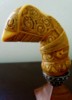
Another puzzling thing was this semi-dualled edge badek / badik (was it really a badik, after all?). I thought badek was always a single-edged weapon, but then I might be wrong. The top edge was blunt actually, until it reaches its 3/4 length (from the bottom) then the sharp edge started till the tip. No pamor traced. The hilt and scabbard were Bugis-like, but I really don't know it's rightful origin. Any info / thoughts are welcomed. Thanks |

|

|
|
3rd February 2013, 10:57 PM
|
#2 |
|
Member
Join Date: Aug 2007
Location: Germany, Dortmund
Posts: 9,736
|
Hi Moshah,
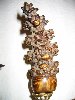
I would call it a badik. Here one from my collection with a real double edge, very sharp. Do you have etched it? I've never seen a badik without pamor. Regards, Detlef |
|
|
|
|
4th February 2013, 12:30 AM
|
#3 |
|
Member
Join Date: Oct 2009
Posts: 171
|
Hi detlef,
Yes indeed yours was also double-edged. I was in the thinking that mine could be something from the Phillipines, as I never saw anything like this. Now I've seen yours and somewhere back I think Artzi has sold one of the likes (pix). It was etched via the coconut juice way and I've failed to see any traces of pamor there on my piece. |
|
|
|
|
4th February 2013, 01:29 AM
|
#4 |
|
Member
Join Date: Apr 2005
Posts: 3,255
|
Hello Moshah,
I believe your blade was made from wesi/besi malela (a heavily forged steel with often higher carbon content which yields the dark, even stain despite being laminated). Your badik could well be from northern Malaya (not sure though). Regards, Kai |
|
|
|
|
4th February 2013, 02:01 AM
|
#5 | |
|
Member
Join Date: Oct 2009
Posts: 171
|
Quote:
From my observation, the besi used was similar to the type that we always see in kerises. Perhaps no nickel contents, hence no pamor. The characteristic of the besi was also akin to some Malay kerises that I have, made me so inclined to say it's a Malay badik. But from my understanding, Malay badiks usually will have a "mar" or "temin" - a round base before the tang (pix) which is not present on the badik of question here. This is why I was not prepare to expect that it was a Malay badik... 
|
|
|
|
|
|
5th February 2013, 07:40 AM
|
#6 | |
|
Member
Join Date: Oct 2009
Posts: 171
|
Quote:
Hi Kai, if the blade was made with such besi with higher carbon contain, does it mean it can easily break? I've read somewhere stated that besi melela was actually comes from a sandy grains along the west coast of java. Is that true? if not laminated, means that it was not done like how a keris should be? Thanks for the input, kai. Really appreciate it... 
|
|
|
|
|
|
5th February 2013, 11:33 AM
|
#7 | |||
|
Member
Join Date: Apr 2005
Posts: 3,255
|
Hello Moshah,
Quote:
Quote:
Quote:
Regards, Kai Last edited by kai; 6th February 2013 at 08:50 AM. Reason: changing "use" into "abuse" |
|||
|
|
|
|
5th February 2013, 02:18 PM
|
#8 |
|
Member
Join Date: Oct 2009
Posts: 171
|
Thanks for the elaborated explanation Kai...
Hmm I'm really critical on this one as most badik I've seen were pamorred, at least slight pamor. This one was plain baja, but somehow the mid part looks like it was fullered, which is something i've never seen on a badik. But then my biggest worry would be another kind of dagger / edged weapon "impersonated" to look like a badik...
|
|
|
|
|
5th February 2013, 04:06 PM
|
#9 |
|
Member

Join Date: Dec 2004
Location: Greenville, NC
Posts: 1,854
|
In Sajen's example, does anyone else see the possibility of a cut down pedang blade finding, perhaps, a second life as a badik?
|
|
|
|
|
5th February 2013, 06:10 PM
|
#10 | |
|
Member
Join Date: Aug 2007
Location: Germany, Dortmund
Posts: 9,736
|
Quote:
|
|
|
|
|
|
5th February 2013, 06:31 PM
|
#11 |
|
Member
Join Date: Oct 2009
Posts: 171
|
I think it is quite unlikely Detlef's was a cut down pedang, as the fuller length would not make any sense, to be that short a fuller for a longer blade.
Definitely there were traces of pamor as well, on detlef's badik. |
|
|
|
|
5th February 2013, 06:54 PM
|
#12 | |
|
Member
Join Date: Aug 2007
Location: Germany, Dortmund
Posts: 9,736
|
Quote:
The blade have a very fine pamor, unfortunately it's very dark etched so it's difficult to see. |
|
|
|
|
|
6th February 2013, 08:46 AM
|
#13 | |
|
Member
Join Date: Apr 2005
Posts: 3,255
|
Hello Moshah,
Quote:
 ). If the N Malay attribution can be confirmed, this might be a local style. As already suggested, it clearly shows heavy Bugis influence. However, the blade is always broad, flat with a wide and shallow central fuller, has a partial edge at the back of the blade, and is made from besi malela. The blade has enough strength for stabbing as well as cutting and is very quick/agile due to its low weight. I believe the stronger material makes this configuration feasible. It's well possible that the looks of European sabres influenced the blade profile; however, all 3 pieces seem to be locally crafted on purpose, not recycled from broken swords. ). If the N Malay attribution can be confirmed, this might be a local style. As already suggested, it clearly shows heavy Bugis influence. However, the blade is always broad, flat with a wide and shallow central fuller, has a partial edge at the back of the blade, and is made from besi malela. The blade has enough strength for stabbing as well as cutting and is very quick/agile due to its low weight. I believe the stronger material makes this configuration feasible. It's well possible that the looks of European sabres influenced the blade profile; however, all 3 pieces seem to be locally crafted on purpose, not recycled from broken swords.The typical Bugis badik from Sulawesi tends to have either a relatively narrow blade optimized for stabbing or a blade with fat belly adding more meat towards the tip for slashing moves. Both types tend to have a fairly thick back of the blade (as usual for most SE Asian daggers). I have seen several with partial back edge like in Detlef's example though. Some appear to be recycled pedang/etc. blades but quite a few are obviously intentional designs like already pointed out for Detlef's badik. Moshah, could you please post a pic of its scabbard? I'll try to come up with pics of mine, too. Regards, Kai |
|
|
|
|
|
6th February 2013, 09:06 AM
|
#14 | |
|
Member
Join Date: Apr 2005
Posts: 3,255
|
Hello Moshah,
Quote:
As you know, not that long ago, people used to freely move back and forth between Sumatra and W Malaysia. Regards, Kai |
|
|
|
|
|
6th February 2013, 01:44 PM
|
#15 | |
|
Member
Join Date: Oct 2009
Posts: 171
|
Quote:
Dear Kai, Of course we still could not confirm the origin of the blade, as much as I would really love to have it labelled "made in N.Malayan" as that would explain much on the absence of pamor material. The dress (pix attached) were bona-fide Bugis. Albeit being newly made (which would lessen the inclination of possibility that it comes from there), the overall image has the Bugis look into them, and so does the blade. If it was a conformed Bugis' badik, I think it is quite "obscene" for it not to have any pamor. Perhaps, made for the peasant... Of course, I am speaking with my limited knowledge in Badik, Bugis arms and socioculture, and limited experience too... 
|
|
|
|
|
|
7th February 2013, 07:43 AM
|
#16 | |||
|
Member
Join Date: Apr 2005
Posts: 3,255
|
Hello Moshah,
Quote:
Quote:
Quote:
The scabbard on the example sold by Artzi is definitely not Sulawesi nor is mine; its ivory buntut also doesn't suggest that this piece was just a low-end version. The hilt on my piece does show the "multicolored" wood typically favored by N Malays, too. Regards, Kai |
|||
|
|
|
|
7th February 2013, 03:44 PM
|
#17 | |||
|
Member
Join Date: Oct 2009
Posts: 171
|
Quote:
Quote:
 Quote:
BTW, would love to see your badik as well, Kai..
|
|||
|
|
|
|
10th February 2013, 05:08 PM
|
#18 |
|
Member
Join Date: Oct 2009
Posts: 171
|
it safely arrives...
Hi guys,
Received it today, safely. I would say the hilt and sheath looks decently new - not a slight of dark, blackish hue that usually takes place on antique hilts. Unless it was clean thoroughly, I stand to be corrected. On the other hand, they were made out of nice wood plot and of a considerable good workmanship, it seems. Apparently the shallow fuller can be clearly seen, as the slight concave runs from the first inch of the base, straight (and tapered) to the tip. The partial double-edge started a little bit further from the mid blade towards the tip. The blade was really smooth to the touch. As I ran my finger along the blade from the base towards the tip through the mid-section, the feel was almost velvety. I know some Malay keris with this same attributes and it is locally coined as "besi baldu" - means velvety iron. Perhaps the absence of pamor contributes to this feel but I do have few non-pamorred kerises, and it feel nothing like this. Except one, old Sumatran / Palembang sepokal which shares this sensation of touch... Kai, I've tried to ask the seller from where it comes from but as I've predicted - to no avail. So guys, is the blade a Bugis, a Malay or perhaps a Sumatran? |
|
|
|
|
12th February 2013, 03:17 PM
|
#19 |
|
Member
Join Date: Oct 2009
Posts: 171
|
We're still in the grey, are we?
BTW Kai, does this badik resembles that one of yours? |
|
|
|
|
14th February 2013, 10:17 AM
|
#20 |
|
Member
Join Date: Dec 2004
Posts: 125
|
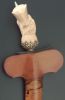
This is also a Peninsular piece which in Kelantan is usually called a "badik Bugis" ie. Bugis style, to distinguish it from the more typical Malay badik which have the mar.
BTW the piece pictured in post #5 is a typical Kelantan style badik and looks like a nice one. Good ones are hard to find. If you have the scabbard I'd love to see it. Also, the piece in post #3 now belongs to me. Such double edged blades are almost certainly a European influence adopted from Western military style blades. |
|
|
|
|
14th February 2013, 04:45 PM
|
#21 | |||
|
Member
Join Date: Oct 2009
Posts: 171
|
Hi Dave,
Quote:
Then your input and Kai's make me believe now that it is a Kelantanese / N.Malayan. Good lord! I've heard that Kelantanese refers to these kind as "bodek" or "pisau bugis"...and the one with the "mar" was a "badik". Since Kelantan and Pattani generally have their own keris and weaponology culture that is unique to itself, I think their badik is their badik and that's that. But definitely the similarities to the sewar's family was there, indeed. Quote:
However I know the owner and would be happy to tell you who is it, if you really want to know. He's quite a figure in the Kelantan keris scene... Quote:
 Well, sorry but I have credited Artzi for it beforehand, because I don't know of the nice badik's whereabout already... Well, sorry but I have credited Artzi for it beforehand, because I don't know of the nice badik's whereabout already... For a Peninsular piece, we hardly get to see any of the likes around so much. Not even here in Malaysia. Were the Kelantanese of the old days are more keen on the badiks with the "mar" type (i.e badik sepat etc) so that they did not make much of badiks with the design like yours and mine? Last edited by Moshah; 14th February 2013 at 11:01 PM. Reason: some spelling error |
|||
|
|
|
|
14th February 2013, 11:10 PM
|
#22 | |
|
Member
Join Date: Oct 2009
Posts: 171
|
Quote:
|
|
|
|
|
|
15th February 2013, 08:32 PM
|
#23 | |
|
Member
Join Date: Oct 2009
Posts: 171
|
Quote:
I guess the badik here is Kelantanese as well, with a mysterious kuningan that looks like a mixture of swassa in the pamor. But I though swassa or any other alloy couldn't mix up with the besi baja, so I really don't know what it is... |
|
|
|
|
|
16th February 2013, 09:45 AM
|
#24 |
|
Member

Join Date: Jul 2012
Location: Mother North
Posts: 189
|
That's some great looking horn on that last one Moshah, especially the color of the hilt.
Cheers, - Thor |
|
|
|
|
16th February 2013, 11:19 AM
|
#25 |
|
Member
Join Date: Oct 2009
Posts: 171
|
Thanks, Thor...but I believe it ain't a horn.
It is a sea ivory. See the dotted line on the pix below. Over here in Malaysia, I think it is not a common material for badik hilt. That's an observation, based on what I've seen, but still I haven't see a lot of things... And it's aged well...ah, the sin of the heart...
|
|
|
|
|
17th February 2013, 03:25 PM
|
#26 |
|
Member
Join Date: Aug 2007
Location: Germany, Dortmund
Posts: 9,736
|
Beautiful badik!
And I can only repeat what I have written in your other thread. Regards, Detlef |
|
|
|
|
17th February 2013, 07:20 PM
|
#27 |
|
Member
Join Date: Jul 2012
Location: Mother North
Posts: 189
|
Interesting. When you say 'sea ivory' which species are you exactly referring to? I am not familiar with any marine ivory both displaying lamellar growth like that, and at the same time showing cracks along the axis shown above. Then again, there's probably a lot of sea mammals whose teeth I haven't seen myself - especially tropical ones.
I know that 'dots in a row' in ivory, is sometimes associated with hippo tusks and their inner interstitial zone (TIZ), but the TIZ wouldn't take the direction shown in a cross section like the one above, unless your badik is very small. How long is the hilt btw? From the picture above, I would still bet on blonde horn - unless you are sure that it is definitely tooth. In that case, it would be interesting to see a macro straight on the very end, as well as one perpendicular to the length of the hilt. Sorry for the long ramble - nerding ivory is kindof what I do. Sweet looking badik regardless! All the best, - Thor |
|
|
|
|
17th February 2013, 07:59 PM
|
#28 |
|
Member
Join Date: Aug 2007
Location: Germany, Dortmund
Posts: 9,736
|
Hello Thor, you know what I would say!?
|
|
|
|
|
17th February 2013, 08:10 PM
|
#29 |
|
Member
Join Date: Jul 2012
Location: Mother North
Posts: 189
|
Hahaha, I do, I do - but hear me out bro!
If you look at the dots going across the bottom of the hilt, I just can't see any way that you can align this row with the TIZ running lengthwise along the inside of the tusk? Unless the above hilt is only like 3 - 4 cm long, the direction doesn't fit.It's totally different from the badik hilt you posted recently. In yours the hilt aligns up nicely with the curve of a hippopotamus tusk and also remember - I agreed with you on that one!
|
|
|
|
|
17th February 2013, 10:42 PM
|
#30 |
|
Member
Join Date: Aug 2007
Location: Germany, Dortmund
Posts: 9,736
|
Maybe Moshah can enlighten us? What he think it is? And how long is the hilt?
|
|
|
|
 |
| Thread Tools | Search this Thread |
| Display Modes | |
|
|


 Linear Mode

