
|
|
|
 20th December 2012, 11:08 AM
|
#1 |
|
Member
Join Date: May 2006
Posts: 7,248
|

Over perhaps a few years now I have read the many and various posts and opinions on hilts made from supposedly hippo ivory, walrus ivory, this ivory, that ivory, and some other ivory. I've looked at close-up pictures of dotted lines that supposedly prove that the material is hippo ivory, I've looked at pictures of vague ivory grains that supposedly prove the material is some other sort of ivory. It seems almost everybody knows more about this exotic discipline of ivory identification than I do, so I have pretty much stayed out of the discussion.
However, it seems to me that somewhere, sometime during the last forty odd years of visits to Indonesia and long wandering conversations with collectors and dealers in keris and other objects in Indonesia, I would have heard some mention of hippo ivory. But I never have. It seems that in my reading on historic trade links with the Old East Indies I would have somewhere stumbled across some mention of hippo ivory coming into what is now Indonesia. I never have. The hilts that I see presented as hippo ivory seem to be almost universally described by dealers and collectors in Indonesia as "tulang ikan" = "fish bone", or "gigi ikan paus" = "whale tooth". I've never heard even the smallest whisper of "kuda nil", or "badak sungai" = hippopotamus. Now, I'm not saying that this total absence of any acknowledgement by the people most closely concerned with keris, and most especially with the extraction of money from the trade in keris, is evidence that these hilts of supposedly hippo ivory are indeed, not hippo ivory. But it does seem strange that if the possibility is there, that these incredibly clever traders would ignore the chance to raise the exotica stakes a notch or two by throwing some hippo into the money mix. So, is it barely possible that this hippo business is just another collector myth? Where is the beginning and foundation for these claims that some hilts are made from hippo ivory? Do we have any good, solid, incontrovertible evidence of just one hilt that is beyond the shadow of any doubt made of hippo ivory? Or do we have opinions that choose to ignore the accumulated knowledge of the demographic most closely associated with the keris? Quite frankly, I had never heard even the smallest suggestion that those poor old hippos in far away Africa had been contributing their body parts to the glorification of keris in Maritime South East Asia, until very recently. I'd really like to try to understand how the whole thing happened. Can somebody point me at an academic paper, or article, or report where an adequate analysis of the materials used in keris hilts demonstrates beyond any doubt that hippo ivory was used to create just one hilt? Or possibly some old trade inventories that list hippo ivory coming into Batavia or some other port in the Old Indies? |

|

|
|
20th December 2012, 12:38 PM
|
#2 |
|
Member
Join Date: Nov 2006
Location: The Netherlands
Posts: 2,238
|
Dear Allan,
Interesting question. Antique dealers and also antique magazines in the west more or less agree that the dotted line indicates hippo ivory. But I must believe you when you say this term is not used in Indonesia. Best would be to go to the source and check with the people making these hilts. Do they ever have pieces of hippo ivory in stock ? Have you ever seen the raw materials in Indonesia which they use ? this would indeed be very intersting. Best regards, Willem |
|
|
|
|
20th December 2012, 01:38 PM
|
#3 |
|
Member
Join Date: Jun 2009
Posts: 1,740
|
Dear Alan and Willem,
Thank you for your interesting comments and again I have no academic background nor proven evidence that these hilts are made from hippo ivory but wish to reply as follows: . All the ivory hilts supposedly made from hippo ivory which I saw or own are either from Sulawesi or Sumatra/ Malaysia, so the Javanese or Balinese dealers or experts are not very qualified to identify them IMO. . The trading between Bugis sailors and East Africa or Oman (which controlled Zanzibar and Tanzania ports until beginning of 20th century) was well established in the past, I will try to find more written evidence. . The external dotted line is connected to the interstitial zone found in hippo ivory and not other species as far as I know. . All the hilts supposedly made from hippo ivory which I saw are old (circa 100 years or more) and the hippo ivory trading with Indonesia vanished long time ago so I doubt that you can find any Indonesian hilt maker familiar with the materials nowadays (but probably in China). . For those of you who like myself are familiar with such pieces, the materials looks and feels very different from the other ivory species from it high density, white colour, and very polished aspect, and it ages much better than elephant ivory for instance (no cracks). Spermwhale tooth ivory is also different because its colour is darker inside. Well, this is my last attempt to convince you on the subject and I will welcome the opinion of experts.  Regards |
|
|
|
|
20th December 2012, 02:23 PM
|
#4 | |
|
Member
Join Date: Aug 2007
Location: Germany, Dortmund
Posts: 9,788
|
Quote:
Regards, Detlef |
|
|
|
|
|
20th December 2012, 06:01 PM
|
#5 |
|
Vikingsword Staff

Join Date: Nov 2004
Posts: 6,441
|
Hippo Teeth
I have seen numerous examples of Hippo Tooth for sale on gunbroker.com .
Usually from a Seller located in Florida . 
|
|
|
|
|
20th December 2012, 06:56 PM
|
#6 |
|
Member
Join Date: Dec 2004
Location: Kuala Lumpur
Posts: 369
|
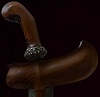
I also believe that the sample above is actually hippo ivory. Not much evidence to form a basis of my belief apart from the dotted line present on hippo ivory matches with the one on these hilts and the following observations.
I noticed that there are 3 main types of ivory normally used to make keris hilts. Elephant (with cross hatch), "hippo" (mainly refered to as "gigi ikan" with the dots) and another one with no dots or cross hatch. The third type is normally smaller in size. Probably this is the real "gigi ikan"? The thing about "gigi ikan" versus elephant ivory and hippo's tooth is that, some people here consider "gigi ikan" as clean while elephant ivory and hippo (if that is the material) as unclean according to teachings in Islam. Probably this is the reason why the material is being presented as gigi ikan in the first place. Currently, "hippo" ivory fetches a bit higher price here as opposed to elephant ivory (probably for the above reason) However when we look to old Malay saying "Sudah dapat gading betuah, tanduk tidak berguna lagi". Meaning a person had something much more valuable (elephant ivory) compared to horn. If "gigi ikan" is being regarded highly in the old days, probably the saying will say "sudah dapat gigi ikan bertuah...." but this is not the case. (Notice that the cleanliness issue does not seem to play any role here) Probably people the really old times are not aware or does not subscribe to the belief that elephant ivory are unclean hence the above old saying. Therefore, my speculation that this "gigi ikan" thing is actually market driven due to the cleanliness issue that arose not very long ago. But, it's just my speculation that is built on a very brittle foundation.. 
|
|
|
|
|
20th December 2012, 08:07 PM
|
#7 | |
|
Member
Join Date: Jun 2009
Posts: 1,740
|
Quote:
Thank you for the interesting Malaysian perspective. Gigi ikan (fish tooth) should normally refer to the spermwhale tooth (the most common) and dugong tooth/tusk (rarer and smaller in size), and they are known as marine ivory. I am not mentioning walrus ivory as I don't think that it was commonly used in the Malay region. I checked the book Senjata Pusaka Bugis and found that they described most of the old ivory hilts shown in the book as dugong ivory (and few as elephant ivory), but I have my doubts about it considering the size and curvature of the Bugis hilts.  Regards |
|
|
|
|
|
20th December 2012, 08:43 PM
|
#8 |
|
Member
Join Date: May 2006
Posts: 7,248
|
First and foremost, let me be very clear:-
Jean, my remarks were not an attack upon you, nor upon anybody else. I am simply try to get some solid evidence for the "hippo ivory" thing. As I have already remarked:- I have never heard mention of hippos until a few years ago. Why? Jean, there is not challenge to trade links between Maritime SE Asia and Africa and the Middle East. It is established fact that trade was carried on for hundreds of years; the Malays began to extend trade links in about the 5th century, and there are populations of Malay people in a number of other countries, including a large presence in Madagascar --- just off the coast of Africa. There is no need to prove any connection between Maritime SE Asia and places far west, that connection is well documented and not at all open to challenge. There is no difficulty at all in presenting a logical argument that hippo ivory could have made it to SE Asia, and could have been used in hilts. But in my questioning post I did not ask for re-iteration of possibilities, beliefs nor logical argument. I asked for something slightly more positive. In respect of this material only appearing in Sumatera and Peninsula hilts, well, maybe. These are the only hilts that have that pistol grip like curve that requires maximum manipulation of the material; in a Javanese or Balinese hilt the same material could be used and the ugly flaw of a dotted line avoided. The material could have been used, but we simply do not know. I have a number of the hilts of the type that is associated with hippos. A couple have dotted lines, most do not. Mix these hilts, close your eyes, and try to identify one from the other. I've tried this, and I cannot. They all feel exactly the same. As to patina:- with the ones I have, he patina on the ones with dotted lines is pretty much the same as on the others, which I believe are marine ivory. Possibly others have a more sensitive touch than do I, and can differentiate on this basis, but I cannot. I have a moderate collection of ivory pieces , and over 100 ivory keris hilts. Some pieces of known whales tooth do have colour variation on inside and outside, others do not. Rasdan, thank you for your input. In my experience ordinary people in Indonesia do not differentiate between one kind of ivory and another. Its all "gading", even tagua nuts are referred to as gading by non-specialists and non-dealers. Why? Because to ordinary people all ivory -like materials look the same . Thus, if we have a colloquial expression --- " no use for horn if you've already got ivory" one could not reasonably expect a differentiation in colloquial usage. If in Malaysia supposed hippo now brings a higher price than other ivory, it would interest me to know when this began to occur. I am inclined to believe that here we have evidence of input from the western world affecting the Malay market. Not dissimilar to the well known Keris Majapahit example. Gigi ikan is a term that I would never expect to hear in Indonesia from a person with no keris connections, nor dealer connections. Now, we've had a recitation of belief. It has been interesting and I accept it as belief. Maybe even entrenched belief. Is there anything just a little stronger out there? |
|
|
|
|
21st December 2012, 10:07 AM
|
#9 | |
|
Member
Join Date: Jun 2009
Posts: 1,740
|
Quote:
Yes indeed, if you google "hippo ivory sale" you will find this site which proposes many tusks at a very attractive price (cheaper than registered elephant ivory). Regards |
|
|
|
|
|
21st December 2012, 10:20 AM
|
#10 |
|
Member
Join Date: May 2006
Posts: 7,248
|
Jean, I don't know if these are Bugis people. The references I have only say "Malay".
They might be Bugis, but I don't know. What I'm mostly interested in is this:- when was the first mention of hippo ivory being used in these hilts, who made it, and upon what basis. Following on from that, the proof that these hilts are definitely hippo ivory, not just the possibility that they could be hippo ivory. |
|
|
|
|
21st December 2012, 10:21 AM
|
#11 |
|
Member
Join Date: Jun 2009
Posts: 1,740
|
I found a recent and interesting article about the various types of ivory at the following address:
http://stoneplus.cst.cmich.edu/zoogems/ivory.html Nothing very new in it but a good summary with references and it confirms the dotted line and the higher density of hippo ivory (and spermwhale ivory) than elephant ivory especially. It also says that Schreger lines are only found in elephant or mamooth ivory Regards Last edited by Jean; 21st December 2012 at 12:17 PM. |
|
|
|
|
20th December 2012, 08:43 PM
|
#12 | |
|
Member
Join Date: Jun 2009
Posts: 1,346
|
Quote:
|
|
|
|
|
|
21st December 2012, 08:56 AM
|
#13 | |
|
Member
Join Date: Jun 2009
Posts: 1,740
|
Quote:
Alan replied to this point and he is fully correct that some of the Madagascar people are from mixed Malay origin. I will try to find more written evidence about the subject. Regards |
|
|
|
|
|
21st December 2012, 12:02 PM
|
#14 | |
|
Member
Join Date: Jun 2009
Posts: 1,346
|
Quote:
As I said, I searched a while ago about Bugis trade, and I even don't have found evidence Bugis traded directly with Ceylon=the Bugis vessels have reached Ceylon. |
|
|
|
|
|
21st December 2012, 01:22 PM
|
#15 | |
|
Member
Join Date: Jun 2009
Posts: 1,740
|
Quote:
I agree, the Malay settlement in Madagascar occurred much earlier than the Bugis trade indeed. Regards |
|
|
|
|
 |
| Thread Tools | Search this Thread |
| Display Modes | |
|
|


 Hybrid Mode
