
|
 19th December 2012, 12:04 AM
|
#1 |
|
Member
Join Date: Dec 2005
Posts: 692
|
 VIVAT PANDOUR INSCRIBED HUSSAR SWORD
Dear Friends,
Here is a sword I'm considering for a swap. It is quite a typical hungarian hussar sword but with "vivat pandour" inscoriptions... Hmmm... it raises me some questions. Those inscriptions are believed to be end of 18 century and commonly found on hunting blades. I never seen the on a hussar sword before. What can you tell me about it? Any comment is apreciated. |

|

|
|
19th December 2012, 02:50 AM
|
#2 | |
|
Member
Join Date: Mar 2005
Location: Australia
Posts: 685
|
Quote:
pandour [ˈpændʊə] (Historical Terms) one of an 18th-century force of Croatian soldiers in the Austrian service, notorious for their brutality [via French from Hungarian pandur, from Croat: guard, probably from Medieval Latin banderius summoner, from bannum ban1] From: http://www.thefreedictionary.com/pandour And all the very best for the festive season to all. Cheers Chris |
|
|
|
|
|
19th December 2012, 05:25 AM
|
#3 |
|
Arms Historian

Join Date: Dec 2004
Location: Route 66
Posts: 10,867
|
An attractive sabre, but for me personally I'm a bit uncomfortable with its 'interpretative' characteristics in which the hilt is 'in the style of' the early 17th century Hungarian forms. However the quillons were typically longer, as was the langet bar which typically ran up the grip most of the way. This configuration to me resembles a kaskara type crossguard, and the langet resembles some 18th century Austrian and German cavalry sabres of 1780s.
The blade seems like an 18th century European cavalry blade with clipped back/shallow yelman. As Chris has well noted the Pandours were irregular troops for Austria during the War of the Austrian Succession (1740-48) originally formed by Baron von Trenck. Thier exploits, while effective for a time, became notably troublesome when many of these troops became renegades and the units disbanded with von Trenck imprisoned (he committed suicide in prison 1749). Thier fearsome reputation became well known throughout Europe in these times however, and motif heralding them in a commemorative sense began to appear as noted, on plug type hunting bayonets around 1750+. As far as I have known, these motif and inscriptions using the term 'VIVAT PANDUR' only occurred on these bayonets ( R.D.C.Evans, 'The Plug Bayonet', 2002, p.94) and on some court type hunting swords of later in the 18th century (Bashford Dean, 1929; Buttin, 1933). This mid to latter 18th century inscription, seems out of place on what would seem to be an interpretation of a Hungarian sabre of 150 years before. The pommel also is quite contrary to the usual protrusion on the early sabres for better grip. My opinions based on these photos of the example posted and comparison to images of actual specimens of Hungarian sabres c.1600 in Ostrowski, 1979. As always age can best be detected with hands on handling, and while tempted to suggest 18th century, I cannot see why a cavalry sabre of 18th century would be made in this style when at this time they had knuckleguards, nor with this motif. |
|
|
|
|
20th December 2012, 02:47 AM
|
#4 | |
|
Member
Join Date: Mar 2005
Location: Australia
Posts: 685
|
Quote:
Seasons greetings to all. Cheers Chris |
|
|
|
|
|
13th January 2013, 09:58 PM
|
#5 |
|
Member
Join Date: Dec 2005
Posts: 692
|
Well thatone is much better, I guess
 Well, at least, apart from the knot  Sorry for the low quality pics. What are those markings, Jim? |
|
|
|
|
14th January 2013, 06:23 PM
|
#6 |
|
Arms Historian
Join Date: Dec 2004
Location: Route 66
Posts: 10,867
|
While the pics are agreeably on the rough side, this sabre seems more impressive agewise, though the sword knot of course has nothing to do with the sword as an original element.
These markings are a type of European device which seem to evolved from earlier Italian makers stamps of about 16th century, a sort of 'star' image closely related to the 'twig' and 'marca mosca' forms. The circle with radiating lines seems to resemble solar symbols, but is referred to by Briggs (1965, p.49) as a 'cogwheel' type mark. It seems these 'cogwheels' occur on Swiss arms c.1560s and in various groupings on N. Italian blades c. 1600-20. While Briggs suggests German copying of these, it seems those are not open circles but filled and not in larger groupings like the Italian configurations. The Italians seemed to favor these multiple and linear repititions of single devices in certain examples, and these 'cogwheels' even seem to occur in some of the sickle type marks instead of the three dots. Since this sword seems East European, either Hungarian or Polish, and with these Italian style grouping of these 'cogwheels', it could possibly be a Styrian product as they seem to have favored Italian markings (especially the sickles) and they are known to have been suppliers to Hungarian producers. |
|
|
|
|
15th January 2013, 02:26 AM
|
#7 |
|
Member
Join Date: Dec 2005
Posts: 692
|
Great! Thank you Jim!
Thank you very much. In the meanwhile I searchead a little in my limited literature and found a similar sword in the croatian book Ubojite Ojstrice by Mario Kovac, under the item number 99 on pages 69 and 114. It is a much better looking husar sword marked with crosses rather than cogs, but arranged in a similar way. The interesting fact is, that it bears also the mark of G.Lindl (according to the author) from Judenburg in Styria. Ironically, the sword returned to Styria, where apparently was produced and it is still located in Styria in an old collection (togheter with that composite kilij I put for comment recently). It is kept by a nice old Lady whos husband passed away and she is still unsure wheter keep the collection or wheter to sell it. I will post better pics when or if I have the chance to visit her. |
|
|
|
|
15th January 2013, 05:55 PM
|
#8 |
|
Arms Historian
Join Date: Dec 2004
Location: Route 66
Posts: 10,867
|
Thank you so much Valjhun!
I do not have the book you note on Croatian arms, but thank you for the support toward my Styrian assessment, also for the detail on this makers name. It is fascinating that this sword indeed returned to Styria, and I really look forward to more on this as it develops, please keep us posted! It is extremely rare to find one of these with this kind of provenance. I am sending PM. All the best, Jim |
|
|
|
|
18th April 2017, 02:11 PM
|
#9 | |
|
Member
Join Date: Apr 2017
Location: Sweden
Posts: 790
|
Literature lead request
Quote:
I wonder if you know how I can best obtain a copy of the book Ubojite Ostrice? I tried to contact the Museum of Zagorje to no avail. Many thanks for your advice. |
|
|
|
|
|
18th April 2017, 11:18 PM
|
#10 |
|
Arms Historian
Join Date: Dec 2004
Location: Route 66
Posts: 10,867
|
Glad to see this thread opened since we have a current discussion on 'pandours' via the 'Austrian hussar' sabres thread going.
Here is a blade of a sabre with the 'Vivat Pandours' image, which I found but not unfortunately with the rest of the sword. As discussed several years ago, the 'Vivat' theme was well known about the time of the original Pandour units c. 1744, but they never used the term pandour. These images with that term came about when other units with similar function were assembled in various European militaries later in the 18th c. (the original von Trenck units in Austria were disbanded c.1748). The 'pandour' term came to be regarded with similar connotation as the 'dragoons' term in England, and such use as meaning 'to be dragooned' or run down mercilessly referring to the British troops in the Highlands in 'police action'. The original units became notorious for wild outlaw type behavior in their pillaging and foraging. Their fearsome appearance with exotic costume and weaponry, along with that added to their countenance. The 'Vivat Pandur' theme was essentially applied in the same sense as 'Remember the Alamo' motto on countless Bowie knives produced in and for Americans long after those events at the Alamo in Texas in 1836. |
|
|
|
|
21st April 2017, 07:38 AM
|
#11 |
|
Member

Join Date: Dec 2004
Location: California
Posts: 1,036
|
common motif on regulation and trade blades alike
A similarly garbed figure on a horse seems to have been a stock figure on engraved saber blades of the 17th-18th cent. which have come down to us in Eastern European and Asiatic hilts. There are minor differences in costume, but the steed is generally rearing up and the horseman typically has a tall hat, some sort of cape, and is holding a saber.
I have two examples in my collection, one a mid-17th cent. Polish saber ex- armory of the Princes zu Salm-Reifferscheidt-Dyck with no "vivat..." banner over the cavalier but with 4 patriotic and religious mottoes in Latin in lieu of this, and the other a Russian one with similar imagery, inscribed "Tula" (in Cyrillic letters) on one side and "1778" on the other, this latter one in a Qianlong- or Jiaqing-era Chinese hilt and scabbard. Prof. E. G. Astvatsturyan, in ORUZHIYE NARODOV KAVKAZA (armament of the Caucasian peoples), St Petersburg 2004, illustrates several examples (figs. 38-40; 43) recorded on shashka blades. One of them has a "Vivat Hussar" banner inscribed over the figure, the author identifies the blade as coming off of an 18th cent. Prussian regulation saber. The others are believed to be Solingen export blades, or native Caucasian copies, on these examples, the horseman is accompanied by the mottoes "Pro Deo et Patria" or a garbled version of "In te, Domini speravi non confundar in aeternum". The most interesting appearance of one of these blades is an extremely rare example of a European blade in Japanese hilt and scabbard, with the outward appearance of a katana when sheathed. In the National Museum in Copenhagen, it is believed to have been fitted-up late in the 17th or early 18th cent. and is ex-King Frederick VII collection, transferred to museum 1864. The familiar horseman is augmented by several Latin inscriptions positioned above and below (as on my Polish saber), these with numerous misspellings and losses (due to corrosion and wear). The sword has been written up in an article by Per Terje Norheim, "Et Euro-Japansk Sverd i Nationalmuseet i Kobenhavn", VAABENHISTORISKE AARBOGER XVI, pp 163-73. Interestingly enough, the author makes reference to yet another European blade in Japanese dress, this one exhibited in London and Oxford in the 1960s, this one inscribed "me fecit solingen 1633" (but no mention made of the horseman iconography.) Bottom line is, that figure of a cavalryman had quite a cachet in its day, a lot like the Marlborough cowboy in our time! |
|
|
|
|
21st April 2017, 07:00 PM
|
#12 |
|
Arms Historian
Join Date: Dec 2004
Location: Route 66
Posts: 10,867
|
Philip, thank you so much for this great input! and especially for always, as is your hallmark, always furnishing such well detailed and cited references. Your resources are remarkable, and the insight from your experience coupled with these references give those pursuing these topics the inroads for further research.
Interesting to know more on these particular motif designs as well, and I like the 'Marlborough man' analogy! 
|
|
|
|
|
30th April 2017, 09:55 PM
|
#13 | |
|
Member
Join Date: Apr 2017
Location: Sweden
Posts: 790
|
Quote:
Last edited by Victrix; 30th April 2017 at 10:14 PM. |
|
|
|
|
|
20th January 2026, 07:27 PM
|
#14 |
|
Member
Join Date: May 2020
Posts: 1,041
|
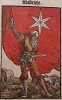
hereby a couple of Pandur daggers, mid 18th century with blades between 36 and 55 cm, only the last one is a small dagger with a 26 cm blade.
|
|
|
|
|
20th January 2026, 07:29 PM
|
#15 |
|
Member
Join Date: May 2020
Posts: 1,041
|
some more
|
|
|
|
|
20th January 2026, 07:32 PM
|
#16 |
|
Member
Join Date: May 2020
Posts: 1,041
|
next batch and interesting uncle Jim did already mention them some time ago as well:
http://www.vikingsword.com/vb/showpo...72&postcount=6 http://www.vikingsword.com/vb/showth...ghlight=pandur and our dear friend victrix also recently in #6: http://www.vikingsword.com/vb/showth...ghlight=pandur mostly from Trenck's pandurs in the Balkan region of what is now the border region Croatia, Slavonia, Dalmatia, Hungary, Bosnia http://www.vikingsword.com/vb/showpo...15&postcount=7 Last edited by gp; 20th January 2026 at 07:54 PM. |
|
|
|
|
23rd January 2026, 09:31 PM
|
#17 |
|
Member
Join Date: Apr 2017
Location: Sweden
Posts: 790
|
Contemporary picture.
|
|
|
|
|
24th January 2026, 07:12 PM
|
#18 |
|
Member
Join Date: Feb 2023
Posts: 251
|
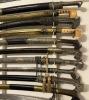
There is an exibition about Trenks Pandours in Croatia in city Požega, put up by Tomislav Aralica, Croatias collector and bigest expert on antique arms and history, he presented several weapons very nice karabela swords, of which one is made for pandour regiment specificaly in passau by Jacobus Mayrschofer.
Wery nice yataghans with blades of reused swords and sabers. |
|
|
|
|
24th January 2026, 07:16 PM
|
#19 |
|
Member
Join Date: Feb 2023
Posts: 251
|
There are also pandour images from old books and graphics from museum in Požega.
|
|
|
|
|
24th January 2026, 07:18 PM
|
#20 |
|
Member
Join Date: Feb 2023
Posts: 251
|
P
|
|
|
|
|
24th January 2026, 11:50 PM
|
#21 |
|
Member
Join Date: Feb 2023
Posts: 251
|
Hmm how the pictures got horizontal I have no idea...
They were vertical. But there is trouble with uploading and delay. |
|
|
|
|
26th January 2026, 02:15 PM
|
#22 |
|
Member
Join Date: May 2020
Posts: 1,041
|
....double, sorry !
|
|
|
|
|
30th January 2026, 07:18 PM
|
#23 |
|
Member
Join Date: Dec 2004
Location: Bay Area
Posts: 1,770
|
Thank you for the photos from the exhibition!
|
|
|
|
|
7th February 2026, 10:48 PM
|
#24 |
|
Member
Join Date: Feb 2023
Posts: 251
|
No problem 😃👍🏻
|
|
|
|
|
13th February 2026, 09:50 AM
|
#25 | |
|
Member
Join Date: Mar 2011
Posts: 217
|
Quote:
|
|
|
|
|
 |
| Thread Tools | Search this Thread |
| Display Modes | |
|
|


 Linear Mode

