
|
 7th August 2012, 06:44 PM
|
#1 |
|
(deceased)
Join Date: Dec 2004
Location: Portugal
Posts: 9,694
|
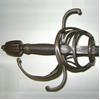
 Sword hilt for ID
The owner told my friend this is an Islamic hilt, but something tells me this is European. I even think a similar one was already posted here.
The guy only left a picture of the hilt and a description of the blade: slightly curved, thin, single edged, length 70-80 cms ( 28 to 31"). Any ideas ... please ? . |

|

|
|
7th August 2012, 07:02 PM
|
#2 |
|
Member
Join Date: Jun 2008
Location: The Sharp end
Posts: 2,928
|
Tut, tut Nando!
Pictures of the whole item please! |
|
|
|
|
7th August 2012, 07:46 PM
|
#3 |
|
(deceased)
Join Date: Dec 2004
Location: Portugal
Posts: 9,694
|
As i said Gene, no more pictures
 .That's why i tried to compensate with the blade description .That's why i tried to compensate with the blade description  . .I know this is a chalenge; hoping the hilt is self speaking . |
|
|
|
|
7th August 2012, 08:56 PM
|
#4 | |
|
Member
Join Date: Jun 2008
Location: The Sharp end
Posts: 2,928
|
Quote:
 So I'll be posting a blade stamp I want to identify now  As for your sword. The hilt looks later 18thC to me. But pictures of the blade might change that opinion. My initial thoughts are that the animal headed full bronze hilt with 'S' guard puts me in mind of the private bandmans swords from that era. But there is something almost 'hunting hanger' about it. The Bird has a very 'exotic' look to it. My feeling is European but colonial. |
|
|
|
|
|
7th August 2012, 10:36 PM
|
#5 |
|
Arms Historian

Join Date: Dec 2004
Location: Route 66
Posts: 10,867
|
I think Gene has a good observation here, this does appear of European form and quite possibly Spanish colonial /Mexican. The striations in the guard are mindful of the scallop shell, often seen in Spanish themes. I cannot see anything here that suggests Islamic.
|
|
|
|
|
7th August 2012, 10:53 PM
|
#6 |
|
Member
Join Date: Dec 2004
Location: NC, U.S.A.
Posts: 2,236
|
Hello gents-
Just wanted to concur with Jean and Jim, adding that although the form is odd, it could also be colonial American- Swords with this exact pommel type, including raised feather patterns, can be seen in the Lattimer collection ('Silver-Mounted Swords' by Danial Hartzler), plates 294, 298, 325, 326, 328, 332, 334, 343. Plate 327, the closest to our eagle with the exact beak pattern (almost ibis-like), eye and feather pattern on a sword by William Ball of Baltimore (1763-1815). His other swords, listed in plates above, all extremely similar. The reason Jim might have hit it on the head is that many/most of Ball's swords bear Spanish blades with the motto- "No Me Saques Sin Razon", etc, etc. Thus, we could have a colonial Spanish sword or one made in New Spain for the American market ca. 1790-1820's?? Nice sword... |
|
|
|
|
8th August 2012, 02:48 PM
|
#7 |
|
(deceased)
Join Date: Dec 2004
Location: Portugal
Posts: 9,694
|
Thank you all Gentleman,
I will transmit your precious thoughts to my friend and will endeavour to post pictures of the whole sword within soon. |
|
|
|
|
8th August 2012, 02:49 PM
|
#8 | |
|
(deceased)
Join Date: Dec 2004
Location: Portugal
Posts: 9,694
|
Quote:

|
|
|
|
|
|
8th August 2012, 03:31 PM
|
#9 | |
|
Member
Join Date: Jun 2008
Location: The Sharp end
Posts: 2,928
|
Quote:
"What's good for the goose is good for the Gander" I didn't realise it was OK to post incomplete pictures of items when asking for ID's until you posted this hilt. Which is good because now I can post that blade stamp I wanted to identify. On the subject of your hilt I think the bird has to be the big clue. It's so distintive and exotic. Again I'm reminded of the cast bronze stylised 'beast head' hilts of the west Indies bandsmens swords from the 19thC. But for some reason this one makes me think VOC/Dutch east indies. Even though as has been said, it does have a Spanish/S.A feel to it Edit: Not the same, but possibly something approaching it is this Dutch east india co sword, dated by the dealer to cicra 1620 (?). Last edited by Atlantia; 8th August 2012 at 03:59 PM. |
|
|
|
|
|
8th August 2012, 05:56 PM
|
#10 | |
|
(deceased)
Join Date: Dec 2004
Location: Portugal
Posts: 9,694
|
Thanks for the picture of the Dutch India example and added suggestions, Gene
.Quote:
The issue is not being or not O.K. to post pictures of partial items, but to encourage the upload of pictures of the full piece, if one is able to get them , for better appreciation and more well based identification ... and for the sake of more solid material for the forum archives. It is not prohibited to post parts of a weapon, if you don't have access to the rest of them, or even if you only have that part. In this specific case, pictures of the full sword and a close up of the blade marks were surpringly achieved in no time and here they are. It should be added that the blade has a false edge in last section. Perhaps through the marks (symbols) we can have you guys to extend your comments on the typology and provenance of this sword. ... for which i would be thankfull. . |
|
|
|
|
|
8th August 2012, 06:08 PM
|
#11 |
|
Member
Join Date: Jun 2008
Location: The Sharp end
Posts: 2,928
|
Found a pic of the rest of that sword:
|
|
|
|
|
8th August 2012, 07:02 PM
|
#12 |
|
Member
Join Date: Dec 2004
Location: NC, U.S.A.
Posts: 2,236
|
Nice pics of both swords. Gene, I like this Dutch hanger very much, especially the lion motifs carved into the ivory hilt. Back to Fernando's sword. Having seen the blade, which is also a classic hanger pattern, I stick by my original opinion of American, possibly made in New Spain for the market. Hartzler's book really is a valuable source, with multiple pics of eagle-hilts from the original Medicus collection plus many 'one-offs' like this one. Most colonial Spanish swords didn't have hanger-type blades, but more of the straight espada types. The few I've seen with curved blades were either massively long, or of a more crude construction. Not so sure about those marks-
It should be noted that the two most common types of weapons with eagle-type hilts in this time period were American and/or New Spain/Mexican. |
|
|
|
|
8th August 2012, 08:36 PM
|
#13 | |
|
Member
Join Date: Jul 2009
Location: Nipmuc USA
Posts: 555
|
Quote:
Sorry, I must disagree no matter how kindly it can be put. The Ball examples (indeed all the pictures you reference) are anything but exacting and are all hollow floating pommels. The beaks are all sharper, less hooked and most of those examples with less than oriental eyes. Indeed, aside from both appearing to be birds heads with feathers, there is really no direct correlation at all. I feel the association to Ball (while noted in my own appreciation) is just plain wrong in this case. However, the blade revealed and described does have similarity to the shorter hangers of colonial America. That is a big however though and truly nothing in Neumann or the Lattimer collection matches this cast brass bird head. there are though a number of odd Latin/Mexican American countries that may have been responsible (while I can see the quite oriental look to it). Just to add (as I do like eagles) there is nothing in the Medicus collection of eagles relevant to the bird of this thread. Cheers GC |
|
|
|
|
|
9th August 2012, 12:17 AM
|
#14 |
|
Arms Historian
Join Date: Dec 2004
Location: Route 66
Posts: 10,867
|
As noted, eagle heads were keenly popular in America post Revolutionary War and well into the 19th century, many of the well known 'eagleheads' were from around the end of the Mexican War (1846). The style of this eagle is indeed unusual and the profound presence of feathers to me seems inclined more to Mexican Republic type influence. The Mexican emblem is of course the eagle, and highly feathered regalia traditional Aztec representation. The blade does seem European hanger in form, the marks as yet are unknown to me but seem somewhat familiar.
The alternating quillons are not remarkably significant as a specific identifier as they were of course common on many forms of hangers, bayonets and swords throughout Europe, on colonial swords in many spheres, and are familiar on the ring hilt daos of China. The Dutch VOC sword is of the form well known in hangers of 17th-18th century and remind me of examples resembling kastanes as well as various lion heads etc. and in ivory. For some reason I cannot recall any example of eaglehead on an Islamic weapon, though of course theoretically some highly stylized hilts are presumed to possibly represent various birds. |
|
|
|
|
9th August 2012, 12:45 AM
|
#15 | |
|
Member
Join Date: Jun 2008
Location: The Sharp end
Posts: 2,928
|
Quote:
Notice the bird heads on the ends of the quillions? I like the Ivory hilted one as well mate. |
|
|
|
|
|
9th August 2012, 12:48 AM
|
#16 | |
|
Member
Join Date: Jun 2008
Location: The Sharp end
Posts: 2,928
|
Quote:
Hey buddy, Are we sure Nandos sword is an eagle? It doesn't look very 'bird of prey' to me. And there is no distinctive 'lip' around the beak. Also it doesn't extend back under the eye, it's stuck on the 'face' like a nut cracker or seed eater. Thats why I think it might be a good clue. |
|
|
|
|
|
9th August 2012, 05:39 AM
|
#17 |
|
Arms Historian
Join Date: Dec 2004
Location: Route 66
Posts: 10,867
|
I guess I better turn in my birdwatchers badge
didnt notice the beak features. Still the sword itself seems very colonial, and perhaps further south into Central America or further? While certainly not entirely faithful to the actual eagle image, the remainder of the heavy feathered plumage is similar to that on the Mexican emblem eagle. The beak as you note does seem rather bluntly placed, reminds me a bit of the toucan, but of course not quite as pronounced beak. Perhaps the perception of the eagle with more southern Americas influence? Otherwise, what sort of bird might it be? |
|
|
|
|
9th August 2012, 01:35 PM
|
#18 |
|
(deceased)
Join Date: Dec 2004
Location: Portugal
Posts: 9,694
|
You guys are fantastic. I don't know how to thank you for your precious input
 . .
|
|
|
|
|
15th August 2012, 07:11 PM
|
#19 |
|
Member
Join Date: Dec 2004
Location: NC, U.S.A.
Posts: 2,236
|
I think that the Spanish colonial/Mexican opinion is the closest until someone presents material to refute it. Under my previous response, I mentioned American eagle-heads with 'very similar' form and I'll stick by with it, in that some of those pieces in the Lattimer collection are obviously later Mexican pieces. Your friend would benefit from that book by Hartlzer I mentioned earlier.
|
|
|
|
|
15th August 2012, 08:55 PM
|
#20 |
|
(deceased)
Join Date: Dec 2004
Location: Portugal
Posts: 9,694
|
Thank you Mark.
And well noted
|
|
|
|
|
16th August 2012, 05:13 PM
|
#21 |
|
Member

Join Date: Jul 2006
Location: Buraimi Oman, on the border with the UAE
Posts: 4,408
|
Salaams all~ Great thread and some classic answers made this a fascinating project to watch ... I think most posts hit the nail on the head in pretty well all aspects of this quandry ~ I would like to add this http://www.mexconnect.com/articles/3...than-face-face which perhaps answers one or two puzzles as to why this is a Mexican Eagle but why that eagle doesnt actually hunt live animals all the time or why it doesnt look like a full on eagle (Atlantia) It is true it rather looks like a seed or nut eater beak...However it is a carrion eater. In fact it will eat snakes but snakes that are usually already dead.
What I find interesting is the peculiar horn grip on the other example more like the Arabian style of Hawks head though obviously not arabian as it is VOC Dutch... but the crossguards !! The Crossguards on both weapons are almost identical. Therefor is not perhaps the #1 weapon Dutch also ? Regards, Ibrahiim al Balooshi. Last edited by Ibrahiim al Balooshi; 16th August 2012 at 05:41 PM. |
|
|
|
|
16th August 2012, 08:04 PM
|
#22 | ||
|
Member
Join Date: Jul 2009
Location: Nipmuc USA
Posts: 555
|
Quote:
Quote:
 Along with having the book in hand, I also have many scans of the eagle and bird pommels (indeed could post all the examples you have listed). I also find no examples in Hartzler's book as obviously Mexican, nor listed as such. Again, I would continue to think it remiss for any to use Ball's work as relevant to the sword in the original post to this thread and indeed the only similarities that of birds with feathers. The same true for the Medicus collection book in reference to eagles found there. Cheers GC |
||
|
|
|
|
17th August 2012, 08:35 AM
|
#23 |
|
Member
Join Date: Jun 2008
Location: The Sharp end
Posts: 2,928
|
The beak of that example is more akin to the carved ivory Dutch example and both are actually eagle like.
The beak on Nando's example is more like an Ibis or even a parrot. I'm not saying it couldn't be an eagle. But if it is an eagle then the person who cast it didn't know what an eagle looks like. |
|
|
|
|
17th August 2012, 01:29 PM
|
#24 | |
|
(deceased)
Join Date: Dec 2004
Location: Portugal
Posts: 9,694
|
Quote:
On the other hand and, assuming i have no ornithologist notions at all, once rejecting the eagle, ibis and parrot are not more fortunate suggestions .
|
|
|
|
|
|
17th August 2012, 11:12 PM
|
#25 | |
|
Member
Join Date: Jul 2009
Location: Nipmuc USA
Posts: 555
|
Quote:
I was really a hold out about the influences of world travels reaching Europe and the kastane bridge particularly until seeing a magnificent portrait of an Englishman in battle of the English civil war with a truly serious kastane hilt. So anyway, this one for the other hanger of the thread I will refrain from posting all the Shriner's scimitars variations I have come across There are a number of full brass hilts of eagle and bird form associated with the Americas and my picture files (many thousands) for those of North America (ie USA) can be broken down pretty easily between the bird and eagle types. It is the bird head pommels of generally English patterns that the Lattimer collection fill the pages along with the true crested eagles. As important in that collection and presentation are the pages of Roman and knighlty form pommels. I found Jim's classification of toucan quite apt and had thought that immediately myself before he wrote it (strange minds do sometimes think alike). My own classifications of three major players in American Eaglehead Pommels is broken down to Larry, Curly and Moe of the three stooges (Osborn, Bolton and Ketand) so I can appreciate whatever one may call an item but the bird in question beginning this thread is none of those. Cheers GC Cheers GC |
|
|
|
|
|
17th August 2012, 11:39 PM
|
#26 |
|
Member
Join Date: Jun 2008
Location: The Sharp end
Posts: 2,928
|
Hi Glen,
I also thought it reminiscent of a Toucan funnily enough. So what's your conclusion? I know the Roman hilts that you speak of, but again they couldn't be miscast as parrots... well the ones I'm familiar with anyway. Even the quite stylised ones are recognisable as Eagles. Hold on I've got one somewhere..... Edit: Even when the form is quite stylised as in this one, it's usually still recognisable as an eagle. As in my dagger pommel below. Last edited by Atlantia; 17th August 2012 at 11:52 PM. |
|
|
|
|
18th August 2012, 02:15 AM
|
#27 | |
|
Member
Join Date: Jul 2009
Location: Nipmuc USA
Posts: 555
|
Hi Gene
Quote:
Cheers GC |
|
|
|
|
|
18th August 2012, 01:43 PM
|
#28 |
|
Arms Historian
Join Date: Dec 2004
Location: Route 66
Posts: 10,867
|
Glen and Gene thank you guys for the kind notes on my toucan suggestion. Although it seemed rather 'left field', it seemed a compelling enough idea to place in the discussion here, which has proven really intriguing.
I think another feature in Fernando's sword which to me stands out for a Mexican weapon is the heavy plumage which seems to correspond to the eagle in the Mexican emblem. In the tropical regions of Mexico it does seem possible that an artisan fashioning a cast hilt might have these influences coupled with the familiarity of the tropical birds such as toucan. The often dramatic stylization and simply general artistic license would seem to offer considerable ground for anomalies such as this. Fernando, still fascinated by the markings you have shown from the blade. Where are they situated, and any chance that close ups might show them in place? All the best, Jim |
|
|
|
|
19th August 2012, 04:43 PM
|
#29 |
|
Member
Join Date: Jul 2009
Location: Nipmuc USA
Posts: 555
|
While I did agree in first impression in similarity to a toucan, the stretch to apply it to the Mexican eagle is as wrong headed as applying the Lattimer collection as examples of the bird. The Aztec mythology of Huitzilopochtli in no way included a toucan. It is true though that there were many tropical birds and colorful feathers well noted.
All in all (aside from the blade itself) a tourista middle eastern brass hilt is as viable an explanation as projecting the possibility to north and south America. The condor, certainly another bird used for sword hilts. Cheers GC |
|
|
|
|
19th August 2012, 09:31 PM
|
#30 | |
|
Arms Historian
Join Date: Dec 2004
Location: Route 66
Posts: 10,867
|
Quote:
Ouch! how deftly placed! Guess thats how we learn. |
|
|
|
|
 |
| Thread Tools | Search this Thread |
| Display Modes | |
|
|


 Linear Mode

