
|
|
|
 3rd March 2012, 03:33 PM
|
#1 |
|
Member

Join Date: Jul 2006
Location: Buraimi Oman, on the border with the UAE
Posts: 4,408
|

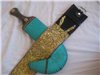
Origin of species Omani Dancing sword SAYF. There are no details indicating the provenance or precise timeline of this swords' origins. It is assumed to have arrived in the 18th century but how and from where or what design is unproven. Perhaps someone simply dreamed it up, from the sword pictured below, as an honorary equipment in parallel with the current ruling familys control viz;
~ Imam Ahmed bin Said bin Ahmed bin Mohammed Al-Busaidi (founder of the Al Busaidi state) was subsequently elected Imam in 1744. He was a popular and well-respected leader. Despite having to reconcile the warring factions after the civil war, Ahmad bin Said developed and built up the Oman navy into a fierce task force, which assisted in the expulsion of the Persians from Basra. He died in 1783 in Rustaq ~ The Possible Contender as to Origin. It looks rather like a Red Sea variant sword known to have origins in Ottoman, Mamaluke, Abbasiid and likely Greek style. The hilt is, in fact, tantalizingly similar in style to the old Omani Sayf Yamani except it looks stretched since its long weighty blade requires a long handle for balance. It is a weapon; i.e. it has a point and a spike at the pommel for the close in business. It is double edged and not flexible being stiff and powerful in make up for stabbing, thrusting and slashing. Looking closely there is what appears to be a hilt guard and though it is tenuous it does appear to be a reinforced structure forward of the grip. On the other hand, and in the absence of proof, it may be totally unrelated.  Regards, Ibrahiim al Balooshi. Last edited by Ibrahiim al Balooshi; 4th March 2012 at 02:47 PM. Reason: text alterations |

|

|
|
3rd March 2012, 09:41 PM
|
#2 |
|
Member
Join Date: Oct 2009
Location: Moscow, Russia
Posts: 118
|
I wonder what sword does this man at the picture have, I guess it shall be a curved kattara or can it be straight saif?
|
|
|
|
|
3rd March 2012, 11:27 PM
|
#3 |
|
Member

Join Date: Jan 2011
Posts: 1,167
|
Video, please.
Hi Ibrahiim, the subject of Omani "dancing swords" fascinates me. Perhaps you have posted elsewhere but..is there any chance of you posting a video of the sword dance in action. Believe it or not there is a tradition of UK sword dancing, called "Morris dancing" ie"Moorish Dancing" often claimed to have been brought back from the Crusades.
|
|
|
|
|
4th March 2012, 02:04 PM
|
#4 | |
|
Member
Join Date: Jul 2006
Location: Buraimi Oman, on the border with the UAE
Posts: 4,408
|
Quote:
 There is a dance routine enactment on web just tap into search Omani Sword Fighting I think.. There is a dance routine enactment on web just tap into search Omani Sword Fighting I think.. Regards, Ibrahiim al Balooshi. |
|
|
|
|
|
4th March 2012, 03:48 PM
|
#5 |
|
Member
Join Date: Oct 2009
Location: Moscow, Russia
Posts: 118
|
Salaams Ibrahiim, thank you for ansewr.
So as far as I understand you, long straight saif was made only for dancing and never was a weapon, neither battle one nor what we can call presentation (like European court swords, small-swords, officer dress-daggers and so on which can't be counted as actual weapons due to light construction but underline the high status of their owners) But I see one more picture of modern days - I guess it's H.M. Sultan Qaboos himself, and as I can see he is wearing a straight saif. So I just wanted to ask could there be a possibility of using straight saifs as a kind of presentation weapon, or their role is only for dancing and nothing more? Thank you in advance! |
|
|
|
|
4th March 2012, 03:51 PM
|
#6 |
|
Member
Join Date: Oct 2009
Location: Moscow, Russia
Posts: 118
|
Also as I can see straight saifs often serve as official presents..
|
|
|
|
|
4th March 2012, 04:08 PM
|
#7 | |
|
Member
Join Date: Jul 2006
Location: Buraimi Oman, on the border with the UAE
Posts: 4,408
|
Quote:
Regards Ibrahiim al Balooshi. |
|
|
|
|
|
4th March 2012, 04:05 PM
|
#8 | |
|
Member
Join Date: Jul 2006
Location: Buraimi Oman, on the border with the UAE
Posts: 4,408
|
Quote:
Salaams Devadatta ~ Yes thats the ruler holding a sword with gold trim in what appears to be either straight or curved variety though I cant tell since its cut off half way bet I suspect it is curved. None the less in the case of the ruler he can wear what he pleases  The straight Sayf is "Dancer Only" not for fighting though often given as a present... Regards Ibrahiim al Balooshi The straight Sayf is "Dancer Only" not for fighting though often given as a present... Regards Ibrahiim al Balooshi
|
|
|
|
|
|
4th March 2012, 11:39 PM
|
#9 | |
|
Member
Join Date: Jan 2011
Posts: 1,167
|
Quote:
|
|
|
|
|
|
5th March 2012, 04:46 PM
|
#10 | |
|
Member
Join Date: Jul 2006
Location: Buraimi Oman, on the border with the UAE
Posts: 4,408
|
Quote:
Salaams David R ~ Then it appears that the closest comparison to the Razha section(SWORDS CELEBRATORY SECTION) in the Funoon pageant tradition~ in the form of a processional dance and secondly in a mimic fight "al yalaah" which goes back to 751 AD and beyond is Morris Dancing in the UK! UK Pantomime styles I believe also exist in the Guy Fawks celebrations and in the ring a ring o roses enactment by children of the great plague...and in pageants such as The Furry Dance. In Oman the unwritten form takes on quite another level and everyday "way of life" events are recorded so that the body of work (The Funoon) is sub-divided into Agriculture, Fishing, Trade, Marriage and War to name a few of the unwritten, acted out, pageantry; songs, dances, poetry and performances which are sacrasanct and handed down faithfully generation to generation. Regards, Ibrahiim al Balooshi. |
|
|
|
|
|
6th March 2012, 05:52 PM
|
#11 |
|
Member

Join Date: Nov 2010
Location: Kuwait
Posts: 1,340
|
""The Omani dancing sword was never used nor was it intended for use as a fighting weapon. The sword dance is purely honorific and as part of the Funoon reflecting a tradition. Going in to bat against a swordsman with a proper sword would leave someone without fingers and probably minus a hand in about 2 seconds flat ! Piano lessons would be cancelled !""
This has already been answered. The lack of quillons or guard is no measure. The evidence can be found in many swords such as: 1- Shashkas. 2- Afghan Shashkas. 3- Sinai bedouin Saber. 4- Dhas. 5- Barongs. 6- Khyber knives. So there is plenty of evidence to counter your assumption here. ""The Omani Sayf dancing sword was designed for the traditions.. The Razha ... nothing else. The shield blocking is part of a show. Exponents can attack the shield but can only score the winning point by touching the opponents thumb with the spatulate tip..."" Sure, that might be the rules of the dance. But you are neglecting the existance of sharp saifs and ones with pointy tips.. oh wait, these are one offs... many one offs. ""The flexibility is for show only~ so that the blade can be buzzed in the air in the procession part of the Razha. People would laugh at you if you went into a sword fight with a 90 degree bending tip !!"" Not necessarily, after all, not all Kattaras are flexible blades ;-) (I take the whole "solid blades are touristy" argument as very.. well pointless) ""No quillons, no spike on the pommel, and a blade that bends virtually in half does not equal a fighting sword..Your suggestion of the spiked pommel being "subjective" is puzzling. ( On this point we are refering to the Old Omani Battle Sword comparing its spiked pommel with the Dancing Sayf which has no spike). The spike being for close quarter battle. Why else would a sword have a spiked pommel? More importantly why has the dancing sword not got one? Hardly subjective; I suggest."" This is subjective because not every sword that went to use through out history has a spiked pommel. The straight Omani saif not having a spiked pommel does not say much about its purpose ;-) ""What is far more relevant is that the term Sayf was passed on from the Old Omani Battle Sword ~ The SAYF YAMAANI ~ along with the TERRS SHIELD to be honoured in the Funoon by this dancing tool, a simbolic accoutrement...not a weapon system as such but given the name Omani Sayf wa Terrs."" Or maybe they just called a saif.. a saif like most arabs do?:P ""Your Bedawi reference is, as you indicate, ill placed, however, I would suggest that this is an interesting weapon requiring serious research and fine detail..."" You still missed the point. My reference was regarding the situation in which the badawi has evolved, the straight Omani "MAY" have went to the exact same thing as like the badawi, there are solid battle omani saifs and dance ones. So all am saying is, your whole conclusion is assumptive. (Decided to reply here, in order not to delay Illiad's topic) |
|
|
|
|
4th March 2012, 01:52 PM
|
#12 | |
|
Member
Join Date: Jul 2006
Location: Buraimi Oman, on the border with the UAE
Posts: 4,408
|
Quote:
Salaams Devadatta ~ Is it Straight Sayf or Curved Kattara? Wow !! Very interesting picture which appears to be the local governor(Wali) of Salalah in 1902 ! He wears a medal and the Royal Khanjar and a long hilt sword. Is it a curved Kattara (hilt marginally longer than the straight and worn in the dress ceremonial (Iconic) role) rather than the Straight Sayf worn in preparation to dance or enact a pageant? The Wali is like the lord mayor (seen here in full official regalia in special head dress and official robes) though with wide sweeping jurisdiction and legal powers acting to solve local water rights, grazing rights, land disputes or arguements over family problems and other affairs ...This looks like his official portrait photograph. The Wali could easily hold a court session with up to 10 or more cases being dealt with symultaneously rather like the Caucasian chalk circle by Tolstoy ~ instant justice ~ The long curved Kattara therefor being the badge of office of the legal governor of Salalah. "The Wali Of Salalah" . Wali Mohamed bin Salim Mirindani. Brilliant post thankyou ! Therefor it is The Omani Curved Kattara. Regards, Ibrahiim al Balooshi. |
|
|
|
|
 |
| Thread Tools | Search this Thread |
| Display Modes | |
|
|


 Hybrid Mode
