
|
 18th January 2012, 09:18 PM
|
#31 | |
|
Member
Join Date: Nov 2011
Location: Brooklyn, NY USA
Posts: 227
|

Quote:

|
|

|

|
|
18th January 2012, 09:28 PM
|
#32 |
|
(deceased)
Join Date: Dec 2004
Location: East Coast USA
Posts: 3,191
|
Rick I think this is a karud from Uzbekistan?
|
|
|
|
|
18th January 2012, 10:34 PM
|
#33 | |
|
Vikingsword Staff

Join Date: Nov 2004
Posts: 6,418
|
 What's In A Name ?
Quote:
Uzbek Icepick con Rhino .  Variation on a theme . 
|
|
|
|
|
|
24th January 2012, 02:15 AM
|
#34 |
|
Member

Join Date: Apr 2007
Location: Wisconsin, USA
Posts: 454
|
My Choora / Pesh Kabz
Early 20th C. The blade is 8 3/4 inches long. Horn grips. Wooden scabbard leather covered but some now missing, otherwise good condition. Overall, 13 inches long.
|
|
|
|
|
25th January 2012, 01:10 PM
|
#35 |
|
Member
Join Date: Dec 2004
Location: London
Posts: 155
|
Hi Dave,
Thanks for posting another great looking dagger. We've had a few with these painted hilts and have often wondered when this style of decoration became popular and why? As ever all comments welcome and a big thanks to all who have shown there babies. |
|
|
|
|
25th January 2012, 01:19 PM
|
#36 |
|
Member
Join Date: Jun 2008
Location: The Sharp end
Posts: 2,928
|
Nice examples gents. Shall we have similar threads for Pesh etc?
|
|
|
|
|
27th January 2012, 10:03 AM
|
#37 |
|
Member
Join Date: Jul 2008
Location: Germany
Posts: 197
|
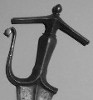
Another Choora
Anyone who has seen one like this?
Best Kurt |
|
|
|
|
29th January 2012, 10:45 AM
|
#38 |
|
Member
Join Date: Dec 2004
Location: London
Posts: 155
|
Hi Kurt,
Thats one very nice dagger, thanks for posting. Never seen one of that particular form, a real work of art. It seems that afghan weapons are rather popular!! A big thanks to all who have posted so far. |
|
|
|
|
23rd February 2012, 04:52 PM
|
#39 |
|
Member

Join Date: Aug 2010
Posts: 54
|
I recently acquired this lovely Choora. What strikes me is the ressemblance in decoration / built with some of the other daggers shown above. The workmanship on this knife is incredible. The carving of the blade, the embellishment on the spine of the blade, the intricate handle design... Let's say I am more than happy having recovered this beauty.
The handle is ivory (probably elephant), blade seems to be wootz. Sheath is wood covered with leather. The tip of the scabbard is reinforced with embellished brass / copper. |
|
|
|
|
23rd February 2012, 06:16 PM
|
#40 |
|
Member

Join Date: Dec 2004
Location: Santa Barbara, California
Posts: 301
|
nice piece of wootz...
I made the rosewood scabbard.
|
|
|
|
|
24th February 2012, 05:16 PM
|
#41 |
|
Member
Join Date: Feb 2010
Location: switzerland
Posts: 299
|
Hi
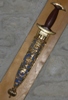
I am a little confused! Can someone explained the difference between, Choora, Karud or Pesh Kabz? I have a friend who comes from Kabul, he simply called all daggers Pesh kabz, and all knives Kard! even if my looking up in books, I always see other words! I have been collecting for 20 years, everything has a blade and always thought I knew the difference, descriptions of Hermann Historica, knives and daggers, 4 vols. I'm confused! I ask some help!! smile 1. Choora? the sheat jes, the Dagger no, Pesh kabz, The blade spine is not straight, the tip is pulled upward. 2. Pesh Kabz 3. Karud 4. Choora 5.picture its Hermann Historika Dolche und Messer aus dem Persischen Kulturraum 6.and the last two are karela south India. |
|
|
|
|
24th February 2012, 05:47 PM
|
#42 |
|
Member
Join Date: Nov 2011
Location: Brooklyn, NY USA
Posts: 227
|
It is my understanding that all 3 terms: Choora, Karud/Kard, and Pesh kabz are used interchangebly and varry based on location and the primary language spoken there.
On a separate note, I did not know that Kerala knives were carried in pairs such as in the example above |
|
|
|
|
29th October 2014, 03:06 AM
|
#43 |
|
Member
Join Date: Dec 2004
Location: Ann Arbor, MI
Posts: 5,503
|
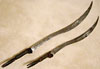
Are we dealing with specific patterns of distinct weapons or just ethnic variations of the,- basically,- the same Pesh Kabz?
Hint: Karud and choora have identical blades but different handles. Karud comes mainly from Central Asia, India and some from Afghanistan. Choora, however, is pinpointed to the Mahsud tribe of the Khyber Pass. |
|
|
|
|
29th October 2014, 03:48 AM
|
#44 |
|
Member

Join Date: Oct 2005
Posts: 420
|
I tried to..
These are my two, of different eras. No one commented.
|
|
|
|
|
29th October 2014, 04:41 AM
|
#45 |
|
Member
Join Date: Mar 2008
Location: Poole England
Posts: 445
|
Some more (must have missed this thread first time around)
Roy |
|
|
|
|
29th October 2014, 09:14 AM
|
#46 | ||
|
Member

Join Date: Jun 2012
Location: USA
Posts: 1,492
|
Quote:
Quote:
|
||
|
|
|
|
31st October 2014, 02:16 PM
|
#47 |
|
Member
Join Date: Dec 2004
Location: Ann Arbor, MI
Posts: 5,503
|
How do we date chooras?
Are there any examples firmly attributable to the 19th century or even earlier? |
|
|
|
|
1st November 2014, 04:08 AM
|
#48 |
|
Member

Join Date: Oct 2007
Posts: 2,818
|
Good Question Ariel.
Here is a nice old Wootz bladed Choora Ariel, how would you place this date wise? Gavin |
|
|
|
|
1st November 2014, 02:05 PM
|
#49 |
|
Member
Join Date: Dec 2004
Location: Ann Arbor, MI
Posts: 5,503
|
Gavin, I know full well that they were not signed or dated by and large. Otherwise I wouldn't have asked. But there are other ways, written sources, for example. And I do believe that experienced dealers do have a sense of age: materials, patination etc.
I have a feeling that a wootz blade or an ivory handle would be unlikely to be found on a choora made in, say, 1940:-) You must have a copy of Egerton: Plate XIV, number 624.Is it a choora or not? Egerton collected his samples during his short stay in India in the 1850s, if I remember.And he even specifically mentions a dagger called Ch'hurra , made in Khorasan, Kabul and Jellalabad: the last two located in the vicinity of the Khyber Pass and the first likely referring to the wootz examples, like yours. Unless there is an iron-clad provenance, I would tentatively place your choora in the 19th century. What do you think? |
|
|
|
|
1st November 2014, 03:16 PM
|
#50 |
|
Member
Join Date: Oct 2007
Posts: 2,818
|
The more I look
Hi Ariel,
It took me a while to spot the knife and sheath you note...madly thumbing through both the original and the reprint looking for a Choora hilt, I couldn't see it for looking. The dagger offers little in detail but I'd agree, its a Choora. The sheath shows designs I'd place as Afghanistan, which is a help. If I was shown this Choora I've shown, I'd say 19th century and to be honest, when I first saw it, I jumped at it thinking it was, not knowing its true qualities and age until I had it in hand. This Choora is Dated 1903 (Thanks Lofty). It is signed to the grip strap and named too. (I now have a Russian silver hilted Shashka in the same native dress that this Choora is found in too, spoils of war no doubt.) I am so glad you mention the wootz factor too. To me, this Choora, having a super fine wootz blade along with this date means two things, wootz was still alive and well in these hidden parts of the world through which there was still great trade in the day and many hidden secrets (Still today) or it is a rehilt of an old blade, which is possible but I am not convinced it is a rehilt of an old blade...I do not have notes at hand but there was written accounts of Gypsies in Central Asia during this later time who were master forgers...I might have mentioned the passage here in the past....20th century wootz manufacture leaves a lot of thoughts to ponder since it was considered a lost art. So I am equally lost with an accurate date unless it has a pedigree or provenance. Gavin
|
|
|
|
|
1st November 2014, 03:47 PM
|
#51 |
|
Member
Join Date: Dec 2004
Location: Ann Arbor, MI
Posts: 5,503
|
Hi Gavin,
Thanks for the speedy answer. I am glad you agree with me on the Egerton's example:it is a choora, plain and simple. Thus, we can be absolutely certain that they existed even in the middle of the 19th century. As I said, with the exact dating there is no doubt that yours is the beginning of the 20th. I am fascinated by the mention of Gypsies making wootz in the 20th. If true, the "re-discoverer of bulat" general Anosov should have just gone to Central Asia instead of adding crushed diamonds to his crucibles:-). If you find the actual source of this info, and if it is believable, that would be a major revelation to the Wootz lovers all over the world. Please try to find it and publish it. And,perhaps, you might be kind enough to post it here: I am sure many, many Forumites willthank you!!! |
|
|
|
|
1st November 2014, 08:54 PM
|
#52 |
|
Member
Join Date: Dec 2004
Location: Ann Arbor, MI
Posts: 5,503
|
And, BTW, can anyone show us examples of the unquestionably Central Asian -made wootz blades?
They have used Persian wootz blades and just dressed them according to the local fashion. Thus, it wood be interesting to see what those Bukharan or Afghani blade smiths were capable of. Then we hopefully can compare the quality of Choora blades to the standards, Persian or local. Egerton specifically mentioned Khorasan as one of production sites, thus Gavin's example might be a remounted one. Last edited by ariel; 1st November 2014 at 09:08 PM. |
|
|
|
|
1st November 2014, 11:50 PM
|
#53 |
|
Member
Join Date: Oct 2007
Posts: 2,818
|
Central Asian Wootz
Here are some Ariel, a perfectly preserved pair of Wootz Bukharan pichoq, turquoise encrusted silver hilts with garnet, silver and Niello bolsters sitting in their original cloth suspension with silver dressed and gilded sheaths attached.
I understand this type of item to be political gifts and also circa 1900, give or take a couple of decades. With regards to the Choora I presented, the chiselled spine designs appear very true to the region as does the polished sections of the blade being a NW Indian thing to my knowledge. Of course the polished panels could be added anytime by someone with the knowledge to do so. Gavin |
|
|
|
|
2nd November 2014, 01:07 PM
|
#54 |
|
Member

Join Date: Jan 2011
Posts: 1,161
|
Here's my example, more of a Khyber Knife being 58cm long in total, but described as a Choora by Ian B at the Armouries. Bought a few years ago, before the recent involvement and so most likely dating to an earlier Imperial campaign. 19thC?
|
|
|
|
|
2nd November 2014, 01:38 PM
|
#55 |
|
Member
Join Date: Oct 2007
Posts: 2,818
|
Certainly a Khyber knife David, it doesn't follow the form of the Choora despite some aspects having a shared similarity.
Gavin |
|
|
|
|
2nd November 2014, 04:24 PM
|
#56 |
|
Member
Join Date: Dec 2004
Location: Ann Arbor, MI
Posts: 5,503
|
Thanks Gavin,
Good beginning of a database. The main problem is that it is likely to be Bukhara and Afghanistan. Capt. Masalski saw manufacture of Central-Asian wootz in the 1850s if my memory is correct. Any documented evidence of its production in Afganistan proper, especially around the Khyber Pass? Kabul or Jellalabad, as per Egerton? |
|
|
|
|
2nd November 2014, 04:27 PM
|
#57 |
|
Member
Join Date: Dec 2004
Location: Ann Arbor, MI
Posts: 5,503
|
DavidR:
Can you show magnified pic? I can' t see wootz pattern. |
|
|
|
|
2nd November 2014, 04:32 PM
|
#58 |
|
Member
Join Date: Jan 2011
Posts: 1,161
|
ariel, I do not think this is wootz, more likely a folded steel.
|
|
|
|
|
2nd November 2014, 04:51 PM
|
#59 | |
|
Member
Join Date: Jul 2008
Location: Germany
Posts: 197
|
Quote:
I am of the same opinion! Kurt |
|
|
|
|
|
4th November 2014, 01:50 AM
|
#60 |
|
Member
Join Date: Dec 2004
Location: Ann Arbor, MI
Posts: 5,503
|
Ah so...
:-) |
|
|
|
 |
| Thread Tools | Search this Thread |
| Display Modes | |
|
|


 Linear Mode

