
|
 6th September 2011, 01:32 PM
|
#1 |
|
Member
Join Date: Mar 2011
Posts: 217
|
 Polish L-guard sword: restoration project
Gents, glad to join your community.
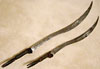
Few days ago I've acquired this lovely saber. Now I'm in thoughts - how to make a new grip. It will be great if you can give me any advice. |

|

|
|
6th September 2011, 02:08 PM
|
#2 |
|
(deceased)
Join Date: Dec 2004
Location: Portugal
Posts: 9,694
|

Welcome to the forum Evgeny.
I will copy your thread to the European section of our forum, so that you have more possibilities to get help. |
|
|
|
|
6th September 2011, 02:15 PM
|
#3 |
|
(deceased)
Join Date: Dec 2004
Location: Portugal
Posts: 9,694
|
Is that a mark on the blade?
Can you get a close up picture? Marks are always interesting  . |
|
|
|
|
6th September 2011, 03:55 PM
|
#4 |
|
Member
Join Date: Mar 2011
Posts: 217
|
Yes, it's marking.
But I didn't clean it yet. |
|
|
|
|
6th September 2011, 03:57 PM
|
#5 |
|
Member
Join Date: Mar 2011
Posts: 217
|
...
Last edited by Evgeny_K; 6th September 2011 at 10:35 PM. |
|
|
|
|
11th September 2011, 09:42 PM
|
#6 |
|
Arms Historian

Join Date: Dec 2004
Location: Route 66
Posts: 10,862
|
Evgeny, first of all may I implore you to use much restraint in cleaning this extremely important sabre!
This weapon corresponds to sabres discussed some years ago in studies of the 'L-guard' hilt which apparantly may have evolved in early 17th century Eastern Europe from Italian hilts with similar feature in 15th into 16th centuries and quite probably other sources. The site of the Battle of Beretschko (1651) in the Ukraine was excavated in the 1970s and documented in an article in 'Muzealnictwo Wojskowe' (Tome 5, 1992) : "Battle of Beretschko in 1651 in Light of Historical and Archaeological Sources" by Igor Svieschnokov. During the Chmielnicki Uprising in 1651, Ukrainian Cossacks clashed with Polish forces, and this particular site among several thousand artifacts were some 32 sabres, many similar but three with this distinctive L guard. In Wagner ("Cut and Thrust Weapons" p.212) a Polish sabre with this feature is shown, and it should be noted that the thumb ring is seen on the 'Beretschko' examples. It appears that the hilt was in use in Poland sometime in the early 17th century. The mention of these examples from this battle simply illustrates the form in use c.1651 in Eastern Europe, there are similar Austrian examples from later in the 17th century. What is key here is the deeply stamped cartouche near the langet on the blade, which appears to carry possible Islamic script or characters. It is known that allied with the Ukrainian Cossacks were some Tatars and Turks. In discussion of Ottoman blades of these times it does seem that stamping of blade with deep circular cartouche was known in certain cases on one side only, possibly arsenal ? It is indeed possible that an Ottoman blade might have been in a Polish sabre of the time, or that similar hilts may have been in use by the Cossacks with Turkish blade. In discussions I have been told that Cossacks used various types of swords which included Polish types as well as Eastern (incl. Ottoman) forms, but there a few actual examples of these Ukrainian swords (except the Berestschko find). Most are the result of repairs and refurbishing which accounts for certain amalgamations rather than congruent patterns. With this it is compelling to suggest that this may be an L guard of Eastern European form of the first half 17th century with possible associations to the Ukrainian Cossacks. With that I would include the distinct possibility that this stamped cartouche could be a tamga, family marking used by Lithuanian Tatars, though that is a remote option. Tamgas are rarely seen on weapons to the best of my knowledge, but the Lithuanians were a large component among the Zaporozhian Cossacks, and I thought it worthy of note. I note that you have posted this sword on another forum as well. While anticipating response there, please feel free to share any of this information with them so that they might add it to thier notes. All very best regards, Jim Last edited by Jim McDougall; 11th September 2011 at 09:54 PM. |
|
|
|
|
12th September 2011, 03:55 PM
|
#7 |
|
Arms Historian
Join Date: Dec 2004
Location: Route 66
Posts: 10,862
|
Addendum:
Forgot to note another feature which I overlooked, at the juncture of the crossguard and langet is the 'Maltese Cross' which is actually the heraldic 'cross pattee' in what is termed wedge form. This device was extremely popular in Poland-Lithuania as a symbol of nobility, and of course is accordingly associated with knighthood. This cross often is seen on the armour and pennons on lances of the famed 'Winged Hussars' and seems well placed on a sabre of this period. Returning to the interesting cartouche, at a glance there is tempting (if not tenuous) resemblance to a winged figure, which while potentially suggesting the winged hussars, may also be a pictogram signifying the Turkish 'deli', light cavalry who may have influenced the winged theme of the Polish hussars. This would again address the possibility of this blade being Turkish, which does not seem likely at this point however. Most blades on these sabres were apparantly produced in Poland or Hungary according to Zygulski, but it is noted that many came from Styria or Genoa. If this were either Styrian or North Italian ( all blades Italian were not necessarily from Genoa, though termed so as this was primary port of departure) one would expect to see the distinctive 'sickle marks' which are paired, dentated semi circles with triple dots at each terminal. Though the scans added are poor in quality, they might present an idea of the type of hilt grip and backstrap likely were present. The metal would most likely have been iron, the wood grip wrapped with black leather. With mounts and scabbard covered in black leather these were often colloquially termed 'black sabres' . Better illustrations of similar hilts in line drawings are in "Cut and Thrust Weapons" Eduard Wagner, 1967 (plates 7,30). Probably the best resource for detailed response would be Michal Dziewulski at the National Museum in Krakow. He wrote the outstanding article on Polish sabres connected to our forum archive site and has worked closely with Professor Zygulski . Last edited by Jim McDougall; 12th September 2011 at 06:01 PM. Reason: add scans such as they are :) |
|
|
|
|
14th September 2011, 06:21 PM
|
#8 |
|
Arms Historian
Join Date: Dec 2004
Location: Route 66
Posts: 10,862
|
Interesting, and disappointing.
Evgeny, who appears to have 'left the building' apparantly chose to post his sabre here despite already being active on another forum. While I know there are a number of members out there quite well versed on these Eastern European swords, nobody bothered to add even the ever popular 'Facebook' blurbs.....yet Fernando offered courteous welcome. With no response Evgeny returned to the other forum to post, which resulted in a whole two empty single line responses, the thread ended. Disappointed that there were no responses here, I sought to retrace as much old information and notes as I could find to compile a worthwhile response, hoping I might be able to offer some help. I always enjoy these kinds of posts personally as I learn going through old notes and recompiling data with new context. I post the results here to share my findings, as always to continue what I have always believed is the goal here..to learn together. I have noticed mention in a number of threads and private messages that there seems to be a lack of interest which has extended to regularly posting members and beyond the usual lurking, though the number of views appear to reflect that activity maintaining well. I had hoped the material I presented would prove helpful to Evgeny, and as always, I am pleased to know that perhaps others find it useful as well. I also always hope that it will promote or inspire others to add material they might have or share other examples. I just wanted to express these notes on this apparantly notable condition here which I hope will improve, and I truly encourage those of you out there reading to join in. I believe collecting should include research, and teamwork and participation in discussions are rewarding and beneficial to all. Thanks for listening, Jim P.S. Jeff, I just saw your post on the other thread on the ethno side, my apologies for not noting your participation ...oops!!
Last edited by Jim McDougall; 15th September 2011 at 04:22 AM. Reason: add note to Jeff |
|
|
|
|
14th September 2011, 06:48 PM
|
#9 | |
|
(deceased)
Join Date: Dec 2004
Location: Portugal
Posts: 9,694
|
Quote:
 . .Obviously Jim, your precious posts will be a benefit to members in general; no time waisted ... never  . .
|
|
|
|
|
|
14th September 2011, 07:22 PM
|
#10 |
|
Member
Join Date: Mar 2009
Posts: 1,071
|
Jim,
I always read with delight your expert articles, I do not believe that a further contribution of Eugene is needed. Here at least one specimen from the late 16th early 17thC. best, |
|
|
|
|
14th September 2011, 08:15 PM
|
#11 |
|
Arms Historian
Join Date: Dec 2004
Location: Route 66
Posts: 10,862
|
Thank you so much Fernando and Jasper! and Jasper that is a fantastic example you post, that is exactly what I was hoping for. I appreciate the kind words, but I am no expert, just a very enthusiastic lifelong student of arms. I usually research and study for many hours or longer before posting, and in doing so it is how I learn. Basically I look forward to either supported rebuttal or confirmation of my notes and especially other contributions. Then we can all update our notes!!!
All the very best, Jim |
|
|
|
|
15th September 2011, 02:21 AM
|
#12 |
|
Member
Join Date: Dec 2004
Location: Bay Area
Posts: 1,769
|
Jim, I am far from being an expert or even someone well versed in the subject of Polish and Zaporozhian Cossack swords, but I have enjoyed reading your thorough posts on the subject. I have learnt a lot from them, and I am sure that others will also benefit from the thread in the future.
On the main question of the thread - how to make a grip to fit the sword, I would leave it without a grip if it were mine. You can guess at a grip based on surviving specimens, but there is no way of knowing how the grip of this particular sword looked like. From a historical point of view, adding a grip will temper with the authenticity of the sword as a whole, and from a collecting point of view, a new grip will not be cheap if well made and fitted, but will add $0 to the overall value of the sword (unless it is passed as being original upon resale, which will be fraudulent). I am sure that everyone has his/her own opinion on this issue, but mine is to leave it as is: the lack of the grip does not detract from this nice sabre. Teodor |
|
|
|
|
15th September 2011, 04:20 AM
|
#13 |
|
Arms Historian
Join Date: Dec 2004
Location: Route 66
Posts: 10,862
|
Thank you very much Teodor, and as you know, personally I am very much with you, I believe in leaving weapons status quo with the exception of stabilizing any active rust or corrosion. As Jeff D. mentioned on the original thread, if any restoration is to be done, it should be done professionally and with considerable restraint. There is nothing worse to be than to see an old warrior stripped of the patination it earned through the years, and overcleaned to garish brightness. Not saying that Evgeny or anyone else here would do that but the concerns remain regardless.
Its always good hearing from you! Best regards, Jim |
|
|
|
|
16th September 2011, 06:43 PM
|
#14 |
|
Arms Historian
Join Date: Dec 2004
Location: Route 66
Posts: 10,862
|
Entertaining
While Evgeny has 'left our building' it seems that there has been at last some activity on his thread over on 'the other side'. In the developing investigation I see that the pages (apparantly from the Zabloski book) which Vitaly posted on our original thread (on Ethnographic) have been posted on the thread. As thier investigation ensues it seems they believe the sabre is early 17th century, however their observation is based on the Zablonski reference, and none of the material presented here seems to have been of any use to them. My invitation to openly use the material provided here over on the other forum was meant seriously, as I know my research is intended to be shared. Wouldn't it be amazing if those serious about weapons research could 'share' information without interfora politics ? I can recall efforts for years many years ago trying to accomplish that, resulting rather unfortunately in the response. I regret that Evgeny left, and as always saw that glimmer of hope. In any case, thank you all for your kind support here, you guys are great!!! All the best, Jim |
|
|
|
|
18th September 2011, 10:45 PM
|
#15 |
|
Member
Join Date: Mar 2011
Posts: 217
|
I'm again here)
Jim, I'm very grateful for your very detailed and informative answer! At one of Russian forums I've already heard that this is probably a Cossack's sword/saber. And interestingly enough, that this sword came to me from the Ukraine) I forgot to specify at the beginning, that the pommel (drop-shaped top) is still remained. I do not support reckless "restoration", so I'll try to be very gentle) |
|
|
|
|
19th September 2011, 07:51 AM
|
#16 |
|
Member
Join Date: Mar 2011
Posts: 217
|
...
Last edited by Evgeny_K; 19th September 2011 at 10:05 AM. |
|
|
|
|
20th September 2011, 04:14 AM
|
#17 | |
|
Arms Historian
Join Date: Dec 2004
Location: Route 66
Posts: 10,862
|
Quote:
Evgeny, Im very glad to see you back! Too often someone will pop in with a query and then be gone. As noted I feared you had 'left the building' due to the tardy response, so thank you for returning. It is a very nice sabre you have posted, and as I have indicated, the results of research some years ago concerning swords of the Zaporozhian cossacks suggest these Polish sabres are known among those used in the Ukraine. From the tone of your posts, I knew you would favor reasonable degree in restoration and appreciate your diligence in seeking detail. Please keep us posted here of your progress, it is good to see old warriors properly cared for. All the best, Jim |
|
|
|
|
|
22nd September 2011, 10:28 AM
|
#18 |
|
Member
Join Date: Mar 2011
Posts: 217
|
|
|
|
|
|
23rd September 2011, 06:09 AM
|
#19 |
|
Arms Historian
Join Date: Dec 2004
Location: Route 66
Posts: 10,862
|
Well posted illustration Evgeny!!! Thank you, shows these sabres in context.
Which of the Osprey publications is this from? All best, Jim |
|
|
|
|
24th September 2011, 07:27 AM
|
#20 | |
|
Member
Join Date: Mar 2011
Posts: 217
|
Quote:
I don't actually know - found this picture while googling. Now trying to find the link. |
|
|
|
|
|
24th September 2011, 12:20 PM
|
#21 |
|
Member
Join Date: Dec 2004
Location: Ann Arbor, MI
Posts: 5,503
|
Cornelistromp:
Can you source the publication where your example was published and the validation of dating? Thanks. |
|
|
|
|
24th September 2011, 12:26 PM
|
#22 |
|
Member
Join Date: Dec 2004
Location: Ann Arbor, MI
Posts: 5,503
|
Once again we are arguing about the permissible extent of restoration:-)
We have seen a lot of examples of restored Moro swords on this Forum ( the first example that comes to my mind). Why adding a new scabbard, handle, silver parts etc. to them is OK, while here it is not? Last edited by ariel; 24th September 2011 at 12:39 PM. |
|
|
|
|
24th September 2011, 05:57 PM
|
#23 |
|
Arms Historian
Join Date: Dec 2004
Location: Route 66
Posts: 10,862
|
Thank you Evgeny for the note, and again, excellent illustration so thank you for sharing it.
It is always good to cite sources for quoted material and particularly illustrations, not only that those of us here might seek those references for further use, but to satisfy copyright matters etc. Typically material used here is considered in fair use perameters, used for scholarly discussion....with the only caveats avoiding using material from live auction and commercial instances. In any case, I know I like to keep references with my notes and they are helpful in future discussions. When it comes to restorations, obviously degree and manner of such matters are a matter of personal choice to the custodian of the weapon. There are no dictations of what is acceptable or not issued here, simply matters of personal opinion. My own personal view for example on older historic weapons which are no longer used and have remained static as either hereditary icons or in the case of items excavated or found, they should be kept to as much the condition in the status ending as possible. Obviously, much as with items found on shipwrecks, they must be stabilized and corrosive activity checked. There is typically much to be learned from artifacts found in situ, and I personally feel a much stronger connection to items unaltered and able to see elements of construction etc. While I admit to having limited understanding of Indonesian, Philippines and Moro as well as many Southeast Asian weapons, it seems that they are much more culturally active and in many cases considered still within what we consider 'working lives'. As such, they are, again as I understand, much revered culturally and it is considered disrespectful for them to remain in damaged or compromised condition. Therefore it is my impression that rather than 'being restored' they are being maintained and properly cared for in accord with cultural expectations. This is not to say that European or any other old swords are not culturally relevant or not entirely revered as traditional icons, which they emphatically are...it is simply that they are perceived in more of a historic view rather than current. They do deserve every bit as much respect and admiration as the weapons of any culture, and again, the manner in which that is observed and carried out is entirely a matter of personal perception. |
|
|
|
|
25th September 2011, 03:01 PM
|
#24 | |
|
Member
Join Date: Mar 2009
Posts: 1,071
|
Quote:
isbn 953-6443-73-4 and the dating in my post #10 is wrong, it must be turn of the 17th and 18thC. 1690-1710 ( not end of 16th and early 17th). |
|
|
|
|
|
26th September 2011, 06:38 PM
|
#25 |
|
(deceased)
Join Date: Dec 2004
Location: Portugal
Posts: 9,694
|
Fascinating examples, Jasper.
|
|
|
|
|
26th September 2011, 07:21 PM
|
#26 |
|
Arms Historian
Join Date: Dec 2004
Location: Route 66
Posts: 10,862
|
Wow! Jasper these are beautiful examples and what outstanding photos!!!
These look professionally photgraphed and perfectly illustrate the particulars of these sabres. Its great to see these in real life rather than just the line drawings I have only ever seen. Are these in the museum you cited as well? Thank you so much for posting these. All the very best, Jim |
|
|
|
|
1st October 2011, 09:36 PM
|
#27 | |
|
Member
Join Date: Mar 2011
Posts: 217
|
Quote:
http://swordmaster.org/2010/10/05/bi...elnickogo.html |
|
|
|
|
|
4th October 2011, 06:16 PM
|
#28 |
|
Arms Historian
Join Date: Dec 2004
Location: Route 66
Posts: 10,862
|
Hi Evgeny, thank you so much for retreiving the source and sharing the link. Also, thank you again for posting here and sharing this fascinating sabre!
All the very best, Jim |
|
|
|
|
7th October 2011, 01:02 AM
|
#29 |
|
Member

Join Date: Oct 2011
Location: Poznan, Poland
Posts: 16
|
Hello.
This is my first post in this forum. At the beginning sincerely apologize for my English. I am a Pole, and unfortunately I only know the Polish language. For communication I use the electronic translator. Sorry for the mistakes and ask for your understanding. I am not a specialist in melee weapons, but I had the opportunity to read about the sword in Polish studies. Sabre with pictures of fellow Evgeny K just seems to be of Polish origin. This suggests the construction of the blade and handle. In the seventeenth century, like sabers used also in Hungary, but they differ in structural details. Wojciech Zabłocki In the book entitled "Cięcia prawdziwą szablą" (Cutting the true saber) sword that is classified as, a polish saber hilt model 1b. In Polish, this type handle is called a "półzamknięty" (semi-closed handle). Sabres have this type of simplified design, handles and perhaps accounted for (as suggested by the author of the book) earlier model (transition) to the most famous Polish saber - hussar saber (as determined by the author as a type 1a). There is also the view that this type of sabers were produced for the less wealthy warriors. Polish origin saber does not exclude the use of it by the Cossacks. Especially that thousands of Cossacks to serve in the Polish army as "Kozacy rejestrowi" (Registered Cossacks). I've just limiting to the formation haul was one of the reasons Khmelnytsky Uprising. It is therefore very likely that they used it as both Poles and Cossacks. http://en.wikipedia.org/wiki/Registered_Cossacks A few words of explanation. I am a hobbyist and am interested in mostly Spanish Navajas. Cold steel is outside the circle of my interests but once I wrote a short article about perhaps the most famous Polish saber - hussar saber - and then that I met with different types of Polish sabers. This article is posted on my website is in Polish but it is possible to automatically translate it into English. If you are interested is welcome. http://www.navaja.pl/roznosci/76-szabla-husarska.html Pozdrawiam serdecznie Janusz |
|
|
|
|
7th October 2011, 12:53 PM
|
#30 |
|
(deceased)
Join Date: Dec 2004
Location: Portugal
Posts: 9,694
|
Welcome to the forum, Janusz.
Splendid material you got in your website .If you search for 'navaja' here in our forum, you will find pictures of some old examples and respective discussion. - Last edited by fernando; 7th October 2011 at 01:07 PM. |
|
|
|
 |
| Thread Tools | Search this Thread |
| Display Modes | |
|
|


 Linear Mode

