
|
 13th July 2005, 04:16 PM
|
#1 |
|
Member
Join Date: Dec 2004
Posts: 655
|
 mamluk khanjar ??
Dear All,
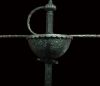
Recently reading David Nicolle's translation of Farisiyya books, I've found that one extremely important weapon, Mamluk khanjar is constantly referred to, and even more is said to " The khanjar should never be left behind", but in the same time this weapon is completely missing from the sword books I have and from all the many modern statues and depictions of mamluks (example attached). From the text is seems that mamluk khanjar was primary a stabbing weapon, basically a short sword (from the description it seems to be longer than an ordinary dagger), that could even be thrown at short distances. This is completely inconsistent with jambia and all other similar things, but it's quite consistent with kindjals (circassians indeed used to throw their kindjals). It's also consistent with some central asian kindjal-like daggers. Could you someone please help me - are there any photographs etc. of mamluks khanjars ? Are they indeed kindjals ? Sincerely yours, Kirill Rivkin |

|

|
|
13th July 2005, 04:31 PM
|
#2 |
|
Member

Join Date: Jan 2005
Posts: 176
|
"Islamic Weapons; Maghrib to Moghul", Anthony C.Tirri, Page 99:
"After the conquest of North Caucasus by the Russians in the 19th century, over 400,000 Circassians fled Caucasus and re-settled in Jordan, Palestine and other Muslim countries. They brought with them their weapon-making skills and weapon styles" This could be the link here. This explains why there are Jordanian Shashqas, and Syrian made Kindjals. Also dont forget, most Burji Mamluks were of circassian origin. |
|
|
|
|
13th July 2005, 05:13 PM
|
#3 |
|
Member
Join Date: Dec 2004
Posts: 655
|
The manual David Nicolle translated I think is from 1412 (it's like totally the most famous one
 ). It's in turkish, but comes from circassian epoch. ). It's in turkish, but comes from circassian epoch.While XIX century events and muhajars (circassian migrants) is a little bit different story, The problem is that no one depicts mamluks of traditional period - pre 1517 with khanjars, so it's hard to understand what their khanjars actually were. It's strange that you can see mamluk mace, bow, multitudes of swords, but not khanjars. |
|
|
|
|
13th July 2005, 05:24 PM
|
#4 |
|
Member
Join Date: Dec 2004
Location: Madrid / Barcelona
Posts: 256
|
Uh... may I ask for the full reference for the manual in question? I'm very interested...
Thank you
|
|
|
|
|
13th July 2005, 06:02 PM
|
#5 |
|
Member
Join Date: Jan 2005
Posts: 485
|
very interesting. i know the ottomans had a type of khanjar, which may have descended from this mamluk weapon, if it existed.
remember, you are taking one persons translation of a 15thC writing. david nicolle may have used the term 'khanjar' for want of a better term. maybe the weapon he was describing had no known name, and he used this term out of context. or maybe he did so with the ottoman dagger in mind and assumed they were describing a similar weapon. just a thought. |
|
|
|
|
13th July 2005, 08:48 PM
|
#6 |
|
Member
Join Date: Dec 2004
Posts: 655
|
I've found actually a link to this article. Unfortunately during the first reading I skipped all the stuff concerning which manual was translated, erroneously attributing authorship and period (well by a few lousy decades).
Here is the link: http://www.ospreypublishing.com/content2.php/cid=274 It's a very good point concerning khanjars. I'm also interested in the menaing of the distinction he makes in his translation in between of khanjar and dagger... |
|
|
|
|
13th July 2005, 09:09 PM
|
#7 |
|
Member
Join Date: Jan 2005
Posts: 485
|
from the david nicholle's book -
'Question What is the best way to overcome fear at night? Answer Keep your trousers on, and your coat and boots, and your sword girded on, and your horse saddled.' i must admit, i tend to be much braver with my trousers on and my horse saddled! |
|
|
|
|
13th July 2005, 09:53 PM
|
#8 |
|
Member

Join Date: May 2005
Location: Merseyside, UK
Posts: 222
|
In his L'art arabe, E. Prisse D'Avennes has a picture of weapons and a helmet which he attributes to Tumanbay II, the last Mamluk sultan of Egypt, who was executed by the Ottomans in 1517. Among the weapons is a dagger. I have no idea if these really are the arms of Tumanbay or where they are now, but here is the picture:
 On a side issue, The Museum of Islamic Art in Cairo has a sword attributed to Sultan Tumanbay I, who reigned in 1501 for about 3 months. Edit: Rivkin, I've just recognised that picture of yours, that's in the military museum in Cairo. Interesting Museum, it has some good stuff, a lot of rubbish and a lot of very dodgy captions. 
Last edited by Aqtai; 13th July 2005 at 10:10 PM. |
|
|
|
|
14th July 2005, 09:07 AM
|
#9 |
|
Member
Join Date: Dec 2004
Location: Madrid / Barcelona
Posts: 256
|
Thank you, Rivkin.
Much appreciated. |
|
|
|
|
16th July 2005, 10:11 PM
|
#10 |
|
Member
Join Date: May 2005
Location: Merseyside, UK
Posts: 222
|
Isn't anyone going to comment on that picture of a possible Mamluk khanjar?
 I would love to know if other people know a bit more about that picture, or about Mamluk daggers in general. Are there any in the Topkapi for instance?
|
|
|
|
|
17th July 2005, 10:26 PM
|
#11 | |
|
Member
Join Date: Jan 2005
Posts: 485
|
Quote:
these daggers, shown in your image, are of a 'common' type. i use the word common lightly, as they are rare, but do exist in enough numbers to research. they are thought, in style, to originate in iran from the 15thC and replicated (or adapted) in style by the ottomans and later, indians. they exist during the mamluk period, so you would think this could be a candidate for the weapon discussed. however, these were all very ornate and many exist in european collections, having been given as court gifts, especially during the sulyman period. due to the high level of workmanship, i find it very hard to believe they were thrown, as mentioned by krill. i have a feeling he was hinting at a more 'useful' weapon. i have many images of this blade type i can try and dig up. |
|
|
|
|
|
18th July 2005, 07:47 PM
|
#12 | |
|
Member
Join Date: May 2005
Location: Merseyside, UK
Posts: 222
|
Quote:
Its funny but I don't actually recall ever seeing a Mamluk dagger, although I have seen lots of Mamluk swords, axes and maces in books. Mind you it's been years since I set foot in a museum (KIDS!  ). I'll have to dig up those photos i took in the Topkapi years ago. ). I'll have to dig up those photos i took in the Topkapi years ago.
|
|
|
|
|
|
20th July 2005, 04:15 PM
|
#13 |
|
Member
Join Date: Jan 2005
Posts: 485
|
hi aqtai,
examples of your dagger. |
|
|
|
|
20th July 2005, 07:08 PM
|
#14 |
|
Member
Join Date: May 2005
Location: Merseyside, UK
Posts: 222
|
Cheers B.I., thanks for that.
The great Mamluk khanjar mystery still remains unsolved though.
|
|
|
|
|
20th July 2005, 08:24 PM
|
#15 |
|
Member
Join Date: Dec 2004
Location: Greensboro, NC
Posts: 1,099
|
I was fortunate enough to see the lapis lazuli hilted example while on display in a museum in NC a year or two ago. It is part of the Khalili collection. While the selection of arms/armour was fairly minimal, there were some fantastic items including a shamshir blade supposedly from the 13th century, some horse armour, some georgeous guns and an amazing war mask. The dagger was simply georgeous in person.
|
|
|
|
|
20th July 2005, 09:22 PM
|
#16 |
|
Member
Join Date: Jan 2005
Posts: 485
|
hi rick,
i too have seen the dagger and the images dont do it justice. this exhibition you mentioned - was it all khalilis? i know he has a great war mask but i am not aware of him owning a 13thC sabre blade. the earliest known islamic curved swords were thought to be those in the topkapi. however, there is a curved blade, thought to date around 1200 and of seljuk period that is in a private collection. i know the owner, and the previous owner and i wonder if it is the same sword. khalili doesnt or hasnt owned it so i wonder which blade you saw? do you have any images or a description. the blade i am refering to has a chisselled hunting chase with spirralling arabeques along the blade. i cant believe you would go to an exhibition without a camera
|
|
|
|
|
20th July 2005, 09:33 PM
|
#17 |
|
Member
Join Date: Dec 2004
Location: Ann Arbor, MI
Posts: 5,503
|
The very first post in this thread (by Rivkin) shows a bronze statue.
Rivkin, who is this fighter, where is the statue from and .....why does he have such a strange sword? |
|
|
|
|
20th July 2005, 10:59 PM
|
#18 |
|
Member
Join Date: Dec 2004
Posts: 655
|
1. I think the problem is that we have no idea how khanjar is different from "dagger" - they seem to be different according to the text, therefore the whole question which is khanjar, which is dagger becomes extremely vague.
2. The stature is from Cairo Military Museum. It's supposed to be a mamluk- the fear of crusaders. There are a lot of things that look strange to me (starting with the fact that mamluks had extremely long beards, that even when cut in half were still something significant). I have not seen monster-swords like this when it comes to crusades, but may be it from the series when an indian made sword, that was owned by a circassian mamluk-atrak is labeled "an immortal example of arabic art" ? |
|
|
|
|
20th July 2005, 11:08 PM
|
#19 |
|
Member
Join Date: Dec 2004
Location: Ann Arbor, MI
Posts: 5,503
|
For the life of me: he looks like something coming out of Russian history:
http://pandora.cii.wwu.edu/vajda/rus...s/slide_15.htm |
|
|
|
|
20th July 2005, 11:09 PM
|
#20 |
|
Member
Join Date: Dec 2004
Location: Greensboro, NC
Posts: 1,099
|
Brian,
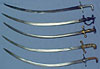
Unfortunately I did not take a camera but I did purchase a catalogue of the collection.  Here are two pics of the sword in question. According to the catalogue description, it is attributed to Sultan Baybars and they place the blade circa 1270. There are two inscriptions on the blade which reference Sultan Baybars. One is a great one and it translates as "Glory to our Lord, the Sultan, al-Malik, the Just, the Learned, the Defender of the Faith, The Warrior at the Frontiers......, al-Zahir Baybars, the Associate of the Commander of the Faithful, may God make his victories glorious!" The other inscription simply states "al-sultan al-Malik al-Zahir Baybars". Here are two pics of the sword in question. According to the catalogue description, it is attributed to Sultan Baybars and they place the blade circa 1270. There are two inscriptions on the blade which reference Sultan Baybars. One is a great one and it translates as "Glory to our Lord, the Sultan, al-Malik, the Just, the Learned, the Defender of the Faith, The Warrior at the Frontiers......, al-Zahir Baybars, the Associate of the Commander of the Faithful, may God make his victories glorious!" The other inscription simply states "al-sultan al-Malik al-Zahir Baybars".
|
|
|
|
|
20th July 2005, 11:20 PM
|
#21 |
|
Member
Join Date: Dec 2004
Posts: 655
|
1. Fantastic pictures ! A short sword (looks like something taken out of Samarkand's steppes is not it ?), can it be a khandjar ?
2. Ariel: The topic of russian arms and armor is a very controversial in itself. Once upon a time I had the opportunity to speak with a relatively well known russian viking archeologist, who was extremely interested in antique weapons. It's happened about 10 years ago, so lot's of it is gone from my memory, but his main point was that the majority, especially early ones, of russian arms and armour were by far not of a local manufacture. Unfortunately under the pressure from the Party the archeologists had to classify viking-frankish "ulbrecht" swords as "true russian bulat, the secret of which we don't know". How much truth in what he told me, I don't know and I hope that someone more knowladgeble can enlighten us. P.S. I awlays wondered if 14th century "russian" and 13th century "turko-mongolian" armour and arms related ? |
|
|
|
|
21st July 2005, 12:04 AM
|
#22 |
|
Member
Join Date: Jan 2005
Posts: 485
|
hi rick,
a catalogue! of course!! a very impressive sword and you have the advantage in having seen it. i must admit, my first impression is one of doubt on such an early attribution. the tang is of a later design. also, the inlay on such early swords was of a much higher level and the lion and script seems crude. i have seen some early dagger blades with inlay that cannot be compared to on later blades. dates and attributions can be added and can i ask who wrote the catalogue? is the sword owned by khalili? what was your impression of the sword and did you think it could be of such an early date? i've attached the early blade. an interesting fact was that it was owned by the talpur family, who by repute collected early blades. the quality of the talpur swords are legendary and there are accounts of them seeking early pieces. |
|
|
|
|
21st July 2005, 12:26 AM
|
#23 |
|
Member
Join Date: Dec 2004
Location: Ann Arbor, MI
Posts: 5,503
|
The Baybars' sword looks like an early Turkish Kilij or Shamshir, something like 16-19 cen. I cannot recall any 13 cen Islamic sword looking that way.
Perhaps, it was just "attributed" to Baybars, just like the so-called "Swords of the Prophet" were attributed to Mohammed... Everybody loves to have an authentic relic belonging to a famous personality. If one is not available, manufacturing it is a holy duty. I remember reading that Catholic churches around the world have something like 200 teeth of St. Paul... I think I have already told an old Russian joke about a Soviet museum exhibiting 2 skulls of Comrade Lenin: one at age 7, and another at age 50. I've heard the same joke from the French (Voltaire), Brits (King Arthur, I think), so the practice is well known. |
|
|
|
|
21st July 2005, 04:00 AM
|
#24 |
|
Member
Join Date: Dec 2004
Location: Greensboro, NC
Posts: 1,099
|
Brian
The catalogue was written by Professor J.M. Rogers who is the Honorary Curator of the Khalili collection as well as holding the Khalili chair of Islamic art and archaeology at the school of Oriental and African Studies, University of London. Much of the Khalili arms/armour collection was catalogued many years back by David Alexander. I do not know if the attribution to the 13th century is based on the opinion of Khalili, Alexander or any of a number of researchers that worked on his collection. I cannot say whether or not the sword would date to the 13th century. I have never handled or seen a sword of such an early date so I am poorly qualified to make such an assessment. The tang showed great age due to its coloration but we know that is not an exact science either. Some of the koftgari is obviously of a later date and the catalogue surmises it is 16th century because the particular "cloud" motif used is comparable to other 16th century work found. I would be comfortable with a 16th century date and it very well could date earlier if the inscription could be somehow authenticated. In any case, it was a nice sword that was being shown with two other really nice Shamshir and a fairly average Yataghan. |
|
|
|
|
21st July 2005, 04:45 AM
|
#25 |
|
Member
Join Date: Dec 2004
Location: Ann Arbor, MI
Posts: 5,503
|
Yes, the "cloud" motif is mentioned by Astvatsaturyan as a Chinese "chi" , typical of Ottoman Turkish decoration of ~16th century and later.
The B.I.'s sword, from Talpur family, looks like Shamshir Shikargar, a hunting sword. The retaining plate at the ricasso is interesting: it looks like Yataghan's, but on the edge side of the blade. |
|
|
|
|
21st July 2005, 08:43 AM
|
#26 |
|
Member
Join Date: Jan 2005
Posts: 485
|
hi rick,
even more intriguing. professor rogers was khalilis teacher when he did his doctrate in SOAS and i believe their relationship began there. rogers knowledge is on islamic art, with a leaning towards painting. khalilis collection was not one of arms, but of islamic art with arms being an almost afterthought. when he began to compile the catalogues of his collection, he thought an arms collection needed to complete the islamic sphere, and so his collection was built up over a relatively short number of years. david alexander, who is widely thought to be the leading academic on islamic arms, was called in to catalogue the collection and his studies into khalilis arms was just during this period. as the sword was not included in the catalogue, it seems unlikely that he would have researched it. a 13thC sabre is of great importance and so would not have been ommited. as far as i am aware, khalili stopped compiling arms after the book was written, as the arms collection was for this purpose alone. i may be wrong but either way, i can find out in september through a meeting i have arranged. i wonder if the sword was overlooked by alexander due to a 'spurious' date in his opinion and then taken up by someone else with more 'faith'. i still stick with my initial opinion, but find the existance of this sword (at whatever date) intriguing enough to want to pursue it further. another point on the seljuk blade, it is formed from a fully developed watered steel technology and shows a granular type pattern. krill, apologies for hijacking your post and diverting it astray. |
|
|
|
|
21st July 2005, 11:38 AM
|
#27 |
|
Member
Join Date: May 2005
Location: Merseyside, UK
Posts: 222
|
Thanks for all the great pictures RSWORD and B.I.
With regard to the sword of Beybars, he was such a famous figure, I'm not surprised that there are swords attributed to him. The Topqapi museum has two swords attributed to famous Mamluk Sultans: Qalawun and Muhammad ibn Qalawun, in both cases Unsal Yucel believed they were actually 16th century swords Yucel belived that this sword however (apart from the scabbard, hilt and crossguard) is genuinely early Mamluk:  The Military Museum in Cairo has a quite a few mail shirts, shields, helmets and weapons, mostly of Ottoman origin, unfortunately the labels are unreliable at best. A lot of them have been placed on mannequins meant to represent figures from Egypt's history. For example there is a mannequin meant to represent an "Ummayyad cavalryman" wearing a kulah khud helmet! The "reconstructions", of which there are many, are even dodgier. They owe more to the artists' imagination and preconceptions than to any historical evidence. That sword above is probably a figment of the artists imagination, although there is a slightly similar 15th century Mamluk sword in the Topqapi. I'll try and scan it for you. |
|
|
|
|
21st July 2005, 12:05 PM
|
#28 |
|
Member
Join Date: Jan 2005
Posts: 485
|
hi aqtai,
the topkapi swords are a great example of judging by comparison, as apposed to inscription. i can find out more about ricks sword, given time as i would love to know who attributed the date and on what basis. its easy to judge casually, but i am sure the statement was not made lightly. btw, a good friend got into the basement of the museum in cairo (by invitation, not a window :-) and he said there were boxes, unopened for generations. a casual browse found a crate of ottoman 'turban' helmets, long forgotten about. it makes you wonder what else lurks in the darkened corners of such places. |
|
|
|
|
21st July 2005, 04:25 PM
|
#29 | |
|
Member
Join Date: May 2005
Location: Merseyside, UK
Posts: 222
|
Quote:
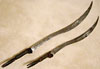
I can't bear to think of all that going to waste. Ironically neither the Cairo Military Museum or the Cairo Museum of Islamic Art have a Turban helmet on show. In fact the Museum of Islamic Art has only one helmet exhibited, which is of kulah khud type. What about the dagger above the "Sword of Beybars", is that Mamluk? Finally here is a sword that is vaguely similar to the one the statue is holding: 
|
|
|
|
|
 |
| Thread Tools | Search this Thread |
| Display Modes | |
|
|


 Linear Mode

