
|
 10th August 2026, 02:49 PM
|
#1 |
|
Member
Join Date: Oct 2018
Posts: 717
|
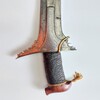
 Pattern weld kris with silver inlays
Maguindanao kris, 1800s, similar in form to Krieger's #1 sample in Plate 14 . 22.5in blade, 27.5in overall. Wooden hilt with brass ferrule. Silver inlays of arrows and circles with apotropaic purpose. Twistcore blade with 4 bars at the middle. I had difficulty etching the blade; the pattern was barely visible even with repeated bouts of white vinegar. Since I didn't want to use FeCl₃, I used dental etching gel as an experimental etchant.
|

|

|
|
10th August 2026, 07:44 PM
|
#2 |
|
EAAF Staff
Join Date: Dec 2004
Location: Louisville, KY
Posts: 7,423
|
W
 W!! W!! What a great blade! 4 twist core laminations are not commonly seen. I'm envious (Most I ever get is 2 twist core laminations  ). ). Congratulations! I was wondering if this type of blade with an average hilt is for one who had the wealth but not the status, or if the hilt was sold off in later generations in hard times. Xasterix what do you think? |
|
|
|
|
Yesterday, 06:17 AM
|
#3 |
|
Member
Join Date: Jun 2009
Posts: 1,348
|
This is a really excellent blade. 4 twisted rods for the whole length plus inlays - this is seldom seen.
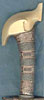
This seems to be a much later hilt, but there are examples of quality blades with old, simple hilts. How much truth is in the lore blades of this type would have been used by Panglima? |
|
|
|
|
Yesterday, 10:19 AM
|
#4 |
|
Member
Join Date: Oct 2018
Posts: 717
|
Thanks very much for the kind words, Sirs Jose and Gustav!
 I've been getting errors with the "reply" function on the site lately, so I'll consolidate my replies to both of you. To be honest, I'm not familiar regarding the age of the hilt- the current cord wrap is already my installation (the original wrap was extensively damaged brass wire). Gustav may be right in his conjecture that it's a younger hilt; I've seen similar hilts on American colonial era krises; the blade I would conservatively place as mid to late 1800s. Regardless of age though, it looks like a functional hilt. Now with regard to owner's preference on blade+dress combinations, it's a bit complicated. As a couple of Moro and Lumad elders shared to me...there are more roles in Moro and Lumad society than the political leadership roles (Datu, Panglima, Sultan, etc). There's the community council of elders which function as a "board of trustees" for many matters- judicial (rules, rewards, and punishment), economic, and political (trade alliances, faction alignment, etc). Then there's the community priest or shaman who specializes in the netherworld- rituals, divinations, herbal or magical cures, etc. There may even be a head blacksmith, a head warrior, etc. These roles, while guaranteeing status, doesn't necessarily equate to wealth. From what I know, certain krises can only be commissioned by certain roles; for example, the specific configuration of a shaman's kris can only be commissioned by the shaman himself, and not by a non-shaman, regardless how wealthy or high in status they would be. In this manner, the kris becomes the exclusive "ID" for a specific role. The exception to this, of course, is when the kris becomes passed down to the next generation, or becomes a pusaka; the current generation need not necessarily hold the same role or office as the original ancestor-owner. Another exception- when the kris gets captured or looted by an opposing tribe or outsider, the dress may become modified, thus making it more difficult to ascertain the original ID. To answer your question, Gustav- I still lack (solid) data to attribute this to Panglima position; however I think it's not the kris of a trader/merchant, or a wealthy landowner. |
|
|
|
 |
|
|


 Linear Mode

