
|
 15th November 2007, 01:10 AM
|
#1 |
|
Member
Join Date: Jul 2005
Location: Toronto, Canada
Posts: 1,242
|
 Abyssinian shotel for coment
Hello,
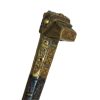
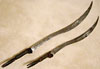
I just received this shotel. The blade is about 30" long and 1/8" thick; the hilt is unfortunately a replacement and not very nice. Oddly the one who made it kept the buttcap. The seller said it was a 20th century piece, but he had no idea what this was. Any comment on that? How late were these swords produced? The first four pics are from the seller, the last two are mine. Thanks for any input, Emanuel |

|

|
|
15th November 2007, 03:30 AM
|
#2 |
|
Arms Historian

Join Date: Dec 2004
Location: Route 66
Posts: 10,872
|
Hi Emanuel,
I would be inclined to agree on 20th century on this blade, and although the hilt is pretty amateur it is better than no hilt at all. The blade is very unusual for a shotel blade as most of this form are much more parabolic and the fullering is typically different it seems (hopefully Roanoa or Tim will say more on this). During the latter 19th century and into the 1930's I believe, there were blades made in England primarily by Wilkinson Sword Co. of a number of forms, some including the traditional deeply curved form. It seems that by this time there was a marked preference for the standard slightly curved sabre blades mounted on the same type hilt as well as the gurade which typically refers to the military stirrup hilt sabres. The pommel cap is most interesting as well, especially with the star of Solomon motif. It is known that in Abyssinia (now Ethiopia) the Falashas were tribal armourers that were actually of the Jewish faith, and furbished weapons for the Amharic rulers. Obviously the six point star is found used symbolically in numerous applications, in Judaism as the Star of David and in other cases as the Star of Solomon, which is of course well placed with the early history of Abyssinia. All best regards, Jim Last edited by Jim McDougall; 15th November 2007 at 03:49 AM. |
|
|
|
|
15th November 2007, 02:19 PM
|
#3 |
|
Member
Join Date: Dec 2004
Location: Ann Arbor, MI
Posts: 5,503
|
I am not sure we can connect the 6-point star to the religious affiliation of Falashas.
The Kings of Ethiopia were convinced that their royal line went all the way back to King Solomon and the Queen of Sheba: they called themselves the House of Judah. The King was, of course, the Lion of Judah and this is the reason for their national symbol ( stamped on many a Wilkinson sword  ) )
|
|
|
|
|
15th November 2007, 02:42 PM
|
#4 |
|
Arms Historian
Join Date: Dec 2004
Location: Route 66
Posts: 10,872
|
I should have worded that better
the note on the Falashas was meant to note that is was interesting that they were of Jewish faith and that the six point star would have had considerable potential in Abyssinian historic context. It was also worthy of note that they did serve as armourers to the Amharic rulers.The note on the Wilkinson sword connection is well placed and the firm use of the Star of Solomon at the forte of thier blades was key to the marking of thier blades, typically enclosing brass plug with proof marks. Since Wilkinson was essentially a prime supplier of blades in the early 20th c. to Abyssinia, the possible influence of that key marking on the pommel cap on this example seems compelling. I believe that in Abyssinian history Menelik was the son of King Solomon and the Queen of Sheba, and the Lion of Judah representing the King was indeed typically marked on Abyssinian blades by Wilkinson and other suppliers to Ethiopia including Solingen. |
|
|
|
|
15th November 2007, 02:53 PM
|
#5 |
|
Member
Join Date: Jul 2005
Location: Toronto, Canada
Posts: 1,242
|
Hi Jim,
Thanks for the response . I did not know trade blades were used on shotels, but I was aware of Wilkinson and others producing gurade blades. Here are some shotel examples from Oriental-Arms and they look a lot like mine with the exception of the hilts.  http://www.oriental-arms.com/search....el&s.x=0&s.y=0 I'm not aware of blades being done differently although I know some have extremely high curvature. Best regards, Eamnuel |
|
|
|
|
15th November 2007, 11:20 PM
|
#6 |
|
Member

Join Date: Jan 2006
Location: Kent
Posts: 2,658
|
Hi Emanuel
,nice blade, I love the shape of these .... it is a shame about the hilt...but I think with careful re-sculpturing with a 'dremmel' type tool, ( like a small electric drill with various small cutting/shaping 'bits') you could make it quite respectable without removing it from the blade. Regards David |
|
|
|
|
16th November 2007, 08:43 PM
|
#7 |
|
Arms Historian
Join Date: Dec 2004
Location: Route 66
Posts: 10,872
|
It seems clear that the blade form seen on Emanuel's example is of what appears to be a native made blade with cross section of earlier highly curved shotel's. I had not been aware of this much less curved form until seeing these, and think it would be interesting to look at examples of the early highly curved ones to compare with.
Could anyone share some of the other Ethiopian swords here; the shotels of high curve, the examples with trade sabre blades and the familiar gurade? Sort of a review of Ethiopian swords for reference! All best regards, Jim |
|
|
|
|
16th November 2007, 09:00 PM
|
#8 |
|
Member
Join Date: Jan 2006
Location: Kent
Posts: 2,658
|
|
|
|
|
|
16th November 2007, 09:28 PM
|
#9 | |
|
Arms Historian
Join Date: Dec 2004
Location: Route 66
Posts: 10,872
|
Quote:
Thanks very much! That thread was a lot of fun, and there were some interesting illustrations shown. I just wanted to develop this particular thread a little as far as illustrations and comments on variations that is a bit more focused and informational as well as current. All the best, Jim |
|
|
|
|
|
17th November 2007, 02:32 PM
|
#10 |
|
Member
Join Date: Jul 2007
Posts: 48
|
I have a similar shaped sword with a similar style brass cap on the pommel. Blade length measure 67 cm, double edged, and wooden hilt. I bought (3) from a fairly reputable dealler in Addis who swore they were coming from Afar and that the Afar were no longer using them. I have never seen any photo's of Afari's wearing such swords (always Gille's) however suppose its possible especially along areas where Afar borders Amhara and Tigray.
|
|
|
|
|
17th November 2007, 07:53 PM
|
#11 |
|
Arms Historian
Join Date: Dec 2004
Location: Route 66
Posts: 10,872
|
Hi Rod,
Thank you the response and excellent information. With your reference to the Afar, it prompted me to recheck Burton ("book of the Sword", p.164-65) where he refers to the 'Dankali' (Danakil, which is also the term for the Afar region of Ethiopia). On the same page in fig.177 he shows a 'smaller Abyssinian blade' shotel with similar shallow recurve and median ridge blade profile as seen on the discussed example. Interestingly on p.165, Burton shows an illustration on what is clearly a kaskara and is captioned 'Dankali sword'. The kaskara of course is from the Sudan, however is well known among Eritrean weapons, and Ethiopian in degree, which would include Danakil or Afar regions. The diffusion of weapons in these regions is well established, and clearly while certain forms are more distinctly seen with certain tribes and regions, a degree of use of the weapons of congruent regions is to be expected. It seems quite reasonable that the Afar would have used shotels with these blades, and in limited degree so that illustrations or direct association would be unlikely. I think your suggestion of possible use of these by Afar tribes near the Ethiopan regions you note is well placed and quite likely. It seems that shotels with this shallow recurved blade were in existence at the time of Burton's research, well before 1884 so probably as early as mid 19th century, so the period of such blade form is established. With the Afar provenance, those tribes as well as those of northern Ethiopian regions may be considered in those who might have used them, and it would seem the form continued in use well into the 20th century. I'm still hoping those who have collected Ethiopian weapons will follow the lead and contribute examples of the early sickle form shotel as well as those with trade blades of sabre form (Wilkinson, Solingen) and possibly gurades. Thank you very much Rod ! All very best regards, Jim |
|
|
|
|
18th November 2007, 09:31 AM
|
#12 |
|
Member
Join Date: Jul 2007
Posts: 48
|
Hi Jim thanks very much for the further comments as it clarifies for me the origins. It also brings up a lot more questions. Why was the shotel not more widely adopted by the Afar given that according to your research it had been used by the Afari as far back as Burtons time? It would seem a more effective figting knife / sword than the Gille. Was it because the spear was widely used by the Afari instead of swords? Which came first the Shotel or the Gille.
As for your points on the regionalisation of the weapons, why has the Gille been widely adopted by the Isse but not by the other Somali tribes who tend to favour the Billao? A theory I have on this last point is that the Isse have been expanding their territory at the expense of the Afar for decades, possibly longer, and whilst capturing this territory they have captured and adopted the weapons of the Afar? There are also questions on the origins of the Isse as they somehow lie outside the 5 major Somali clans. Rod |
|
|
|
|
18th November 2007, 03:16 PM
|
#13 |
|
Member
Join Date: Jul 2005
Location: Toronto, Canada
Posts: 1,242
|
Hi Jim and all,
Thank you for the great information. Rod it's interesting that you bring up the Afar connection; some time ago Ron had posted some swords from the Oromo and Galla groups and the swords looked like a cross between a shotel and a gile. Here is the thread http://www.vikingsword.com/vb/showthread.php?t=3245 Now the gile is still b eing produced and I saw pictures of Afar/Danakil tribesmen carrying a gile and an AK-47. It isn't hard to imagine that shotel were made well into the 20th century. Best regards, Emanuel |
|
|
|
|
18th November 2007, 08:27 PM
|
#14 |
|
Arms Historian
Join Date: Dec 2004
Location: Route 66
Posts: 10,872
|
Hi Rod and Emanuel,
Thank you so much for the great responses and posing both excellent observations and further questions! Emanuel, thank you for the link to the thread on the Oromo/Galla shotels, which nicely illustrates more on the fascinating hybridization of the weapons of these regions. With reference to your questions Rod, on the manner of choice and adoption of weapon forms in these regions, I think the intense geopolitical and ethnic flux in these regions, which indeed continues to this day, may be the most likely reason for such selection in weapons. While the Issa are in degree a subgroup of Somalia, in the regions where they are situated, such as Djibouti, I think that political or traditional inclinations might lean either toward the Afar (Danakil) of Ethiopia or conversely toward the primary Somali clans. This may prompt preference to the favored 'gile' or transitional form of shotel of Ethiopia or otherwise, to the favored 'belawa' of Somalia. Although this line of thinking may seem simplistic, it does seem plausible, as tribal traditions and identity are passionately intense in these regions. This became quite evident to me some time ago with an Eritrean friend, who was emphatically of the Beja, and constantly spoke of the turmoil there. It seems the gile was typically a secondary weapon, with the spear as primary, and with the same diffusion typical of these melding peoples, it would seem that adaption would develop a weapon form or its hybrids, to changes in warfare and strategy. With that the shotel, a sword, and the gile, a knife, probably evolved into the nebulous area of short sword/ large knife, like the distinct 'Khyber knife', and appeared in the form seen used by the Oromo/Galla. The gile, like various dagger and knife forms, is today primarily a traditional element of costume in many cultures, and is worn as an accoutrement used in utility and combat as required, it seems to me. As Emanuel notes, many of these traditional edged weapons may be seen today, alongside the standard AK-47. I'm not sure which came first, the gile, or the shotel, and it would be interesting to see other examples and hopefully early forms. It seems the first narrated reference to the shotel was mid 19th century, while the gile I dont know. I wonder what the etymology of these terms is? All best regards, Jim |
|
|
|
|
19th November 2007, 01:16 PM
|
#15 |
|
Member
Join Date: Dec 2006
Posts: 173
|
My one has a little different shape. The hilt is in three parts (might be the darker two are horn) and the tang is riveted on the pommel. It was assigned by the former collector to the Galla tribe. May I have your opinion about it ?
Thank You Paolo |
|
|
|
|
20th November 2007, 07:28 PM
|
#16 |
|
Member
Join Date: Jul 2007
Posts: 48
|
Hi Paolo its a very interesting and nice sword you have. I have not seen one like that before so difficult for me to comment. However I am posting below two knives with similar designed hilts (one I have posted previously). Neither are sickle shaped nor are they Oromo in origin. Both are from southern regions (probably wolliso and sidamo) although these tribes are somewhat closely related to the Oromo. One is a horn hilt and the other has an Ivory hilt. I am wondering if anyone knows where this hilt design may originate from and is it restricted to the Oromo related groups.
|
|
|
|
|
20th November 2007, 08:10 PM
|
#17 |
|
Member
Join Date: Dec 2006
Posts: 173
|
Hi Rod,
above all, the second knife's hilt looks very similar to that of my sword. Now I'm really curious to know more about its origin. Paolo |
|
|
|
|
21st November 2007, 06:10 PM
|
#18 |
|
Member

Join Date: Jun 2005
Posts: 243
|
Ciao, Paolo. Very nice sword. I do not know which area of Abyssinia it originated from. The only thought I have is that it is very VERY similar to one that is at the Pigorini Museum in Rome. Flavio posted the pictures a while back and is listed as number 2. Unfortunatelly, the identification card cannot be read. Maybe Flavio as made a note of it?
|
|
|
|
|
21st November 2007, 06:54 PM
|
#19 |
|
Member
Join Date: Dec 2006
Posts: 173
|
Hi roanoa,
Is this? |
|
|
|
|
22nd November 2007, 01:25 AM
|
#20 |
|
Arms Historian
Join Date: Dec 2004
Location: Route 66
Posts: 10,872
|
Interesting discussion and examples gentlemen.
|
|
|
|
|
24th November 2007, 02:24 AM
|
#21 |
|
Member
Join Date: Jun 2005
Posts: 243
|
Ciao, Paolo. Have you checked with Flavio about the description of the Pigorini sword? It is a very nice example of a not so common variation. I am a bit uncertain about calling it a "shotel" as it has characteristics that set it apart from the typical shotel forms. I have seen somewhere a reference about it being called SHAMLA. But considering the many languages spoken in Abyssinia, shamla could very well simply mean "sword".....
|
|
|
|
|
24th November 2007, 03:58 PM
|
#22 |
|
Member
Join Date: Jul 2007
Posts: 48
|
Hi Roanna,
is there a link between the hilt designs as seen in Paolos sword and the couple of daggers I posted. Do you think this is a characteristic of Oromia related tribes or just coincidence in this case? Rod |
|
|
|
|
26th November 2007, 05:57 PM
|
#23 |
|
Member
Join Date: Jun 2005
Posts: 243
|
Hi, Rod. The handles you are referring to are of typical Abyssinian design, but there is not enough evidence to trace them to a particular ethnic group.
|
|
|
|
|
29th November 2007, 03:25 PM
|
#24 |
|
Member
Join Date: Jun 2005
Posts: 243
|
Hi, Rod. Just saw this picture (horribly small..... I hope it will show OK) and thought of you. The knife is identified (I hope the identification is correct) as being from the Sidamo province of Ethiopia. Cheers.
|
|
|
|
|
30th November 2007, 10:53 PM
|
#25 |
|
Member
Join Date: Jul 2007
Posts: 48
|
Hi Roanna, thanks very much for this. Yes its an interesting style of knife and scabbard and given that the one I have is extremely heavy (34cm blade but approx. 1.5 cm thick in the centre) had some previous discussions on whether it had an agricultural purpose as well as fighting. My guess for cutting enset (ornamental banana commonnon to the area). Thanks Rod.
|
|
|
|
|
7th December 2007, 02:59 PM
|
#26 |
|
Member
Join Date: Jul 2005
Location: Toronto, Canada
Posts: 1,242
|
Hello,
I talked with an Ethiopian gentleman about Ethiopian swords and when I mentioned the shotel he didn't understand what I meant. He did not recognize the word nor did he understand my description of the sword. Could we have the word wrong? Or is it more likely that the shotel is not in living memory, or is uncommonly known to Ethiopians? I will show him a pic next time and see what he says. Furthermore when I mentioned the "guradé" he corrected my pronunciation to "guragué". Any comments on this? Regards, Emanuel |
|
|
|
|
8th December 2007, 12:06 AM
|
#27 |
|
Arms Historian
Join Date: Dec 2004
Location: Route 66
Posts: 10,872
|
Hi Emanuel,
I'm really glad you brought this up, as over the years I have tried in vain to find any etymology to many of the terms used for certain ethnographic weapons. Some time ago I mentioned the term 'shotel' to individuals from various parts of Ethiopia... none had the slightest idea what the term meant, so it would appear not to be a word widely known in the languages there. I cannot claim these casually asked questions offer definitive proof that the term is unknown entirely, just interesting that it was not known by unrelated individuals from different regions. Again, some time ago I discovered that the term 'kaskara' is entirely unknown not only in the Sudan, and by different tribal groups, but in Eritrea as well. I questioned individuals who were from Sudan, Darfur, and Beja tribesman from Eritrea. None knew the word kaskara, and none could offer either any suggestion where the word might have come from. The sword is known only as sa'if. Even a friend who was deeply involved in archaeology and study in Sudan did some checking with the University of Khartoum, and found no results with the word kaskara. The term katar, for the well known Indian dagger with transverse grips, according to Dr. G.N.Pant is a misnomer. According to him, the term is actually jemadhar, and the misapplication was perpetuated by Egerton in his 1880 work on Indian arms. The katar applies to a traditional form dagger of Northern India. Due to the fact that the term katar has become so firmly embedded as referring to the well known transverse grip dagger in collectors parlance, it would be entirely counter production to try to resolve at this point. It would seem that much of this curious terminology has come from transliterations, semantics and often outright misunderstanding by early narrators and arms writers. From these works, early collectors have unwittingly created a weapons terminology that often has little to do with the languages where the weapons have originated. It gets more complicated! There is no such sword as a scimitar....this is simply a transliteration trying to describe shamshir. There are shamshirs in India? Yes..but they are termed talwars!!! The Ottoman kilij is a well known form, but what if the blade is different, what if it has a shamshir blade but kilij hilt? etc etc etc. If you can come up with any information on 'shotel' it will be truly a revelation and I am more than anxious to hear more. It will truly be one small step for ethnographic weapons -kind, where I have only stumbled!!! Please keep us posted Emanuel, All the best, Jim |
|
|
|
|
8th December 2007, 02:05 AM
|
#28 |
|
Member
Join Date: Jul 2005
Location: Toronto, Canada
Posts: 1,242
|
Hi Jim
I'm starting to wonder whether the "guragué" is not related to the Gurage ethnic group. They make up only about 4 percent of the Ethiopian population, so I don't know how great a link can be drawn here. What I'll do is show the man a number of shotel with different curvatures and ask him what he knows about them. Then again, Ron likely knows far more than this man would, so perhaps he'll chime in with thoughts. Spring refers in his "African Arms and Armour" (1993) to Nathaniel Pearce having given the name shotel, in "The Life and Adventures of Nathaniel pearce" (1831). It can actually be read here: http://books.google.com/books?id=58o...0p3_vinsuhwy2o I love ethno study  ! !Warmest regards and safe driving, Emanuel Last edited by Manolo; 8th December 2007 at 02:23 AM. |
|
|
|
|
8th December 2007, 02:55 AM
|
#29 |
|
Arms Historian
Join Date: Dec 2004
Location: Route 66
Posts: 10,872
|
I love 'ethno' research too!!!! mostly because of the company I'm in here, and no matter how much stuff I dig up on the topics....you guys find more, as you have shown here
I'm addicted to learning as much as I can, and here it never stops.Good thinking on possibilities for 'gurade', and excellent call on the use of the shotel term in the 1831 book mentioned in Spring. This of course establishes a benchmark for known use of the term, and we can go from there. I look forward to hearing more on your findings on the term. I'm with you in hoping that Ron might add his observations on these terms as his unsurpassed study and knowledge on these weapons certainly has included this topic. Thank you for the kind wishes, I'll keep it on the road!!! All the best, Jim |
|
|
|
|
8th December 2007, 06:38 AM
|
#30 |
|
Member
Join Date: Jun 2005
Posts: 243
|
You have opened the Pandora box.... Shotel. Well, for starters there is a village in Eritrea named Shotel. So the word exists, at least in the Tygrinian language spoken in Eritrea and Tigrai. It may not exist in Amharic and therefore it may not be known in Ethiopia. My mother-in-law (she was a full-blood Eritrean) told me that shotel meant "big knife". So she knew the word. I can see, though, that the term may have been used only in a few areas of Abyssinia and then lost along the way. Gurade is a different story. It may be pronounced GURADE, GORADE or GORADIE, but it is the correct word, both in Amharic and Tygrinian, for sword, though the term SE'F (from the Arabic SAIF) is widely used. I guess that Se'f really means "sword" and Gurade means "sabre". Gurage is an Ethnic group and the word has nothing to do with swords. I am not surprised by the fact that a lot of Ethiopians know absolutely nothing about these things. Nobody I ever talked to even understood a single word of Ge'ez. Again, my mother-in-law, who knew the whole Bible almost by heart, understood Ge'ez, and was able to translate a few inscriptions. The new generations don't even know who Ras Alula was.... Blame it to the DERG, I guess. Bottom line is that I will continue to used these terms as I am convinced they are historically and ethnically correct.
|
|
|
|
 |
| Thread Tools | Search this Thread |
| Display Modes | |
|
|


 Linear Mode

