
|
|
|
 22nd November 2025, 05:35 PM
|
#1 |
|
EAAF Staff
Join Date: Nov 2004
Location: Upstate New York, USA
Posts: 1,002
|

I will entirely agree that the strapping on my sheath is designed for left side carry and right side cross draw. Maybe it may actually have been used with the knife in the past as the knife is narrow enough to be inserted, but, as noted, the mouth is quite wide compared with this blade.
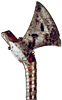
Below is an image from Lew's estate sale of a knife of unknown origin with the cutting edge on the slightly concave long edge that would likely better fill this sheath and in the right direction for left carry, right draw. My knife is unusual and good observations have been made above. I guess the question is whether it is something left over from Spanish colonial times or totally unrelated. |

|

|
|
24th November 2025, 12:13 PM
|
#2 |
|
Vikingsword Staff

Join Date: Dec 2004
Location: The Aussie Bush
Posts: 4,741
|
Hi Lee,
Lew's knife is consistent with a Spanish colonial origin also. The ring for the first finger is found on espada ancha and occasional knives of Latin America. |
|
|
|
|
24th November 2025, 04:13 PM
|
#3 | |
|
Arms Historian

Join Date: Dec 2004
Location: Route 66
Posts: 10,866
|
Quote:
I recall one weapon that seemed to fall into the Latin American category with such a feature yet its other character leaned into the familiar espada ancha category. ..truly a variant and illustrating how these forms were inclined to meld together at times. Colonial blacksmiths and artisans were always innovative, and well used whatever resources were at hand, repurposing components of many forms constantly. They provided perplexing csonundrums for those of us afflicted with the arms investigation obsession  Spanish colonial, again, is probably the most accurate designation for most of these kinds of weapons, with qualifying additions as required. |
|
|
|
|
 |
| Thread Tools | Search this Thread |
| Display Modes | |
|
|


 Hybrid Mode
