
|
|
|
 13th June 2019, 11:39 PM
|
#1 |
|
Member
Join Date: Dec 2004
Location: Ann Arbor, MI
Posts: 5,503
|

I would be interested to know the original source of translating “ Jamdhar” from Sanskrit to English as “ double edged dagger”.
Was it a primary source or that of a European visitor concentrating on the appearance of a particular object and using it as a general term? Indeed, all jamadhars ( katars) are double edged, but so are many other short-, and even long-bladed Indian weapons. Is chillanum a Jamadhar? A Bich’hwa? A Khanda? |

|

|
|
14th June 2019, 12:10 PM
|
#2 |
|
Member
Join Date: Apr 2011
Location: Moscow, Russia
Posts: 430
|
Linguistics is an exact science as is mathematics. There is no need to explore unprofessional glossaries and dictionaries, interview modern Indians who have long been speaking a different language.
The Yamuna River is so named because it is the twin sister of the Ganges, because it flows in parallel. YAM = twin DHAR - it is "edge" even in Hindi. Up to now. In Sanskrit was a some different word formation and such a word as "double edged" was possible in it. How can we study Indian weapons without knowing the basics? Unfortunately we can... |
|
|
|
|
14th June 2019, 02:25 PM
|
#3 |
|
Member

Join Date: Dec 2004
Location: Europe
Posts: 2,718
|
I dont know which thoughts Pant had with the plate, and it is too late to ask him,, but it seems to me that he called almost all 'katars' for jamdahar, with a few exceptions, so I dont see why we cant stick to the name katar/jamdahar and leave out all the 'artistic' names.
|
|
|
|
|
14th June 2019, 04:53 PM
|
#4 | |
|
Member
Join Date: Apr 2011
Location: Moscow, Russia
Posts: 430
|
Quote:
I am little more a supporter of the term "jamdhar" only because the Mughals themself distinguished only two types of Indian daggers (not counting the well-known for them "khanjars"): "jamdhar" (H-shaped) and "khapwa" - Indian dagger with a double bend blade, falsely known to us as chilanum ("falsely" until someone will be able to find confirmation of the actual use of this term. Although it is also associated with the verb "to cut", like most other Indian weapon terms, I have not seen evidence. But please don't tell me about the "glossaries"). The Mughals clearly distinguished these two types of daggers. The term "kattara" was apparently used to refer widely to Indian daggers as a whole. |
|
|
|
|
|
14th June 2019, 07:16 PM
|
#5 | |
|
Member
Join Date: Dec 2004
Location: Ann Arbor, MI
Posts: 5,503
|
Quote:
Agree wholeheartedly. None of us (and all together) know Sanskrit or any other Indian language well enough to even think about our ability to perform a linguistical analysis. In the current state this is the worst example of " name game". Let's agree that calling these strange implements katar or jamadhar is a personal choice and drop the historical and linguistical confabulations altogether until somebody smarter and professionally better trained than us performs a detailed and conclusive study. Katar= jamadhar? My vote: Aye! |
|
|
|
|
|
15th June 2019, 02:28 AM
|
#6 |
|
Member
Join Date: Feb 2018
Posts: 90
|
I agree with Ariel and (it seems) everyone else that this discussion is a bit silly. Whether we like it or not, in modern times, katar is staying as the "common" name for these punch daggers until a tv show or movie calls it a jam(a)dhar.
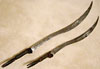
I also personally prefer the name jamdhar, partially because the (incorrect?) explanation that it means "tooth of death" sounds really cool to me, but also because when I say "katar" out loud it sounds a bit too close to "guitar" for comfort, so jamdhar is easier for me to say  . .Actually on that note, though, Mercenary, as you seem rather knowledgeable in Hindi/Sanskrit, is the idea that jama = yama, the god of death, totally false? It's just that, personally, I could totally see yama becoming jama, and, with the edition of dhar, the word overall translating to some version of tooth/blade of death. Finally, just to continue our discussion of odd katar forms, I've attached some examples that always looked unusual to me (and are hopefully discussion-provoking to you guys). The last one isn't technically a katar, but these odd "parrying weapons" seem to always be mounted with katar blades. |
|
|
|
|
15th June 2019, 09:54 AM
|
#8 |
|
Member
Join Date: Apr 2011
Location: Moscow, Russia
Posts: 430
|
The problem is that never serious historians or linguists were interested in research in the field of Indian weapons. All published books somehow compile each other and are not much advanced further than the Egerton catalog or Hendley's books. Because they are intended not for other scientists or researchers, but for collectors (dealers) and for just interested people.
In this situation, amateurs have a chance to bring something new. For this reason this forum is much more interesting and closer to me than published books of faimous authors, in which there is nothing new. Because interesting, unexpected and most importantly - new questions are raised right here. I am sorry gentlemen, but "jamdhar" as "double edged" it is a fact from Sanskrit texts, like it or not. This word could in time denote different weapons, but its etymology was established long ago. "Tooth of the god of death" is poetical homonym. I would be happy to read somewhere what the Sanskrit names of weapons really meant, because many of them are compound words and make sense, as "tulwar" for example. But since no one is obviously going to do this (because it is impossible to take it from somewhere to rewrite and publish), I will do it myself, I have been working on it for a couple of years and I will need as much again. Anyway, thanks for our discussions. They do not leave me indifferent. |
|
|
|
|
15th June 2019, 05:42 PM
|
#9 | |
|
Arms Historian

Join Date: Dec 2004
Location: Route 66
Posts: 10,848
|
Quote:
Nihl, I wanted to address your post directly as you have gratefully redirected away from the linguistics issues to continue the discussion on unusual jamadhar Most intriguing is the one with five blades which indeed appear to be of jamadhar form, but mounted perpendicularly on what appears to be a 'vambrace'. These have apparently occurred with up to seven blades, but as usual, their manner of use is unclear. I was surprised to see one offered in sale which showed the interior, which had a centrally situated transverse handle, and it seems suggested it was used in a slashing manner. I had always though, with the flueret like fixtures at each end (with apertures which seemed for lashing or securing to the forearm) that perhaps these might have been used in a kind of fearsome armor attire......as seen in the curious figure (attached photo) bristling with blades. This somewhat well known photo seems to have fancifully labeled 'the executioner' but I cannot recall the source (I expect my mention of this will result in scathing rebuttal here) and even more specifically has been claimed to be from a durbar in Delhi. Again, I am simply recounting what I recall of this well known image without suggesting or implying accuracy or meaning or intent. It is for the purpose of illustrating 'possible' applications of such 'innovative weaponry'. As noted, this would seem aside from the example of these with inner handle which obviously would not be worn on the forearm as a vambrace. |
|
|
|
|
|
15th June 2019, 07:11 PM
|
#10 |
|
Member
Join Date: Dec 2004
Location: Ann Arbor, MI
Posts: 5,503
|
I am not so pessimistic and dismissive about the value of the already existing books and articles. Purely statistically, only 2.5% of all published stuff is of tangible value. The bottom line,- choose what you want to read:-)
I find Jens’ paper “ How old is the Katar?” belonging to these 2.5%. It gives more actual historical information than anything I have gotten from the rest or books I have in my library. Of course, it is purely factual as are all historical studies: one cannot perform an experiment to validate one’s historical hypothesis , as is the norm in physics, physiology, engineering etc. But I would strongly advise any person aspiring to re-write the “book” on the Katar to read it carefully. One could notice that in the 12 century book “Pritviraj Raso” there already was a term for double- edged objects: dodhara ( just like the saw-edged objects aradam and arapusta: Indians were notorious for the obsessive-compulsive approach to precise descriptions). Thanks One could also put into his mental piggy bank that the Sanskritized names of Jamadhara and Katar are mentioned separately , telling us that those were separate ( at least in some way) weapons. One would have to take the above into account while conducting a novel study of katars. Jens gave a superb basis for future endeavors; we may ignore it at our peril. |
|
|
|
|
15th June 2019, 11:22 PM
|
#11 | |
|
Member
Join Date: Feb 2018
Posts: 90
|
Quote:
Also to address your post directly it seems to me like these things are the indian equivalent of the european "sword breaker" dagger. Though of course it has just about the same capacity to break an opponent's blade (not much), it looks like a formidable trapping weapon, with the projections on either side serving as additional pieces to parry with. The example I posted from arms&antiques (which claims that its example is from the 17th century, possibly making this a less-than-modern invention) also has this katar-style grip, which supports how these are to be held, placing the apparatus over the hand and wrist, and not directly in front of the hand/knuckles. This arrangement (over the hand) would prevent the katar blades from being easily used in their standard punching manner, further supporting that it is an odd parrying weapon, and not necessarily for direct offensive purposes. The multiple blades would make slashing difficult, and further on the punching aspect, thrusting (punching) with the blades seems incredibly awkward and almost pointless. Trapping or deflecting (given the tubular shape of the "guard") would work, but it seems like at best you could only give someone a really painful shove with the thing, assuming their armor doesn't nullify the points of the blades.To everybody else in the thread, not to be rude, but if we are to keep discussing vague aspects of indian arms research instead of the very real forms of katar that don't even have a name, could we at least try to define the kind of research/information that is to be looked for? Just a simple idea really, but it is easier to discuss/research things when you actually know what those "things" are. Vague mutterings about how "more research can be done" seem rather pointless if said research isn't even talked about, especially in a thread where the whole (original) topic is about clarifying old, obscure information. I very much appreciate Ariel's quips though .
|
|
|
|
|
|
15th June 2019, 02:50 PM
|
#12 | |
|
Member
Join Date: Dec 2004
Location: Ann Arbor, MI
Posts: 5,503
|
Quote:
Who knows? Maybe you are that man. After all, Neo was The One to destroy the “Matrix”....... Godspeed! |
|
|
|
|
 |
| Thread Tools | Search this Thread |
| Display Modes | |
|
|




 Hybrid Mode
