
|
 27th March 2016, 05:33 PM
|
#1 |
|
Member
Join Date: Dec 2004
Location: Ann Arbor, MI
Posts: 5,503
|
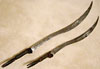
 Shashka??? Or what ????
From Czerny's auction. Ended not sold.
Wooden grips, nielloed fitting on the eared pommel, "indian" ricasso, fullers resemble Afghan work. I am lost... Where from, how old? |

|

|
|
27th March 2016, 08:45 PM
|
#2 |
|
Member

Join Date: Jan 2011
Posts: 1,167
|
My bet is Central Asia, Bukhara or thereabouts!
|
|
|
|
|
27th March 2016, 09:19 PM
|
#3 |
|
Member
Join Date: Jan 2006
Posts: 936
|
I also think it is Indian/Afghani.
|
|
|
|
|
28th March 2016, 02:38 AM
|
#4 | |
|
Member

Join Date: Jun 2012
Location: USA
Posts: 1,492
|
The point of the blade reminds me of some pulwar I have seen.
Quote:
|
|
|
|
|
|
28th March 2016, 12:44 PM
|
#5 |
|
Member
Join Date: Jan 2011
Posts: 1,167
|
From my files.
|
|
|
|
|
28th March 2016, 03:27 PM
|
#6 |
|
Member
Join Date: Dec 2004
Location: Ann Arbor, MI
Posts: 5,503
|
David,
I do not think so. Yours is a classical "Bukharan" saber of a shashka-like form with 5 rivets ( we discussed them already). The one from Czerny's is a totally different animal, IMHO. Much closed to the Afghani "pseudo-shashka". P.S. A friend of mine from Belarus sent me pics of that sword published on another auction. Here we can see the upper part of the blade with the "box-like" system of fullers. AFAIK, this is very typical of Afghani blades. |
|
|
|
|
28th March 2016, 06:36 PM
|
#7 |
|
Member
Join Date: Dec 2004
Location: Bay Area
Posts: 1,770
|
It is rare, but not completely uncommon for Afghan blades to have traveled West. Here is an example of such a blade, with a shashka hilt, in clearly Ottoman scabbard:
http://vikingsword.com/vb/showthread...hlight=shashka Teodor |
|
|
|
|
28th March 2016, 07:32 PM
|
#8 |
|
Member
Join Date: Dec 2004
Location: Ann Arbor, MI
Posts: 5,503
|
Gentlemen,
Here is an Afghani Pulwar with identical fullering. I checked Askhabov, Astvatsaturyan and Rivkin's books as well as my own Caucasian Shashkas and there are no similar examples. Moreover, look at the handle: the "cheeks" are separated by wide distance covered with a strap. This is absolutely incompatible with Caucasian examples, but identical to Afghani pesh kabzes, chooras and pseudo-shashkas. The only strange thing is the "dimple" next to the bolster for the index finger and ( perhaps) rather short pommel. But the more I look at it, the stronger I feel for the Afghani origin. |
|
|
|
|
28th March 2016, 07:57 PM
|
#9 |
|
Member
Join Date: Dec 2004
Location: Ann Arbor, MI
Posts: 5,503
|
Teodor,
I re-read your topic re. Afghani blade in Caucasian mounts. I guess there might be examples of Afghani blades traveling West. Caucasian mercenaries ( Georgians, Armenians and Circassians) constituted the backbone of Shah Abbas' cavalry and fought in Afghanistan and India. There is a sword in the Hermitage collection consisting of a Khanda blade and Georgian handle. But the construction of the handle on the Czerny's example absolutely excludes Gaucasian origin and is strongly tilted toward Afghanistan. |
|
|
|
|
28th March 2016, 08:09 PM
|
#10 |
|
Arms Historian

Join Date: Dec 2004
Location: Route 66
Posts: 10,872
|
I must admit , especially with Ariel not having an exact bead on this thing, that it is quite subtly an anomaly which seems to fall between the cracks on many counts.
Between his knowledge on the weaponry of these regions and the sources he notes not able to define it, any precise classification seems unlikely. I do agree however that this does seem N. Indian, that is from Afghan regions, and the expected hybridization which comes from these and Central Asian areas. While of course the hilt is fashioned to look like a shashka, the structure is quite different. The distinctive 'cleft' is achieved by using what appears to be a metal block 'sandwiched' between the grip plates and clearly profiled to match that curious forefinger nock at the base of the grips. There is no metal bolster at the base of the grip as known to be typical on the 'pseudo-shashkas' of Afghanistan, and while this has the 'feel' it does not correspond to typical Bukharen sabres (as posted by David), which indeed 'usually' have five grip rivets. The blade as well pointed out, does seem remarkably similar to similar seen on other Afghan swords. That blockish fuller type effect seems to recall some of the Persian trade blades, which I have seen with a kind of wrap around fuller near the forte. One feature not yet addressed is the curious starburst device on the pommel area of the grip, and if memory serves, that resembles something like this in Kubachi type embossed silver hilts and in that same hilt location. I cannot yet find images, but it does seem that such devices were often placed on Caucasian (usually Daghestani) hilts with some award or other significance. What makes that so intriguing is that here is a distinct Caucasian affectation added to a hilt designed to approximate a Caucasian shashka, with a clearly N.Indian/Afghan blade( the ricasso), but the entire assembly is constructed quite unlike the various forms mentioned overall. Last edited by Jim McDougall; 28th March 2016 at 08:38 PM. |
|
|
|
|
29th March 2016, 04:45 PM
|
#11 |
|
Member
Join Date: Sep 2014
Location: Austria
Posts: 1,919
|
What is what?!
Before continuing the discussion maybe it would be better to clarify WHAT IDENTFIES A SWORD?! Is it the blade? Is it the hilt? Is it both?
In my understanding it is the blade that primarily identifies a sword (and when I say sword I mean it in its broadest sense, including sabres), then secondarily comes the hilt. More exactly, have a look at the Czerny's last auction (no. 57) at lot no. 2. Is that a Shamshir or a Tulwar?! In my oppinion it is clearly a shamshir because of the typical geometry of the blade. If you think it is a tulwar because of the hilt... well then think twice after having a look at lot no. 8 which also has the very same rounded pommel Tulwar hilt, yet is undoubtedly a Sousson Patah. To get a better grasp of it, you can also have a look at lot no. 11 which is a Khanda, despite the same Tulwar type hilt. In the case in the opening of this thread neither the blade, nor the hilt bear the characteristics of a shashka namely a moderate, rather constant curvature along the whole length of the blade, a rather constant width of the blade, a full length fuller/fullers and an arched point (similar to the Kissaki of the Japanese swords but without any clear separation line between the point and the rest of the blade). To better understand what I mean, please have a look at lots no. 200-202 of the same Czerny auction that illustrate rather typical Shashkas. In my opinion the sabre you were inquiring about is an imitation of a Shashka that would be most accurately described as a sabre, and it remained unsold for a good reason! PS: I bought many blades from Czerny's as they are one of the leading auction houses dealing weapons. |
|
|
|
|
29th March 2016, 10:42 PM
|
#12 | |
|
Member
Join Date: Jun 2012
Location: USA
Posts: 1,492
|
Quote:
|
|
|
|
|
|
29th March 2016, 10:46 PM
|
#13 | |
|
Arms Historian
Join Date: Dec 2004
Location: Route 66
Posts: 10,872
|
Quote:
Naturally in its true sense, the term 'sword' describes obviously the assemblage of the hilt, guard(s) and of course blade. In many cases where the sword is scabbarded it is assumed as part of the descriptive term, though in many cases the note sword with scabbard is used. These often spiraling discussions on terms for types of swords, the elements, features and all manner of nomenclature are often though interesting, simply further confusing to most. The reason being that in most instances, the rule is: it depends! It seems there is a kind of inherent obsession among many collectors that an item must be specifically categorized and dated. The idea of extra words in classifying and qualifying and item is often abhorrent, especially with sellers who seem to consider that it compromises the piece. In this case, indeed the term sabre qualifies what it indeed is.......a shashka itself also falls into the sabre spectrum.......but its name is far more exciting and the fact that this sabre is clearly intended to recall shashka form adds to the intrigue. A better description, "A sabre of North India with shashka style hilt". Actually, many references are known to avoid concentration on blades in swords described in certain degree because blades were often, if not typically varied widely as they were trade or other foreign examples. The hilts were considered a matter of local affectation and usually followed their preferences. Obviously there are exceptions and variations to all of this... Thus, it depends! If all else fails in classifying or categorizing a weapon, describe it in words attending to its features, components or whatever is most applicable. A hilt might be a solid piece, such as a shashka, but how to describe the top part features? is it a pommel? or part of the grips? The blade is always the blade but when the hilt is absent.....it is not a sword. When a hilt only exists, it is a hilt, not a sword. When they are together, no matter if homogenous or not, it is a sword. But if the parts are not homogenous, it then becomes the dreaded 'composite' sword. However, in ethnographic situations, many swords use other than native blades. In India, the well known 'firangi' phenomenon exists, which means it is an Indian sword (hilt) with a foreign blade. Otherwise, the traditional term for these type swords are 'khanda'. But is the 'khanda' the old Indian form, or the post contact European influenced Hindu basket hilt? As far as the 'tulwars' go. These are instantly perceived as the familiar disc pommel form known as Indo-Persian. However, in Mughal courts things Persian prevailed in many cases, and there were Persian shamshirs. What did they call them? Tulwars...it is an Indian term for sword. In Northern India, specifically what is now Afghanistan, the sword (sabre) known as paluoar is typically regarded as THE Afghan sword . Actually, it is a form of tulwar, with likely Deccani ancestry but favored in regions of North India (before Afghanistan was recognized) and is regarded as a form of tulwar. The term 'paluoar' is according to earlier discussions not familiar to locals and not used. In the Sudan, the broadswords known to us as kaskara, to the locals are known simply as sa'if, the Arabian word for sword (not specified). In years of research I found that the term kaskara is not known anywhere in the Sudan, and only used by western collectors and writers. This goes to the so called 'nimcha' of Morocco, the multi quilloned guard sabre, which curiously Stone identifies as Algerian. In Morocco, these are termed sa'if, and have nothing to do with the 'nimcha' term. They are Arabian sabres which in around mid 17th century became known in Moroccan context, it seems to English merchants. We could probably talk for days on the misnomers, collectors terms, transliterations, semantics errors and all manner of the difficulties with the proper describing and terms of weapons and nomenclature!! But maybe a book, then a movie!!? 
|
|
|
|
|
|
30th March 2016, 03:41 AM
|
#14 |
|
Member
Join Date: Dec 2004
Location: Ann Arbor, MI
Posts: 5,503
|
Jim,
I cannot agree more. This is a saber-like weapon assimilating influences from multiple sources. However, this is not a modern composite stuff. Somebody somewhere some time created it as it is and as a serious weapon. My question was what is the most likely place and the most likely time of its manufacture. Having seen the unobstructed view if the box-like fullering together with the construction of the handle, I vote for Afghanistan, 19th century. Your point of misapplication of the "name game" is well taken. While it is important to dig out the original (native) names of the weapons, we might do well to remember that many names with deep roots in the Western glossaries are just figments of European imagination and poor transliteration: no native Afghani of the 19th century would use "Khyber Knife", "Salawar Yataghan", " Karud" or "Pulwar". We use them as a form of a stenographic "quick-and-dirty" moniker to let us know what we are dealing with, but they are completely artificial and foreign for a native owner. Not for nothing did Elgood and Hales limit the use of presumably "native" names in their recent books. And BTW many genuine Caucasian shashkas carried strongly curved Persian shamshir and European saber blades. Also, not to forget that most of the earliest Circassian shashkas carried European trade saber blades rather than locally-made ones. |
|
|
|
|
30th March 2016, 05:47 AM
|
#15 | |
|
Member
Join Date: Jan 2006
Posts: 936
|
Quote:
|
|
|
|
|
|
30th March 2016, 05:59 AM
|
#16 |
|
Arms Historian
Join Date: Dec 2004
Location: Route 66
Posts: 10,872
|
Thank you Ariel, we are entirely on the same page. I also agree that this sabre is a genuinely produced of the period sword fully intended for use, and probably Afghan regions 19th c.
I am really curious about that starburst device on the hilt, and wish I could find the images of the embossed metalwork on what I think was a Kubachi hilted shashka with that incorporated in the context. I have seen Daghestani shaskas with small silver devices emplaced in the same location with the suggestion these were awards or similar devices. I also remain curious on that finger nock at the base of the grip and feel sure I have seen similar on other sabres, but again cannot place yet. On the terms for these weapon forms, indeed these are pretty much locked into our glossaries of arms with these European versions of what was contrived to be the proper names for them. Probably one of the most bizarre and fanciful examples (fortunately used only in romanticized narratives or novels) is the term 'scimitar . Alex, agreed on that last image, in fact it seems examples I have seen with the Ottoman 'pistol grip' hilt and distinct shamshir blades were indeed termed 'Ottoman shamshirs'......thus properly qualifying the shamshir with that denomination. |
|
|
|
|
30th March 2016, 06:38 AM
|
#17 | |
|
Member
Join Date: Jun 2012
Location: USA
Posts: 1,492
|
Quote:
The pulwar is another example, they can have several different blade types but the hilt identifies them. |
|
|
|
|
|
30th March 2016, 07:02 AM
|
#18 | |
|
Member
Join Date: Sep 2014
Location: Austria
Posts: 1,919
|
Quote:
I have seen many authors making the very same confusion and identifying a sword exclusively by its hilt. And yes, the hilt can be used for defining/identifying a sword, but when the blade is not very characteristic and cannot be identified as such. In this case, the Ottoman Kilij is characterized primarily by the presence of the yelman and in lesser measure by the reinforced T-shaped spine extending along about two thirds of the blade and the fuller which the Shamshir lacks. Also the archetypal Kilij has a specific shape with a very shallow curvature (or no curvature at all) for the portion of the blade near the hilt, and a very deep curvature closer to the tip like the one in your second photo. Of course there are blades that display mixed characteristics (as you may encounter "Shamshirs" having fullers or even an yelman) and cannot be accurately identified. In such cases allocating a specific name other than the generic terms of "sword" or "sabre" would be rather inaccurate and misleading, but it is not the case with the Ottoman Shamshir in your photo. If however, you are Turkish, then the term Kilij (more accurately Kilic) will become also accurate, but only for you, because in Turkish, Kilic, literally means sword... any sword. But then, in the same line of thought, you would be correct calling "Kilic" even a Japanese Katana or an Italian Rapier. Last edited by mariusgmioc; 30th March 2016 at 08:22 AM. |
|
|
|
|
|
30th March 2016, 10:05 AM
|
#19 |
|
Member
Join Date: Dec 2004
Location: Ann Arbor, MI
Posts: 5,503
|
There was a special term for Turkish sabers with pistol handles and shamshir blades: kilij ajemi .
The terminal "c" in some European versions of transcribing Turkish word "kilij" in fact much have a diacritical mark, indicating its pronunciation as "ch" or "dzh" . Correctly, it is Ç. Thus, Kilich, KiliÇ and kilij are the same word with identical pronunciation but different Latin letters used. Sometimes it is simply difficult to phonetize foreign sounds precisely: Russian X is Kh, and Щ in English uses 4 letters: SHCH. Thus, Khrushchev:-) And what is correct: Czar or Tsar? Woody Allen pondered on it once and New York Times crosswords treacherously use both spellings to frustrate you. Bastards that they are:-))) |
|
|
|
|
30th March 2016, 11:06 AM
|
#20 | |
|
Member
Join Date: Jun 2012
Location: USA
Posts: 1,492
|
Quote:
The same goes for shashka, if it looks like a shashka it is called "shashka", if it can be further identified such as Bukhara, Circassian, Afghan, Russian then that is added to the description. Last edited by estcrh; 30th March 2016 at 11:17 AM. |
|
|
|
|
|
30th March 2016, 11:42 AM
|
#21 |
|
Member

Join Date: Mar 2006
Location: Room 101, Glos. UK
Posts: 4,286
|
how about a russian klych shashka. note the scabbard ring placement...
|
|
|
|
|
30th March 2016, 12:06 PM
|
#22 | |
|
Member
Join Date: Jan 2011
Posts: 1,167
|
Quote:
|
|
|
|
|
|
30th March 2016, 12:12 PM
|
#23 | ||
|
Member
Join Date: Jun 2012
Location: USA
Posts: 1,492
|
Quote:
Links to items currently for sale are not allowed. Robert Quote:
Last edited by Robert; 30th March 2016 at 06:46 PM. |
||
|
|
|
|
30th March 2016, 12:39 PM
|
#24 | |
|
Member
Join Date: Jan 2006
Posts: 936
|
Quote:
, but traditionally, Kilij signifies the blade with yelman, not any blade with pistol grip. There are Indian blades with yelman and tulwar-type hilts that can be called Kilij-type blades because of specific blade profile, regardless of the grip. Likewise, there are Kilijes with other, not pistol hilt types. It is profile of the blade that makes it a Kilij to begin with.
|
|
|
|
|
|
30th March 2016, 12:43 PM
|
#25 | |
|
Member
Join Date: Jun 2012
Location: USA
Posts: 1,492
|
Quote:
|
|
|
|
|
|
30th March 2016, 12:47 PM
|
#26 | |
|
Member
Join Date: Jan 2006
Posts: 936
|
Quote:
They all could be wrong, of course. Please substantiate your argument. By the way, in Oriental Arms sample above, it states "shamshir blade in Turkish fittings". The Kilij/Shamshir title may refer to "Kilij" as a word for sword in Turkish language, as in other similar descriptions. but I have not seen anything saying any blade with pistol grip is a Kilij. We had similar argument before about "Saif" as any sword with Arab hilt Word Saif means sword in Arabic, just as Kilij is sword in Turkish. What this has to do with the hilt type? |
|
|
|
|
|
30th March 2016, 12:56 PM
|
#27 | |
|
Member
Join Date: Jun 2012
Location: USA
Posts: 1,492
|
Quote:
http://www.swordsantiqueweapons.com/s1072_full.html |
|
|
|
|
|
30th March 2016, 01:07 PM
|
#28 |
|
Member
Join Date: Jan 2006
Posts: 936
|
Good, this is a Turkish\Ottoman shamshir that someone called Kilij. Do you have more reliable references, not on-line ads?
|
|
|
|
|
30th March 2016, 01:11 PM
|
#29 | |
|
Member
Join Date: Jun 2012
Location: USA
Posts: 1,492
|
Quote:
|
|
|
|
|
|
30th March 2016, 01:24 PM
|
#30 | |
|
Member
Join Date: Sep 2014
Location: Austria
Posts: 1,919
|
Quote:
If this line of thougt is correct, then whatever sword bears a characteristic Indian disc-shaped pommel, is a Tulwar (see for example lots 1, 2, 4-11 of Czerny's last auction; pay spacial attention to lots 7, 8 and 11).  www.czernys.com/auctions_view.php?asta=57 |
|
|
|
|
 |
| Thread Tools | Search this Thread |
| Display Modes | |
|
|


 Linear Mode

